3OEY | pdb_00003oey

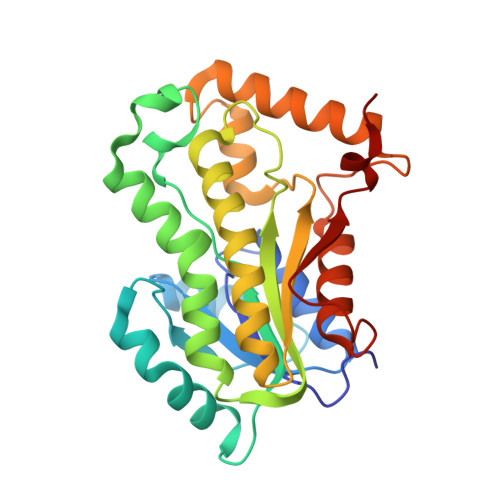
Crystal structure of InhA_T266E:NADH complex


Experimental Data Snapshot

  • Method: X-RAY DIFFRACTION
  • Resolution: 2.00 Å
  • R-Value Free: 
    0.214 (Depositor), 0.217 (DCC) 
  • R-Value Work: 
    0.182 (Depositor), 0.184 (DCC) 
  • R-Value Observed: 
    0.183 (Depositor) 

wwPDB Validation 3D Report Full Report

Validation slider image for 3OEY

Ligand Structure Quality Assessment 


This is version 1.2 of the entry. See complete history

Literature

Phosphorylation of InhA inhibits mycolic acid biosynthesis and growth of Mycobacterium tuberculosis.

Molle, V.Gulten, G.Vilcheze, C.Veyron-Churlet, R.Zanella-Cleon, I.Sacchettini, J.C.Jacobs Jr, W.R.Kremer, L.

(2010) Mol Microbiol 78: 1591-1605

  • DOI: https://doi.org/10.1111/j.1365-2958.2010.07446.x
  • Primary Citation Related Structures: 
    3OEW, 3OEY, 3OF2

  • PubMed Abstract: 

    The remarkable survival ability of Mycobacterium tuberculosis in infected hosts is related to the presence of cell wall-associated mycolic acids. Despite their importance, the mechanisms that modulate expression of these lipids in response to environmental changes are unknown. Here we demonstrate that the enoyl-ACP reductase activity of InhA, an essential enzyme of the mycolic acid biosynthetic pathway and the primary target of the anti-tubercular drug isoniazid, is controlled via phosphorylation. Thr-266 is the unique kinase phosphoacceptor, both in vitro and in vivo. The physiological relevance of Thr-266 phosphorylation was demonstrated using inhA phosphoablative (T266A) or phosphomimetic (T266D/E) mutants. Enoyl reductase activity was severely impaired in the mimetic mutants in vitro, as a consequence of a reduced binding affinity to NADH. Importantly, introduction of inhA_T266D/E failed to complement growth and mycolic acid defects of an inhA-thermosensitive Mycobacterium smegmatis strain, in a similar manner to what is observed following isoniazid treatment. This study suggests that phosphorylation of InhA may represent an unusual mechanism that allows M. tuberculosis to regulate its mycolic acid content, thus offering a new approach to future anti-tuberculosis drug development.


  • Organizational Affiliation
    • Institut de Biologie et Chimie des Protéines, Université Lyon1, IFR128 BioSciences, Lyon-Gerland, Lyon Cedex 07, France. vmolle@ibcp.fr

Macromolecule Content 

  • Total Structure Weight: 29.36 kDa 
  • Atom Count: 2,252 
  • Modeled Residue Count: 267 
  • Deposited Residue Count: 269 
  • Unique protein chains: 1

Macromolecules

Find similar proteins by:|  3D Structure
Entity ID: 1
MoleculeChains  Sequence LengthOrganismDetailsImage
Enoyl-[acyl-carrier-protein] reductase [NADH]269Mycobacterium tuberculosis H37RvMutation(s): 1 
Gene Names: inhAMT1531MTCY277.05Rv1484
EC: 1.3.1.9
UniProt
Find proteins for P9WGR1 (Mycobacterium tuberculosis (strain ATCC 25618 / H37Rv))
Explore P9WGR1 
Go to UniProtKB:  P9WGR1
Entity Groups
Sequence Clusters30% Identity50% Identity70% Identity90% Identity95% Identity100% Identity
UniProt GroupP9WGR1
Sequence Annotations
Expand
Reference Sequence

Small Molecules

Ligands 2 Unique
IDChains Name / Formula / InChI Key2D Diagram3D Interactions
NAD

Query on NAD


Download:Ideal Coordinates CCD File
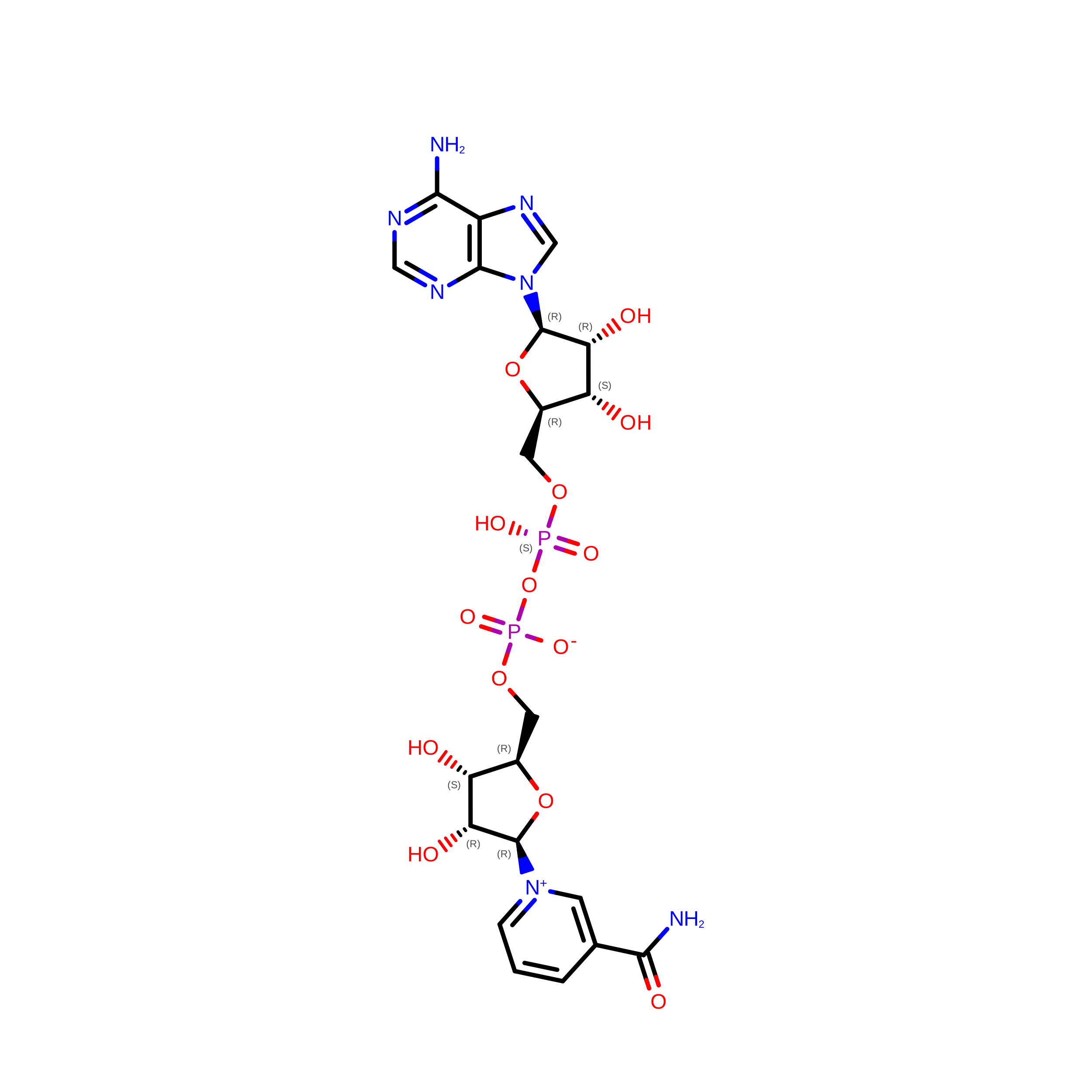
B [auth A]NICOTINAMIDE-ADENINE-DINUCLEOTIDE
C21 H27 N7 O14 P2
BAWFJGJZGIEFAR-NNYOXOHSSA-N
MPD

Query on MPD


Download:Ideal Coordinates CCD File
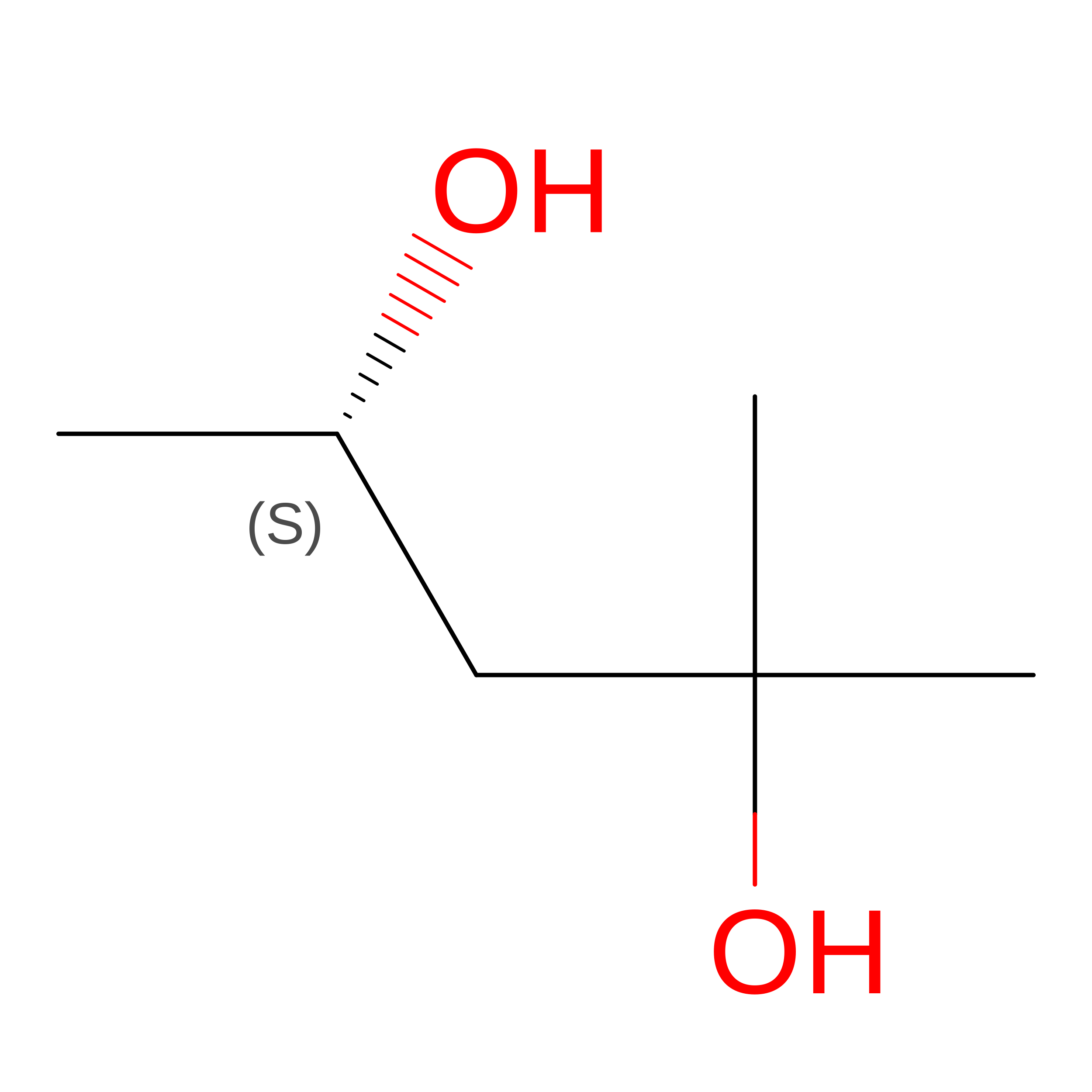
C [auth A](4S)-2-METHYL-2,4-PENTANEDIOL
C6 H14 O2
SVTBMSDMJJWYQN-YFKPBYRVSA-N

Experimental Data & Validation

Experimental Data

  • Method: X-RAY DIFFRACTION
  • Resolution: 2.00 Å
  • R-Value Free:  0.214 (Depositor), 0.217 (DCC) 
  • R-Value Work:  0.182 (Depositor), 0.184 (DCC) 
  • R-Value Observed: 0.183 (Depositor) 
Space Group: P 62 2 2
Unit Cell:
Length ( Å )Angle ( ˚ )
a = 98.154α = 90
b = 98.154β = 90
c = 139.439γ = 120
Software Package:
Software NamePurpose
PHENIXrefinement
DENZOdata reduction
SCALEPACKdata scaling

Structure Validation

View Full Validation Report


Ligand Structure Quality Assessment 


Entry History 

Deposition Data

Revision History  (Full details and data files)

  • Version 1.0: 2010-12-01
    Type: Initial release
  • Version 1.1: 2011-07-13
    Changes: Version format compliance
  • Version 1.2: 2024-02-21
    Changes: Data collection, Database references, Derived calculations