






3O2D | pdb_00003o2d

Crystal structure of HIV-1 primary receptor CD4 in complex with a potent antiviral antibody


Experimental Data Snapshot

  • Method: X-RAY DIFFRACTION
  • Resolution: 2.19 Å
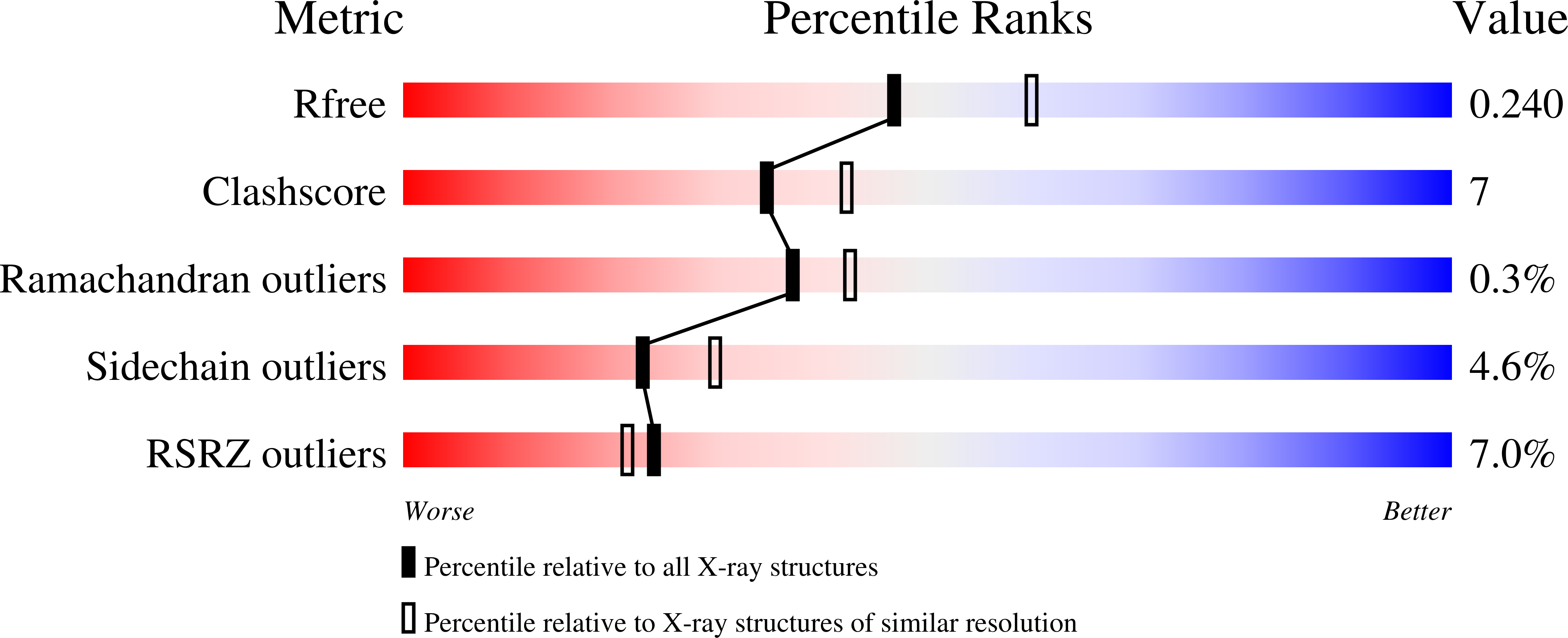
  • R-Value Free: 
    0.224 (Depositor), 0.240 (DCC) 
  • R-Value Work: 
    0.192 (Depositor), 0.209 (DCC) 
  • R-Value Observed: 
    0.194 (Depositor) 

wwPDB Validation 3D Report Full Report

Validation slider image for 3O2D

This is version 1.2 of the entry. See complete history

Literature

Crystal Structure of HIV-1 Primary Receptor CD4 in Complex with a Potent Antiviral Antibody.

Freeman, M.M.Seaman, M.S.Rits-Volloch, S.Hong, X.Kao, C.Y.Ho, D.D.Chen, B.

(2010) Structure 18: 1632-1641

  • DOI: https://doi.org/10.1016/j.str.2010.09.017
  • Primary Citation Related Structures: 
    3O2D

  • PubMed Abstract: 

    Ibalizumab is a humanized, anti-CD4 monoclonal antibody. It potently blocks HIV-1 infection and targets an epitope in the second domain of CD4 without interfering with immune functions mediated by interaction of CD4 with major histocompatibility complex (MHC) class II molecules. We report here the crystal structure of ibalizumab Fab fragment in complex with the first two domains (D1-D2) of CD4 at 2.2 Å resolution. Ibalizumab grips CD4 primarily by the BC-loop (residues 121-125) of D2, sitting on the opposite side of gp120 and MHC-II binding sites. No major conformational change in CD4 accompanies binding to ibalizumab. Both monovalent and bivalent forms of ibalizumab effectively block viral infection, suggesting that it does not need to crosslink CD4 to exert antiviral activity. While gp120-induced structural rearrangements in CD4 are probably minimal, CD4 structural rigidity is dispensable for ibalizumab inhibition. These results could guide CD4-based immunogen design and lead to a better understanding of HIV-1 entry.


  • Organizational Affiliation
    • Division of Molecular Medicine, Children's Hospital, and Department of Pediatrics, Harvard Medical School, 3 Blackfan Circle, Boston, MA 02115, USA.

Macromolecule Content 

  • Total Structure Weight: 69.58 kDa 
  • Atom Count: 4,966 
  • Modeled Residue Count: 616 
  • Deposited Residue Count: 632 
  • Unique protein chains: 3

Macromolecules

Find similar proteins by:|  3D Structure
Entity ID: 1
MoleculeChains  Sequence LengthOrganismDetailsImage
ibalizumab light chainA [auth L]219Mus musculusMutation(s): 0 
Find similar proteins by:|  3D Structure
Entity ID: 2
MoleculeChains  Sequence LengthOrganismDetailsImage
ibalizumab heavy chainB [auth H]225Mus musculusMutation(s): 0 
Find similar proteins by:|  3D Structure
Entity ID: 3
MoleculeChains  Sequence LengthOrganismDetailsImage
T-cell surface glycoprotein CD4C [auth A]188Homo sapiensMutation(s): 0 
Gene Names: CD4
UniProt & NIH Common Fund Data Resources
Find proteins for P01730 (Homo sapiens)
Explore P01730 
Go to UniProtKB:  P01730
PHAROS:  P01730
GTEx:  ENSG00000010610 
Entity Groups
Sequence Clusters30% Identity50% Identity70% Identity90% Identity95% Identity100% Identity
UniProt GroupP01730
Sequence Annotations
Expand
Reference Sequence

Experimental Data & Validation

Experimental Data

  • Method: X-RAY DIFFRACTION
  • Resolution: 2.19 Å
  • R-Value Free:  0.224 (Depositor), 0.240 (DCC) 
  • R-Value Work:  0.192 (Depositor), 0.209 (DCC) 
  • R-Value Observed: 0.194 (Depositor) 
Space Group: P 21 21 21
Unit Cell:
Length ( Å )Angle ( ˚ )
a = 52.164α = 90
b = 66.266β = 90
c = 266.659γ = 90
Software Package:
Software NamePurpose
ADSCdata collection
PHASERphasing
REFMACrefinement
HKL-2000data reduction
HKL-2000data scaling

Structure Validation

View Full Validation Report


Entry History 

Deposition Data

Revision History  (Full details and data files)

  • Version 1.0: 2010-12-22
    Type: Initial release
  • Version 1.1: 2011-07-13
    Changes: Version format compliance
  • Version 1.2: 2024-10-09
    Changes: Data collection, Database references, Structure summary





