3NYJ | pdb_00003nyj

Crystal Structure Analysis of APP E2 domain


Experimental Data Snapshot

  • Method: X-RAY DIFFRACTION
  • Resolution: 3.20 Å
  • R-Value Free: 
    0.380 (Depositor), 0.375 (DCC) 
  • R-Value Work: 
    0.297 (Depositor), 0.288 (DCC) 

wwPDB Validation 3D Report Full Report

Validation slider image for 3NYJ

This is version 1.3 of the entry. See complete history

Literature

The E2 Domains of APP and APLP1 Share a Conserved Mode of Dimerization.

Lee, S.Xue, Y.Hu, J.Wang, Y.Liu, X.Demeler, B.Ha, Y.

(2011) Biochemistry 50: 5453-5464

  • DOI: https://doi.org/10.1021/bi101846x
  • Primary Citation Related Structures: 
    3NYJ, 3PMR

  • PubMed Abstract: 

    Amyloid precursor protein (APP) is genetically linked to Alzheimer's disease. APP is a type I membrane protein, and its oligomeric structure is potentially important because this property may play a role in its function or affect the processing of the precursor by the secretases to generate amyloid β-peptide. Several independent studies have shown that APP can form dimers in the cell, but how it dimerizes remains controversial. At least three regions of the precursor, including a centrally located and conserved domain called E2, have been proposed to contribute to dimerization. Here we report two new crystal structures of E2, one from APP and the other from APLP1, a mammalian APP homologue. Comparison with an earlier APP structure, which was determined in a different space group, shows that the E2 domains share a conserved and antiparallel mode of dimerization. Biophysical measurements in solution show that heparin binding induces E2 dimerization. The 2.1 Å resolution electron density map also reveals phosphate ions that are bound to the protein surface. Mutational analysis shows that protein residues interacting with the phosphate ions are also involved in heparin binding. The locations of two of these residues, Arg-369 and His-433, at the dimeric interface suggest a mechanism for heparin-induced protein dimerization.


  • Organizational Affiliation
    • Department of Pharmacology, Yale School of Medicine, New Haven, Connecticut 06520, USA.

Macromolecule Content 

  • Total Structure Weight: 24.96 kDa 
  • Atom Count: 1,263 
  • Modeled Residue Count: 181 
  • Deposited Residue Count: 207 
  • Unique protein chains: 1

Macromolecules

Find similar proteins by:|  3D Structure
Entity ID: 1
MoleculeChains  Sequence LengthOrganismDetailsImage
Amyloid beta A4 protein207Homo sapiensMutation(s): 0 
Gene Names: A4AD1APP
UniProt & NIH Common Fund Data Resources
Find proteins for P05067 (Homo sapiens)
Explore P05067 
Go to UniProtKB:  P05067
PHAROS:  P05067
GTEx:  ENSG00000142192 
Entity Groups
Sequence Clusters30% Identity50% Identity70% Identity90% Identity95% Identity100% Identity
UniProt GroupP05067
Sequence Annotations
Expand
Reference Sequence

Small Molecules

Ligands 1 Unique
IDChains Name / Formula / InChI Key2D Diagram3D Interactions
OS

Query on OS


Download:Ideal Coordinates CCD File
B [auth A]OSMIUM ION
Os
XQBKHDFIPARBOX-UHFFFAOYSA-N
Modified Residues  1 Unique
IDChains TypeFormula2D DiagramParent
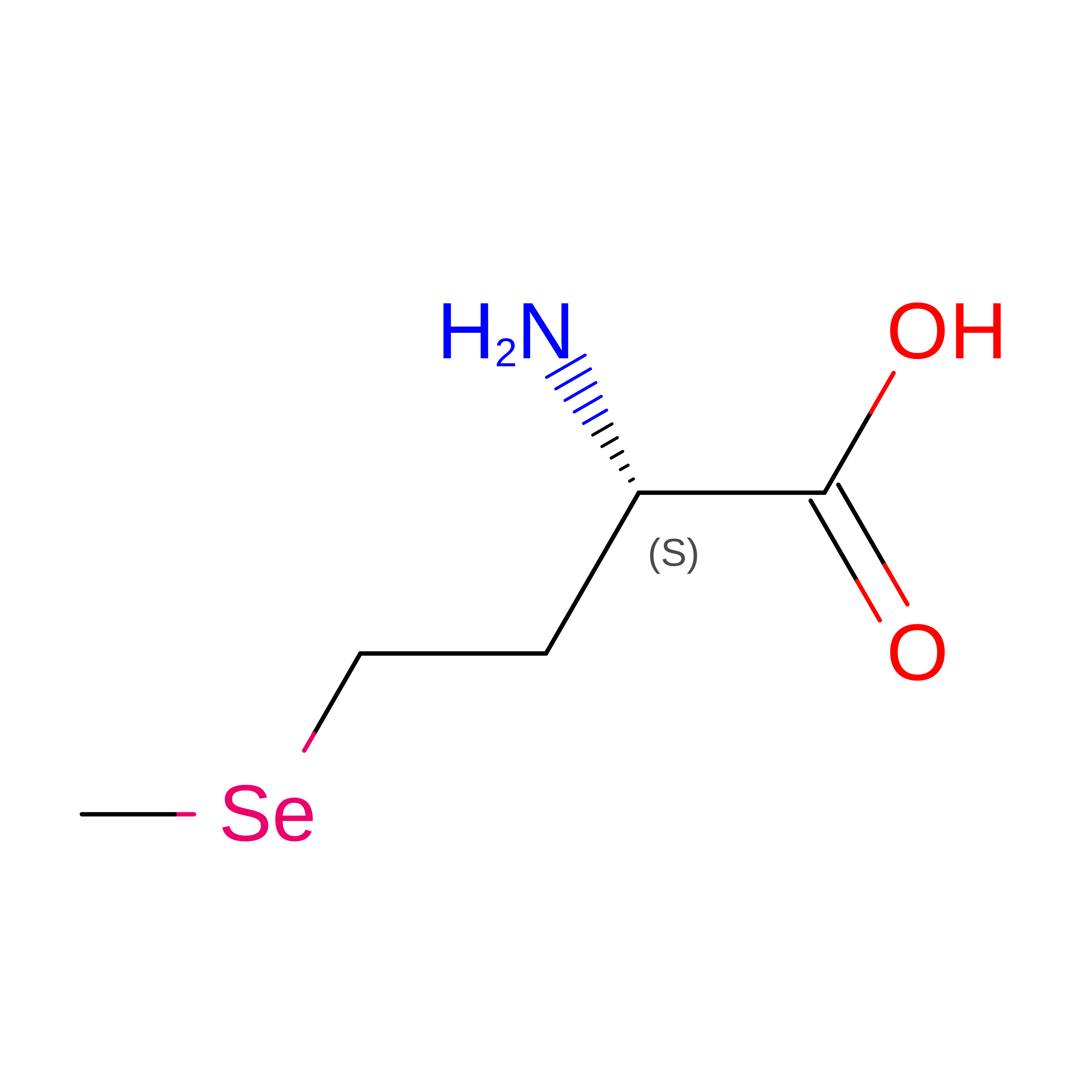
MSE
Query on MSE
A
L-PEPTIDE LINKINGC5 H11 N O2 SeMET

Experimental Data & Validation

Experimental Data

  • Method: X-RAY DIFFRACTION
  • Resolution: 3.20 Å
  • R-Value Free:  0.380 (Depositor), 0.375 (DCC) 
  • R-Value Work:  0.297 (Depositor), 0.288 (DCC) 
Space Group: P 21 21 2
Unit Cell:
Length ( Å )Angle ( ˚ )
a = 114.979α = 90
b = 40.149β = 90
c = 58.376γ = 90
Software Package:
Software NamePurpose
SCALEPACKdata scaling
PHASERphasing
DMphasing
REFMACrefinement
PDB_EXTRACTdata extraction
CBASSdata collection
DENZOdata reduction

Structure Validation

View Full Validation Report


Entry History 

Deposition Data

Revision History  (Full details and data files)

  • Version 1.0: 2011-06-01
    Type: Initial release
  • Version 1.1: 2011-07-13
    Changes: Version format compliance
  • Version 1.2: 2017-11-08
    Changes: Refinement description
  • Version 1.3: 2024-11-20
    Changes: Data collection, Database references, Derived calculations, Structure summary