3NS0 | pdb_00003ns0

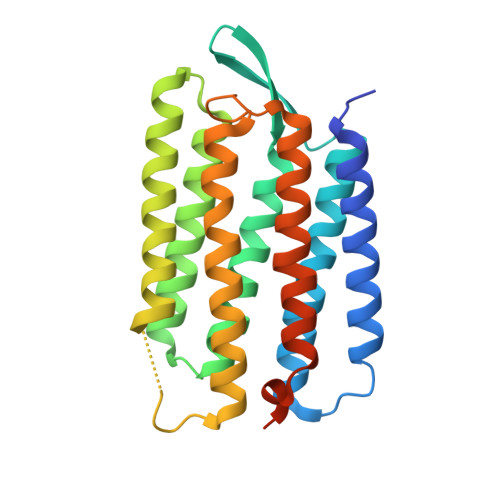
X-ray structure of bacteriorhodopsin


Experimental Data Snapshot

  • Method: X-RAY DIFFRACTION
  • Resolution: 1.78 Å
  • R-Value Free: 
    0.229 (Depositor), 0.233 (DCC) 
  • R-Value Work: 
    0.205 (Depositor), 0.214 (DCC) 
  • R-Value Observed: 
    0.205 (Depositor) 

Starting Model: experimental
View more details

wwPDB Validation 3D Report Full Report

Validation slider image for 3NS0

Ligand Structure Quality Assessment 


This is version 1.3 of the entry. See complete history

Literature

X-ray-Radiation-Induced Changes in Bacteriorhodopsin Structure.

Borshchevskiy, V.I.Round, E.S.Popov, A.N.Buldt, G.Gordeliy, V.I.

(2011) J Mol Biology 409: 813-825

  • DOI: https://doi.org/10.1016/j.jmb.2011.04.038
  • Primary Citation Related Structures: 
    3NS0, 3NSB

  • PubMed Abstract: 

    Bacteriorhodopsin (bR) provides light-driven vectorial proton transport across a cell membrane. Creation of electrochemical potential at the membrane is a universal step in energy transformation in a cell. Published atomic crystallographic models of early intermediate states of bR show a significant difference between them, and conclusions about pumping mechanisms have been contradictory. Here, we present a quantitative high-resolution crystallographic study of conformational changes in bR induced by X-ray absorption. It is shown that X-ray doses that are usually accumulated during data collection for intermediate-state studies are sufficient to significantly alter the structure of the protein. X-ray-induced changes occur primarily in the active site of bR. Structural modeling showed that X-ray absorption triggers retinal isomerization accompanied by the disappearance of electron densities corresponding to the water molecule W402 bound to the Schiff base. It is demonstrated that these and other X-ray-induced changes may mimic functional conformational changes of bR leading to misinterpretation of the earlier obtained X-ray crystallographic structures of photointermediates.


  • Organizational Affiliation
    • Laboratoire des Protéines Membranaires, Institut de Biologie Structurale J.-P. Ebel, UMR5075 CEA-CNRS-UJF, Grenoble 38027, France.

Macromolecule Content 

  • Total Structure Weight: 32.85 kDa 
  • Atom Count: 1,852 
  • Modeled Residue Count: 223 
  • Deposited Residue Count: 248 
  • Unique protein chains: 1

Macromolecules

Find similar proteins by:|  3D Structure
Entity ID: 1
MoleculeChains  Sequence LengthOrganismDetailsImage
Bacteriorhodopsin248Halobacterium salinarumMutation(s): 0 
Membrane Entity: Yes 
UniProt
Find proteins for P02945 (Halobacterium salinarum (strain ATCC 700922 / JCM 11081 / NRC-1))
Explore P02945 
Go to UniProtKB:  P02945
Entity Groups
Sequence Clusters30% Identity50% Identity70% Identity90% Identity95% Identity100% Identity
UniProt GroupP02945
Sequence Annotations
Expand
Reference Sequence

Small Molecules

Ligands 2 Unique
IDChains Name / Formula / InChI Key2D Diagram3D Interactions
LI1

Query on LI1


Download:Ideal Coordinates CCD File
C [auth A]
D [auth A]
E [auth A]
F [auth A]
G [auth A]
C [auth A],
D [auth A],
E [auth A],
F [auth A],
G [auth A],
H [auth A],
I [auth A],
J [auth A],
K [auth A]
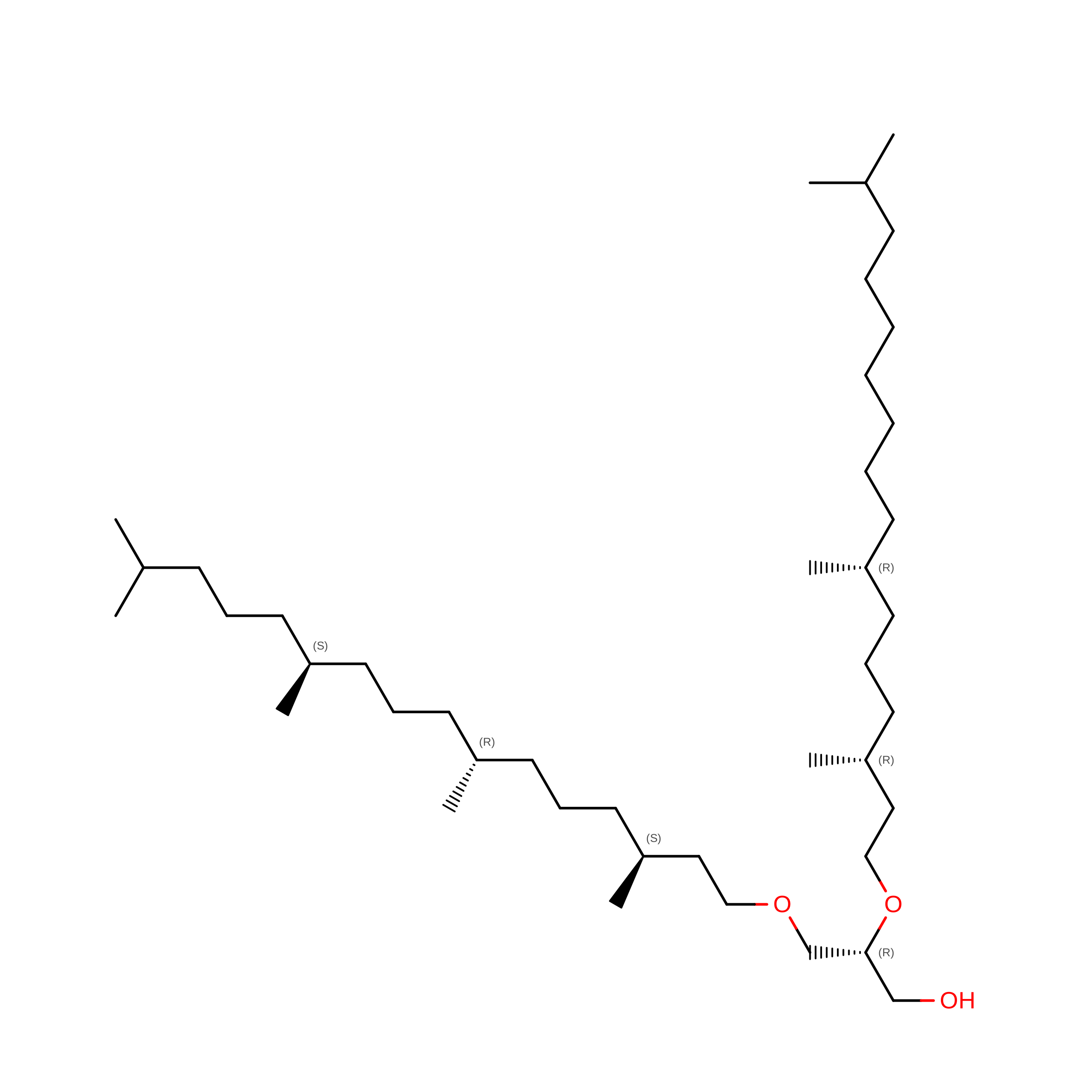
1-[2,6,10.14-TETRAMETHYL-HEXADECAN-16-YL]-2-[2,10,14-TRIMETHYLHEXADECAN-16-YL]GLYCEROL
C42 H86 O3
YERVUJAKCNBGCR-BIHSMRAKSA-N
RET

Query on RET


Download:Ideal Coordinates CCD File
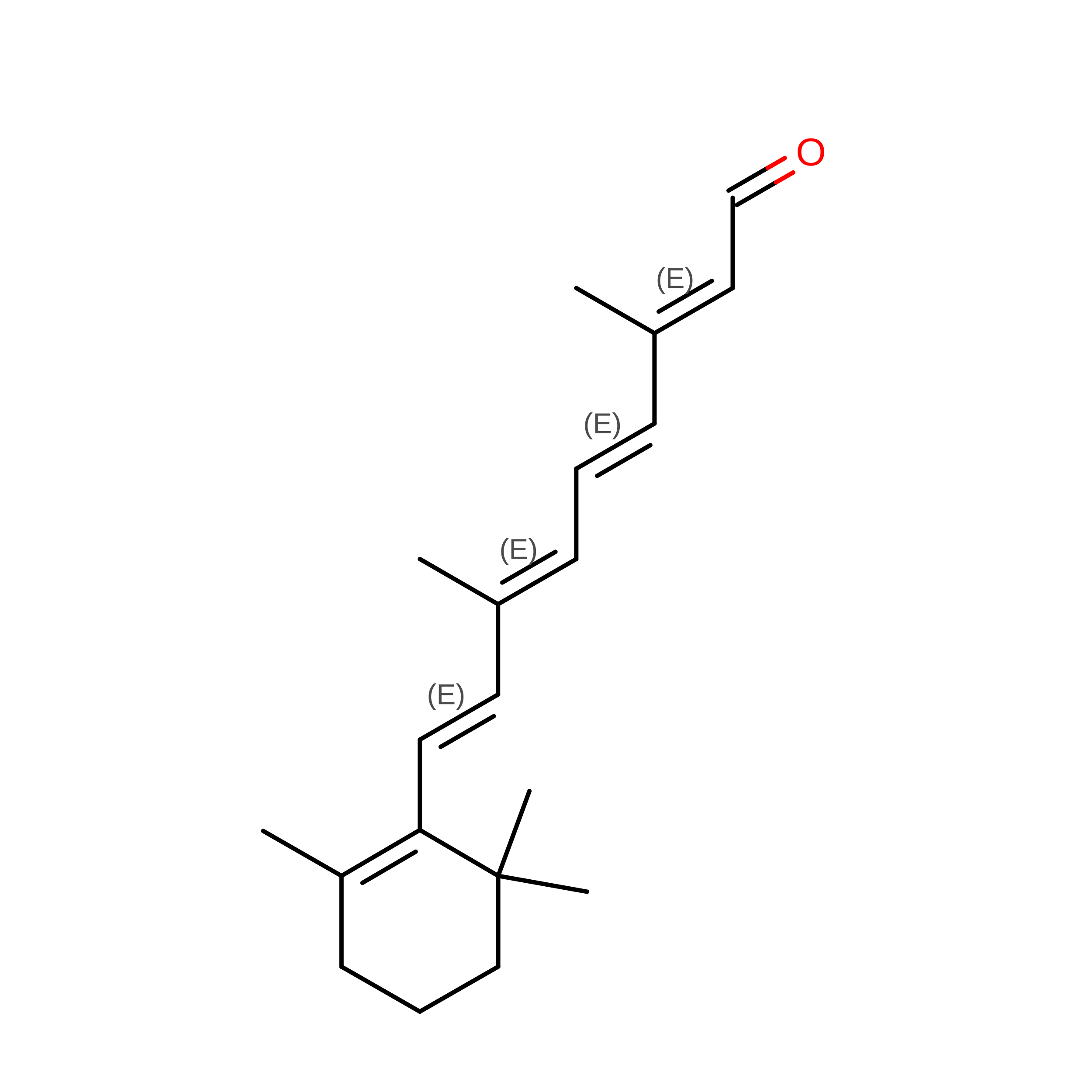
B [auth A]RETINAL
C20 H28 O
NCYCYZXNIZJOKI-OVSJKPMPSA-N

Experimental Data & Validation

Experimental Data

  • Method: X-RAY DIFFRACTION
  • Resolution: 1.78 Å
  • R-Value Free:  0.229 (Depositor), 0.233 (DCC) 
  • R-Value Work:  0.205 (Depositor), 0.214 (DCC) 
  • R-Value Observed: 0.205 (Depositor) 
Space Group: P 63
Unit Cell:
Length ( Å )Angle ( ˚ )
a = 60.956α = 90
b = 60.956β = 90
c = 109.95γ = 120
Software Package:
Software NamePurpose
DNAdata collection
CNSrefinement
MOSFLMdata reduction
SCALAdata scaling
CNSphasing

Structure Validation

View Full Validation Report


Ligand Structure Quality Assessment 


Entry History 

Deposition Data

Revision History  (Full details and data files)

  • Version 1.0: 2011-05-11
    Type: Initial release
  • Version 1.1: 2011-07-13
    Changes: Version format compliance
  • Version 1.2: 2023-09-06
    Changes: Data collection, Database references, Derived calculations, Refinement description
  • Version 1.3: 2024-11-27
    Changes: Structure summary