3NPE | pdb_00003npe

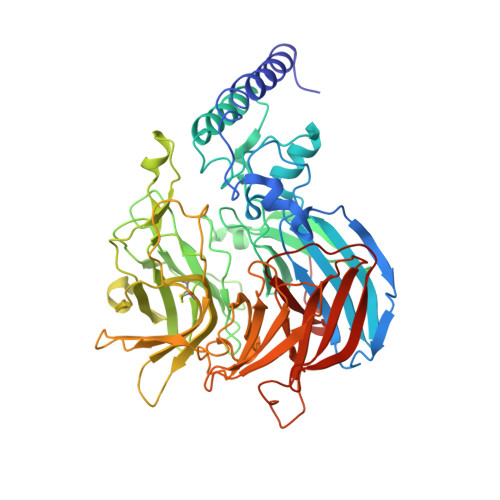
Structure of VP14 in complex with oxygen


Experimental Data Snapshot

  • Method: X-RAY DIFFRACTION
  • Resolution: 3.20 Å
  • R-Value Free: 
    0.272 (Depositor), 0.266 (DCC) 
  • R-Value Work: 
    0.241 (Depositor), 0.228 (DCC) 
  • R-Value Observed: 
    0.242 (Depositor) 

wwPDB Validation 3D Report Full Report

Validation slider image for 3NPE

This is version 1.4 of the entry. See complete history. 

Literature

Structural insights into maize viviparous14, a key enzyme in the biosynthesis of the phytohormone abscisic acid.

Messing, S.A., Gabelli, S.B., Echeverria, I., Vogel, J.T., Guan, J.C., Tan, B.C., Klee, H.J., McCarty, D.R., Amzel, L.M.

(2010) Plant Cell 22: 2970-2980

  • DOI: https://doi.org/10.1105/tpc.110.074815
  • Primary Citation Related Structures: 
    3NPE

  • PubMed Abstract: 

    The key regulatory step in the biosynthesis of abscisic acid (ABA), a hormone central to the regulation of several important processes in plants, is the oxidative cleavage of the 11,12 double bond of a 9-cis-epoxycarotenoid. The enzyme viviparous14 (VP14) performs this cleavage in maize (Zea mays), making it a target for the rational design of novel chemical agents and genetic modifications that improve plant behavior through the modulation of ABA levels. The structure of VP14, determined to 3.2-Å resolution, provides both insight into the determinants of regio- and stereospecificity of this enzyme and suggests a possible mechanism for oxidative cleavage. Furthermore, mutagenesis of the distantly related CCD1 of maize shows how the VP14 structure represents a template for all plant carotenoid cleavage dioxygenases (CCDs). In addition, the structure suggests how VP14 associates with the membrane as a way of gaining access to its membrane soluble substrate.


  • Organizational Affiliation: 
    • Department of Biophysics and Biophysical Chemistry, Johns Hopkins University, School of Medicine, Baltimore, Maryland 21205, USA.

Macromolecule Content 

  • Total Structure Weight: 58.02 kDa 
  • Atom Count: 4,042 
  • Modeled Residue Count: 522 
  • Deposited Residue Count: 529 
  • Unique protein chains: 1

Macromolecules

Find similar proteins by:|  3D Structure
Entity ID: 1
MoleculeChains  Sequence LengthOrganismDetailsImage
9-cis-epoxycarotenoid dioxygenase 1, chloroplastic529Zea maysMutation(s): 0 
Gene Names: VP14
EC: 1.13.11.51
Membrane Entity: Yes 
UniProt
Find proteins for O24592 (Zea mays)
Explore O24592 
Go to UniProtKB:  O24592
Entity Groups
Sequence Clusters30% Identity50% Identity70% Identity90% Identity95% Identity100% Identity
UniProt GroupO24592
Sequence Annotations
Expand
Reference Sequence

Small Molecules

Ligands 4 Unique
IDChains Name / Formula / InChI Key2D Diagram3D Interactions
DIO

Query on DIO


Download:Ideal Coordinates CCD File
E [auth A],
F [auth A],
G [auth A]
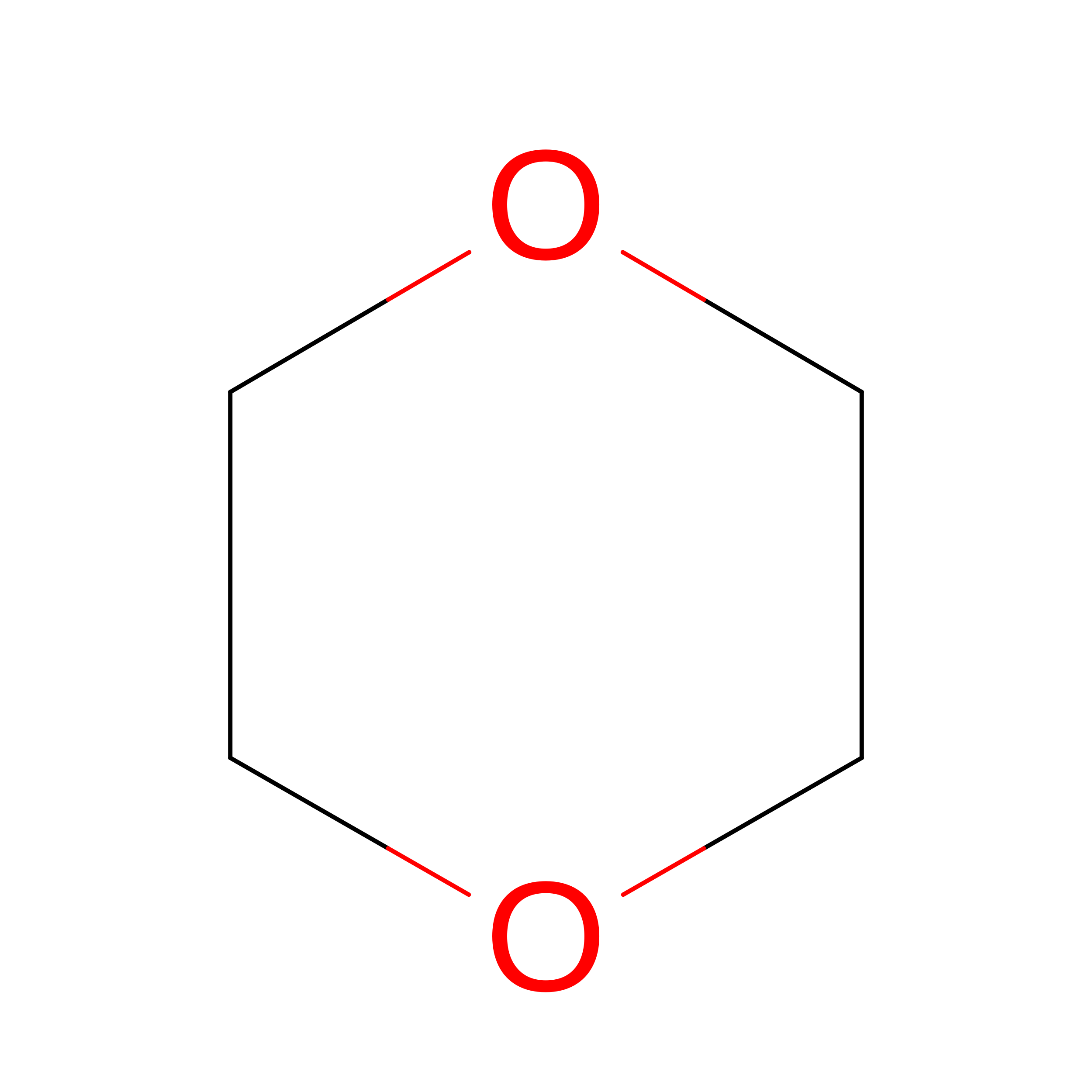
1,4-DIETHYLENE DIOXIDE
C4 H8 O2
RYHBNJHYFVUHQT-UHFFFAOYSA-N
FE2

Query on FE2


Download:Ideal Coordinates CCD File
B [auth A]FE (II) ION
Fe
CWYNVVGOOAEACU-UHFFFAOYSA-N
OXY

Query on OXY


Download:Ideal Coordinates CCD File
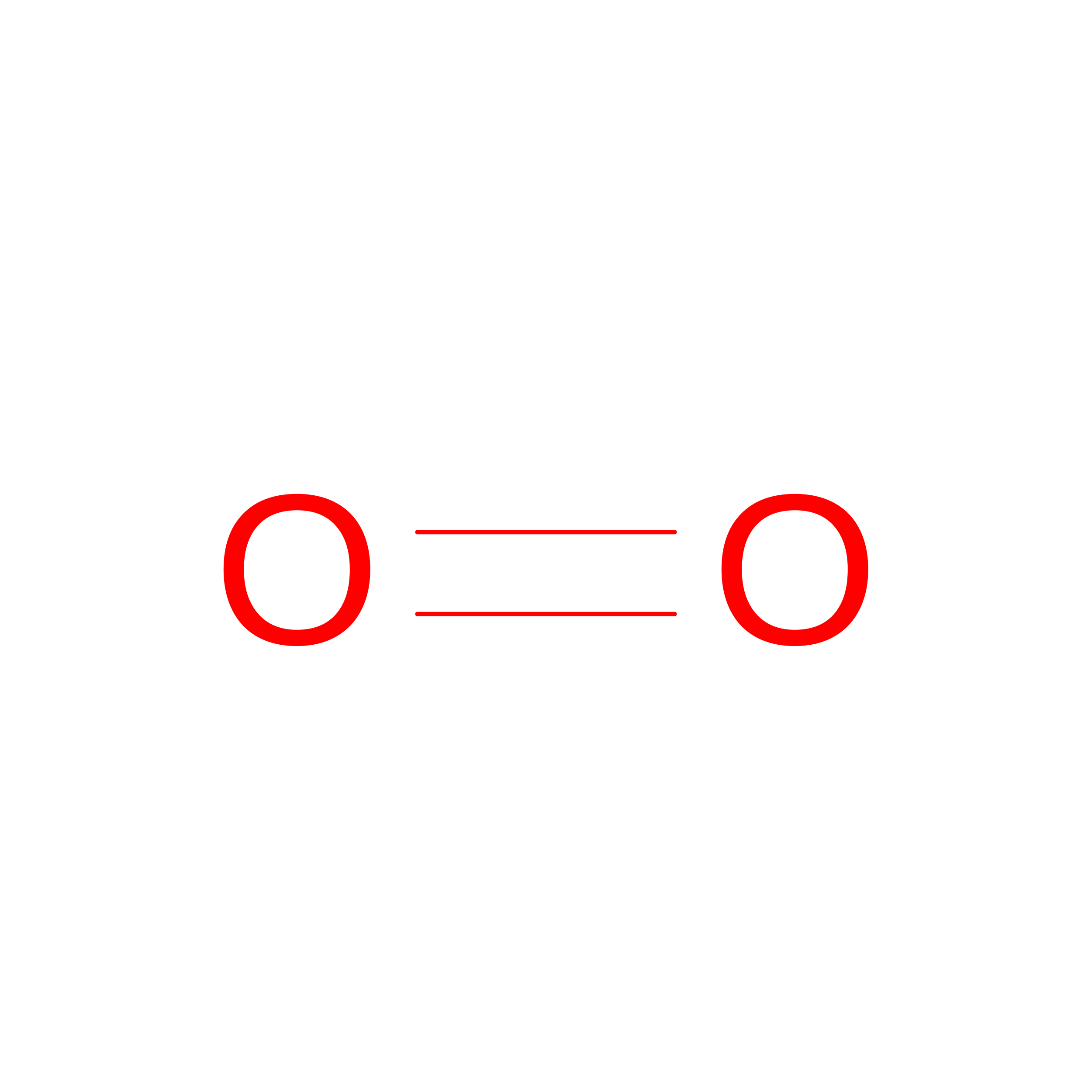
C [auth A]OXYGEN MOLECULE
O2
MYMOFIZGZYHOMD-UHFFFAOYSA-N
OH

Query on OH


Download:Ideal Coordinates CCD File
D [auth A]HYDROXIDE ION
H O
XLYOFNOQVPJJNP-UHFFFAOYSA-M

Experimental Data & Validation

Experimental Data

  • Method: X-RAY DIFFRACTION
  • Resolution: 3.20 Å
  • R-Value Free:  0.272 (Depositor), 0.266 (DCC) 
  • R-Value Work:  0.241 (Depositor), 0.228 (DCC) 
  • R-Value Observed: 0.242 (Depositor) 
Space Group: P 63 2 2
Unit Cell:
Length ( Å )Angle ( ˚ )
a = 161.521α = 90
b = 161.521β = 90
c = 150.816γ = 120
Software Package:
Software NamePurpose
DENZOdata reduction
SCALEPACKdata scaling
SOLVEphasing
RESOLVEphasing
REFMACrefinement
PDB_EXTRACTdata extraction

Structure Validation

View Full Validation Report


Entry History 

Deposition Data

Revision History  (Full details and data files)

  • Version 1.0: 2010-11-10
    Type: Initial release
  • Version 1.1: 2011-07-13
    Changes: Version format compliance
  • Version 1.2: 2017-11-08
    Changes: Refinement description
  • Version 1.3: 2023-12-27
    Changes: Data collection, Database references, Derived calculations
  • Version 1.4: 2024-11-20
    Changes: Structure summary