3NA5 | pdb_00003na5

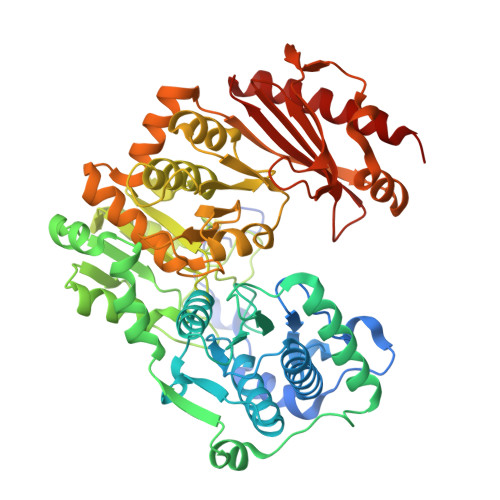
Crystal structure of a bacterial phosphoglucomutase, an enzyme important in the virulence of several human pathogens.


Experimental Data Snapshot

  • Method: X-RAY DIFFRACTION
  • Resolution: 1.70 Å
  • R-Value Free: 
    0.218 (Depositor), 0.220 (DCC) 
  • R-Value Work: 
    0.182 (Depositor), 0.186 (DCC) 
  • R-Value Observed: 
    0.184 (Depositor) 

Starting Model: experimental
View more details

wwPDB Validation 3D Report Full Report

Validation slider image for 3NA5

This is version 1.4 of the entry. See complete history

Literature

Crystal structure of a bacterial phosphoglucomutase, an enzyme involved in the virulence of multiple human pathogens.

Mehra-Chaudhary, R.Mick, J.Tanner, J.J.Henzl, M.T.Beamer, L.J.

(2011) Proteins 79: 1215-1229

  • DOI: https://doi.org/10.1002/prot.22957
  • Primary Citation Related Structures: 
    3NA5, 3OLP

  • PubMed Abstract: 

    The crystal structure of the enzyme phosphoglucomutase from Salmonella typhimurium (StPGM) is reported at 1.7 A resolution. This is the first high-resolution structural characterization of a bacterial protein from this large enzyme family, which has a central role in metabolism and is also important to bacterial virulence and infectivity. A comparison of the active site of StPGM with that of other phosphoglucomutases reveals conserved residues that are likely involved in catalysis and ligand binding for the entire enzyme family. An alternate crystal form of StPGM and normal mode analysis give insights into conformational changes of the C-terminal domain that occur upon ligand binding. A novel observation from the StPGM structure is an apparent dimer in the asymmetric unit of the crystal, mediated largely through contacts in an N-terminal helix. Analytical ultracentrifugation and small-angle X-ray scattering confirm that StPGM forms a dimer in solution. Multiple sequence alignments and phylogenetic studies show that a distinct subset of bacterial PGMs share the signature dimerization helix, while other bacterial and eukaryotic PGMs are likely monomers. These structural, biochemical, and bioinformatic studies of StPGM provide insights into the large α-D-phosphohexomutase enzyme superfamily to which it belongs, and are also relevant to the design of inhibitors specific to the bacterial PGMs.


  • Organizational Affiliation
    • Department of Biochemistry, University of Missouri, Columbia, Missouri 65211, USA.

Macromolecule Content 

  • Total Structure Weight: 122.33 kDa 
  • Atom Count: 9,161 
  • Modeled Residue Count: 1,090 
  • Deposited Residue Count: 1,140 
  • Unique protein chains: 1

Macromolecules

Find similar proteins by:|  3D Structure
Entity ID: 1
MoleculeChains  Sequence LengthOrganismDetailsImage
Phosphoglucomutase
A, B
570Salmonella enterica subsp. enterica serovar Typhimurium str. LT2Mutation(s): 0 
Gene Names: pgmSTM0698
EC: 5.4.2.2
UniProt
Find proteins for Q8ZQW9 (Salmonella typhimurium (strain LT2 / SGSC1412 / ATCC 700720))
Explore Q8ZQW9 
Go to UniProtKB:  Q8ZQW9
Entity Groups
Sequence Clusters30% Identity50% Identity70% Identity90% Identity95% Identity100% Identity
UniProt GroupQ8ZQW9
Sequence Annotations
Expand
Reference Sequence

Experimental Data & Validation

Experimental Data

  • Method: X-RAY DIFFRACTION
  • Resolution: 1.70 Å
  • R-Value Free:  0.218 (Depositor), 0.220 (DCC) 
  • R-Value Work:  0.182 (Depositor), 0.186 (DCC) 
  • R-Value Observed: 0.184 (Depositor) 
Space Group: P 21 21 21
Unit Cell:
Length ( Å )Angle ( ˚ )
a = 81.466α = 90
b = 105.792β = 90
c = 126.797γ = 90
Software Package:
Software NamePurpose
d*TREKdata scaling
MOLREPphasing
REFMACrefinement
PDB_EXTRACTdata extraction
d*TREKdata reduction

Structure Validation

View Full Validation Report


Entry History 

Deposition Data

Revision History  (Full details and data files)

  • Version 1.0: 2011-02-16
    Type: Initial release
  • Version 1.1: 2011-07-13
    Changes: Version format compliance
  • Version 1.2: 2023-09-06
    Changes: Data collection, Database references, Derived calculations, Refinement description
  • Version 1.3: 2023-11-22
    Changes: Data collection
  • Version 1.4: 2024-11-27
    Changes: Structure summary