3MHZ | pdb_00003mhz

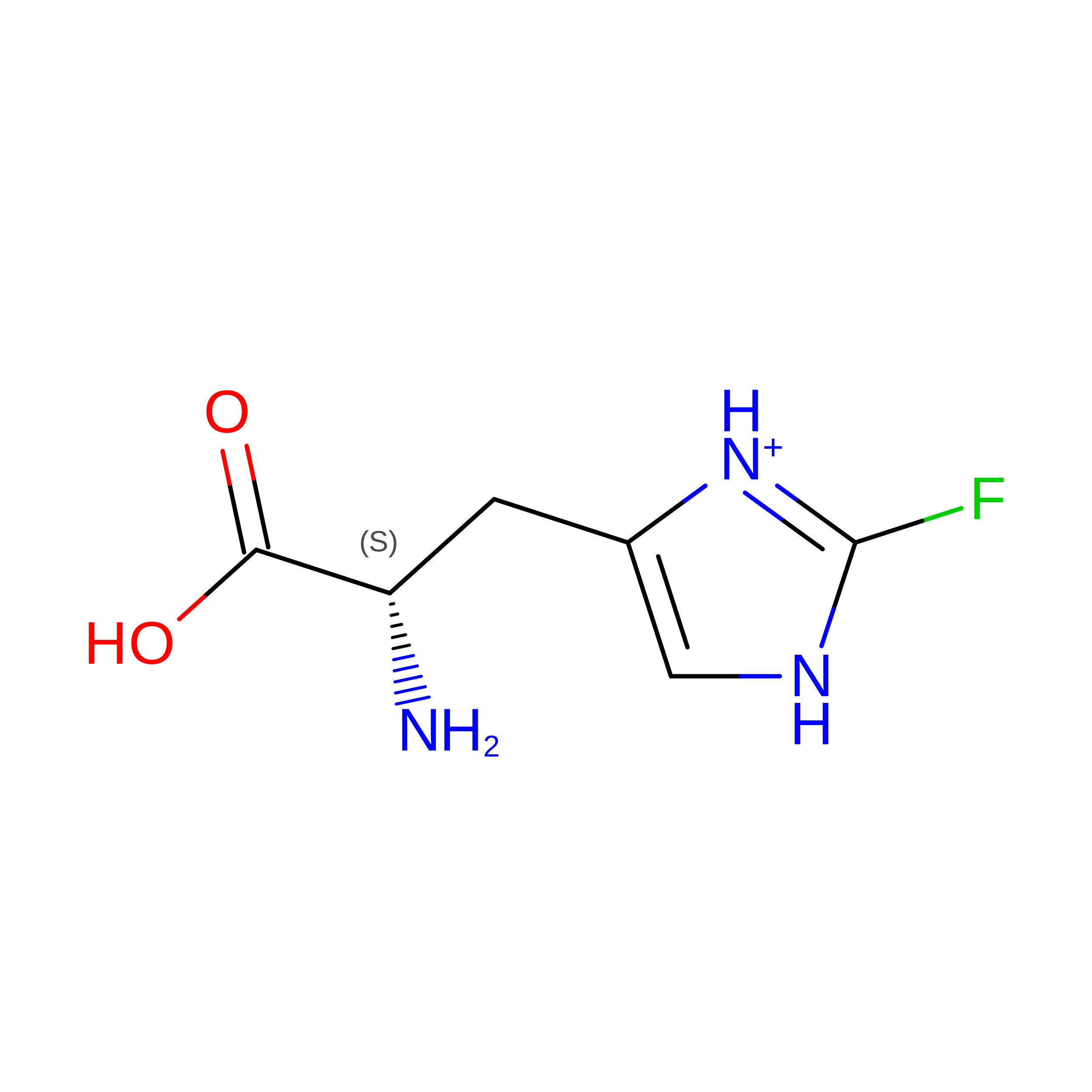
1.7A structure of 2-fluorohistidine labeled Protective Antigen


Experimental Data Snapshot

  • Method: X-RAY DIFFRACTION
  • Resolution: 1.70 Å
  • R-Value Free: 
    0.222 (Depositor), 0.232 (DCC) 
  • R-Value Work: 
    0.192 (Depositor), 0.202 (DCC) 

Starting Model: experimental
View more details

wwPDB Validation 3D Report Full Report

Validation slider image for 3MHZ

This is version 1.4 of the entry. See complete history

Literature

Evidence that histidine protonation of receptor-bound anthrax protective antigen is a trigger for pore formation.

Wimalasena, D.S.Janowiak, B.E.Lovell, S.Miyagi, M.Sun, J.Zhou, H.Hajduch, J.Pooput, C.Kirk, K.L.Battaile, K.P.Bann, J.G.

(2010) Biochemistry 49: 6973-6983

  • DOI: https://doi.org/10.1021/bi100647z
  • Primary Citation Related Structures: 
    3MHZ

  • PubMed Abstract: 

    The protective antigen (PA) component of the anthrax toxin forms pores within the low pH environment of host endosomes through mechanisms that are poorly understood. It has been proposed that pore formation is dependent on histidine protonation. In previous work, we biosynthetically incorporated 2-fluorohistidine (2-FHis), an isosteric analogue of histidine with a significantly reduced pK(a) ( approximately 1), into PA and showed that the pH-dependent conversion from the soluble prepore to a pore was unchanged. However, we also observed that 2-FHisPA was nonfunctional in the ability to mediate cytotoxicity of CHO-K1 cells by LF(N)-DTA and was defective in translocation through planar lipid bilayers. Here, we show that the defect in cytotoxicity is due to both a defect in translocation and, when bound to the host cellular receptor, an inability to undergo low pH-induced pore formation. Combining X-ray crystallography with hydrogen-deuterium (H-D) exchange mass spectrometry, our studies lead to a model in which hydrogen bonds to the histidine ring are strengthened by receptor binding. The combination of both fluorination and receptor binding is sufficient to block low pH-induced pore formation.


  • Organizational Affiliation
    • Department of Chemistry, Wichita State University, Wichita, Kansas 67260, USA.

Macromolecule Content 

  • Total Structure Weight: 83.22 kDa 
  • Atom Count: 5,722 
  • Modeled Residue Count: 673 
  • Deposited Residue Count: 735 
  • Unique protein chains: 1

Macromolecules

Find similar proteins by:|  3D Structure
Entity ID: 1
MoleculeChains  Sequence LengthOrganismDetailsImage
Protective antigen735Bacillus anthracisMutation(s): 0 
Gene Names: pagApagpXO1-110BXA0164GBAA_pXO1_0164
UniProt
Find proteins for P13423 (Bacillus anthracis)
Explore P13423 
Go to UniProtKB:  P13423
Entity Groups
Sequence Clusters30% Identity50% Identity70% Identity90% Identity95% Identity100% Identity
UniProt GroupP13423
Sequence Annotations
Expand
Reference Sequence

Experimental Data & Validation

Experimental Data

  • Method: X-RAY DIFFRACTION
  • Resolution: 1.70 Å
  • R-Value Free:  0.222 (Depositor), 0.232 (DCC) 
  • R-Value Work:  0.192 (Depositor), 0.202 (DCC) 
Space Group: P 21 21 21
Unit Cell:
Length ( Å )Angle ( ˚ )
a = 71.368α = 90
b = 93.975β = 90
c = 119.115γ = 90
Software Package:
Software NamePurpose
DENZOdata reduction
SCALEPACKdata scaling
MOLREPphasing
REFMACrefinement
PDB_EXTRACTdata extraction
HKL-2000data reduction
HKL-2000data scaling

Structure Validation

View Full Validation Report


Entry History 

Deposition Data

Revision History  (Full details and data files)

  • Version 1.0: 2010-08-11
    Type: Initial release
  • Version 1.1: 2011-07-13
    Changes: Version format compliance
  • Version 1.2: 2017-11-08
    Changes: Refinement description
  • Version 1.3: 2023-09-06
    Changes: Data collection, Database references, Derived calculations, Refinement description
  • Version 1.4: 2024-11-27
    Changes: Structure summary