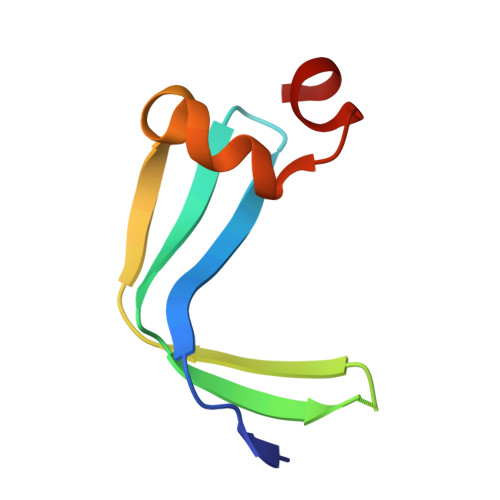
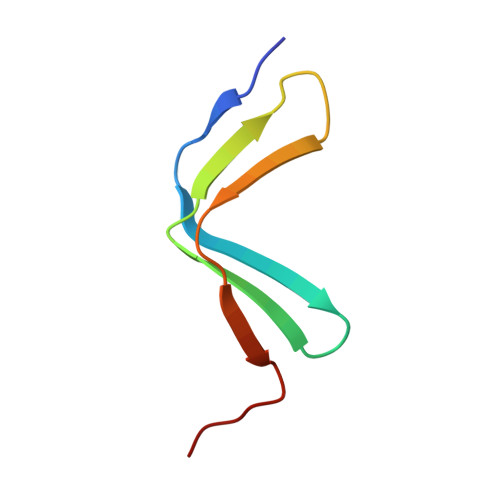
3LKX | pdb_00003lkx

Human nac dimerization domain


Experimental Data Snapshot

  • Method: X-RAY DIFFRACTION
  • Resolution: 2.50 Å
  • R-Value Free: 
    0.253 (Depositor), 0.251 (DCC) 
  • R-Value Work: 
    0.215 (Depositor), 0.211 (DCC) 
  • R-Value Observed: 
    0.218 (Depositor) 

Starting Model: experimental
View more details

wwPDB Validation 3D Report Full Report

Validation slider image for 3LKX

This is version 1.4 of the entry. See complete history

Literature

The crystal structure of the human nascent polypeptide-associated complex domain reveals a nucleic acid-binding region on the NACA subunit

Liu, Y.Hu, Y.Li, X.Niu, L.Teng, M.

(2010) Biochemistry 49: 2890-2896

  • DOI: https://doi.org/10.1021/bi902050p
  • Primary Citation Related Structures: 
    3LKX

  • PubMed Abstract: 

    In archaea and eukaryotes, the nascent polypeptide-associated complex (NAC) is one of the cytosolic chaperones that contact the nascent polypeptide chains as they emerge from the ribosome and assist in post-translational processes. The eukaryotic NAC is a heterodimer, and its two subunits form a stable complex through a dimerizing domain called the NAC domain. In addition to acting as a protein translation chaperone, the NAC subunits also function individually in transcriptional regulation. Here we report the crystal structure of the human NAC domain, which reveals the manner of human NAC dimerization. On the basis of the structure, we identified a region in the NAC domain of the human NAC alpha-subunit as a new nucleic acid-binding region, which is blocked from binding nucleic acids in the heterodimeric complex by a helix region in the beta-subunit.


  • Organizational Affiliation
    • Hefei National Laboratory for Physical Sciences at Microscale and School of Life Sciences, University of Science and Technology of China, Hefei, Anhui 230027, China.

Macromolecule Content 

  • Total Structure Weight: 13.14 kDa 
  • Atom Count: 903 
  • Modeled Residue Count: 119 
  • Deposited Residue Count: 120 
  • Unique protein chains: 2

Macromolecules

Find similar proteins by:|  3D Structure
Entity ID: 1
MoleculeChains  Sequence LengthOrganismDetailsImage
Transcription factor BTF366Homo sapiensMutation(s): 0 
Gene Names: NACA
UniProt & NIH Common Fund Data Resources
Find proteins for P20290 (Homo sapiens)
Explore P20290 
Go to UniProtKB:  P20290
PHAROS:  P20290
GTEx:  ENSG00000145741 
Entity Groups
Sequence Clusters30% Identity50% Identity70% Identity90% Identity95% Identity100% Identity
UniProt GroupP20290
Sequence Annotations
Expand
Reference Sequence
Find similar proteins by:|  3D Structure
Entity ID: 2
MoleculeChains  Sequence LengthOrganismDetailsImage
Nascent polypeptide-associated complex subunit alpha54Homo sapiensMutation(s): 0 
Gene Names: BTF3
UniProt & NIH Common Fund Data Resources
Find proteins for Q13765 (Homo sapiens)
Explore Q13765 
Go to UniProtKB:  Q13765
PHAROS:  Q13765
GTEx:  ENSG00000196531 
Entity Groups
Sequence Clusters30% Identity50% Identity70% Identity90% Identity95% Identity100% Identity
UniProt GroupQ13765
Sequence Annotations
Expand
Reference Sequence

Experimental Data & Validation

Experimental Data

  • Method: X-RAY DIFFRACTION
  • Resolution: 2.50 Å
  • R-Value Free:  0.253 (Depositor), 0.251 (DCC) 
  • R-Value Work:  0.215 (Depositor), 0.211 (DCC) 
  • R-Value Observed: 0.218 (Depositor) 
Space Group: P 61 2 2
Unit Cell:
Length ( Å )Angle ( ˚ )
a = 59.755α = 90
b = 59.755β = 90
c = 176.823γ = 120
Software Package:
Software NamePurpose
DENZOdata reduction
SCALEPACKdata scaling
REFMACrefinement
PDB_EXTRACTdata extraction
MAR345dtbdata collection
HKL-2000data reduction
HKL-2000data scaling
PHASERphasing

Structure Validation

View Full Validation Report


Entry History 

Deposition Data

Revision History  (Full details and data files)

  • Version 1.0: 2010-03-23
    Type: Initial release
  • Version 1.1: 2011-07-13
    Changes: Advisory, Version format compliance
  • Version 1.2: 2014-02-12
    Changes: Database references
  • Version 1.3: 2017-11-01
    Changes: Refinement description
  • Version 1.4: 2023-11-01
    Changes: Data collection, Database references, Refinement description