3LHD | pdb_00003lhd

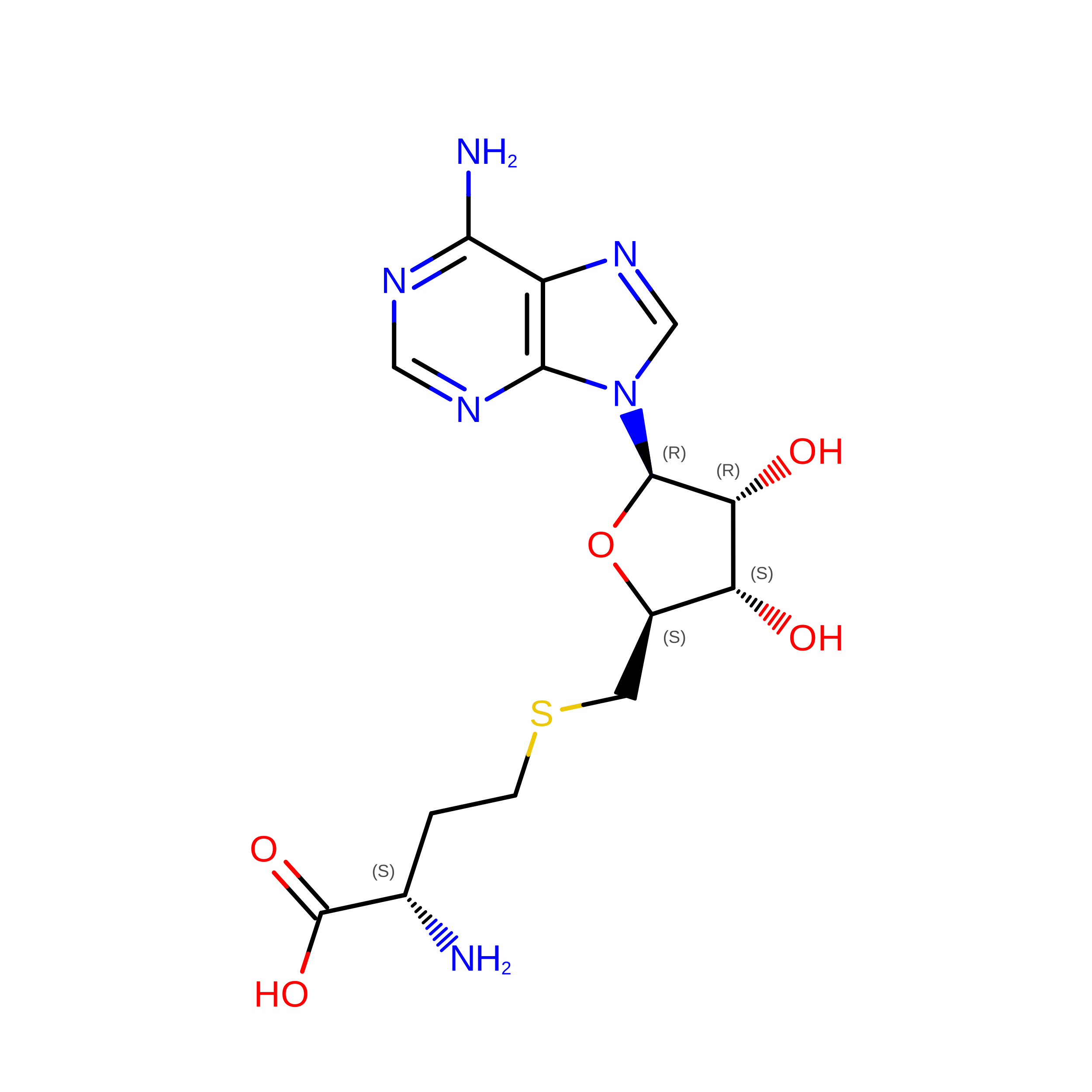
Crystal structure of P. abyssi tRNA m1A58 methyltransferase in complex with S-adenosyl-L-homocysteine


Experimental Data Snapshot

  • Method: X-RAY DIFFRACTION
  • Resolution: 2.59 Å
  • R-Value Free: 
    0.286 (Depositor), 0.282 (DCC) 
  • R-Value Work: 
    0.231 (Depositor), 0.227 (DCC) 
  • R-Value Observed: 
    0.233 (Depositor) 

Starting Model: experimental
View more details

wwPDB Validation 3D Report Full Report

Validation slider image for 3LHD

Ligand Structure Quality Assessment 


This is version 1.3 of the entry. See complete history

Literature

Insights into the hyperthermostability and unusual region-specificity of archaeal Pyrococcus abyssi tRNA m1A57/58 methyltransferase.

Guelorget, A.Roovers, M.Guerineau, V.Barbey, C.Li, X.Golinelli-Pimpaneau, B.

(2010) Nucleic Acids Res 38: 6206-6218

  • DOI: https://doi.org/10.1093/nar/gkq381
  • Primary Citation Related Structures: 
    3LGA, 3LHD, 3MB5

  • PubMed Abstract: 

    The S-adenosyl-L-methionine dependent methylation of adenine 58 in the T-loop of tRNAs is essential for cell growth in yeast or for adaptation to high temperatures in thermophilic organisms. In contrast to bacterial and eukaryotic tRNA m(1)A58 methyltransferases that are site-specific, the homologous archaeal enzyme from Pyrococcus abyssi catalyzes the formation of m(1)A also at the adjacent position 57, m(1)A57 being a precursor of 1-methylinosine. We report here the crystal structure of P. abyssi tRNA m(1)A57/58 methyltransferase ((Pab)TrmI), in complex with S-adenosyl-L-methionine or S-adenosyl-L-homocysteine in three different space groups. The fold of the monomer and the tetrameric architecture are similar to those of the bacterial enzymes. However, the inter-monomer contacts exhibit unique features. In particular, four disulfide bonds contribute to the hyperthermostability of the archaeal enzyme since their mutation lowers the melting temperature by 16.5°C. His78 in conserved motif X, which is present only in TrmIs from the Thermococcocales order, lies near the active site and displays two alternative conformations. Mutagenesis indicates His78 is important for catalytic efficiency of (Pab)TrmI. When A59 is absent in tRNA(Asp), only A57 is modified. Identification of the methylated positions in tRNAAsp by mass spectrometry confirms that (Pab)TrmI methylates the first adenine of an AA sequence.


  • Organizational Affiliation
    • Laboratoire d'Enzymologie et Biochimie Structurales, CNRS, 1 avenue de la Terrasse, 91198 Gif-sur-Yvette, France.

Macromolecule Content 

  • Total Structure Weight: 117.22 kDa 
  • Atom Count: 8,185 
  • Modeled Residue Count: 1,012 
  • Deposited Residue Count: 1,012 
  • Unique protein chains: 1

Macromolecules

Find similar proteins by:|  3D Structure
Entity ID: 1
MoleculeChains  Sequence LengthOrganismDetailsImage
SAM-dependent methyltransferase, putativeA [auth C],
B [auth A],
C [auth B],
D
253Pyrococcus abyssi GE5Mutation(s): 0 
Gene Names: PAB0283
EC: 2.1.1.36 (PDB Primary Data), 2.1.1.219 (UniProt)
UniProt
Find proteins for Q9V1J7 (Pyrococcus abyssi (strain GE5 / Orsay))
Explore Q9V1J7 
Go to UniProtKB:  Q9V1J7
Entity Groups
Sequence Clusters30% Identity50% Identity70% Identity90% Identity95% Identity100% Identity
UniProt GroupQ9V1J7
Sequence Annotations
Expand
Reference Sequence

Experimental Data & Validation

Experimental Data

  • Method: X-RAY DIFFRACTION
  • Resolution: 2.59 Å
  • R-Value Free:  0.286 (Depositor), 0.282 (DCC) 
  • R-Value Work:  0.231 (Depositor), 0.227 (DCC) 
  • R-Value Observed: 0.233 (Depositor) 
Space Group: P 21 21 21
Unit Cell:
Length ( Å )Angle ( ˚ )
a = 66.03α = 90
b = 127.577β = 90
c = 151.396γ = 90
Software Package:
Software NamePurpose
AMoREphasing
REFMACrefinement
DENZOdata reduction
SCALEPACKdata scaling

Structure Validation

View Full Validation Report


Ligand Structure Quality Assessment 


Entry History 

Deposition Data

Revision History  (Full details and data files)

  • Version 1.0: 2010-05-19
    Type: Initial release
  • Version 1.1: 2011-07-13
    Changes: Version format compliance
  • Version 1.2: 2023-09-06
    Changes: Data collection, Database references, Derived calculations, Refinement description
  • Version 1.3: 2024-10-16
    Changes: Data collection, Structure summary