3L4R | pdb_00003l4r

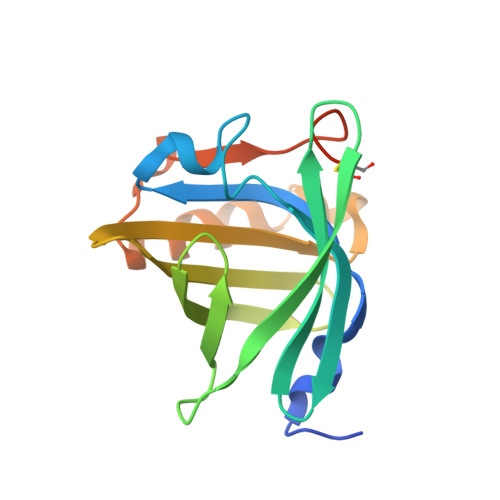
Crystal structure of the dog lipocalin allergen Can f 2 and implications for cross-reactivity to the cat allergen Fel d 4


Experimental Data Snapshot

  • Method: X-RAY DIFFRACTION
  • Resolution: 1.45 Å
  • R-Value Free: 
    0.168 (Depositor), 0.180 (DCC) 
  • R-Value Work: 
    0.157 (Depositor), 0.164 (DCC) 
  • R-Value Observed: 
    0.158 (Depositor) 

Starting Model: experimental
View more details

wwPDB Validation 3D Report Full Report

Validation slider image for 3L4R

This is version 1.3 of the entry. See complete history

Literature

Crystal Structure of the Dog Lipocalin Allergen Can f 2: Implications for Cross-reactivity to the Cat Allergen Fel d 4

Madhurantakam, C.Nilsson, O.B.Uchtenhagen, H.Konradsen, J.Saarne, T.Hogbom, E.Sandalova, T.Gronlund, H.Achour, A.

(2010) J Mol Biology 401: 68-83

  • DOI: https://doi.org/10.1016/j.jmb.2010.05.043
  • Primary Citation Related Structures: 
    3L4R

  • PubMed Abstract: 

    The dog lipocalin allergen Can f 2 is an important cause of allergic sensitization in humans worldwide. Here, the first crystal structure of recombinant rCan f 2 at 1.45 A resolution displays a classical lipocalin fold with a conserved Gly-Xaa-Trp motif, in which Trp19 stabilizes the overall topology of the monomeric rCan f 2. Phe38 and Tyr84 localized on the L1 and L5 loops, respectively, control access to the highly hydrophobic calyx. Although the rCan f 2 calyx is nearly identical with the aero-allergens MUP1, Equ c 1 and A2U from mouse, horse and rat, respectively, no IgE cross-reactivity was found using sera from five mono-sensitized subjects. However, clear IgE cross-reactivity was demonstrated between Can f 2 and the cat allergen Fel d 4, although they share less than 22% sequence identity. This suggests a role for these allergens in co-sensitization between cat- and dog-allergic patients.


  • Organizational Affiliation
    • Centre for Infectious Medicine, F59, Department of Medicine Huddinge, Karolinska University Hospital Huddinge, Karolinska Institutet, Stockholm, Sweden.

Macromolecule Content 

  • Total Structure Weight: 19.57 kDa 
  • Atom Count: 1,383 
  • Modeled Residue Count: 151 
  • Deposited Residue Count: 170 
  • Unique protein chains: 1

Macromolecules

Find similar proteins by:|  3D Structure
Entity ID: 1
MoleculeChains  Sequence LengthOrganismDetailsImage
Minor allergen Can f 2170Canis lupus familiarisMutation(s): 0 
Gene Names: can f 2
UniProt
Find proteins for O18874 (Canis lupus familiaris)
Explore O18874 
Go to UniProtKB:  O18874
Entity Groups
Sequence Clusters30% Identity50% Identity70% Identity90% Identity95% Identity100% Identity
UniProt GroupO18874
Sequence Annotations
Expand
Reference Sequence

Small Molecules

Ligands 1 Unique
IDChains Name / Formula / InChI Key2D Diagram3D Interactions
GOL

Query on GOL


Download:Ideal Coordinates CCD File
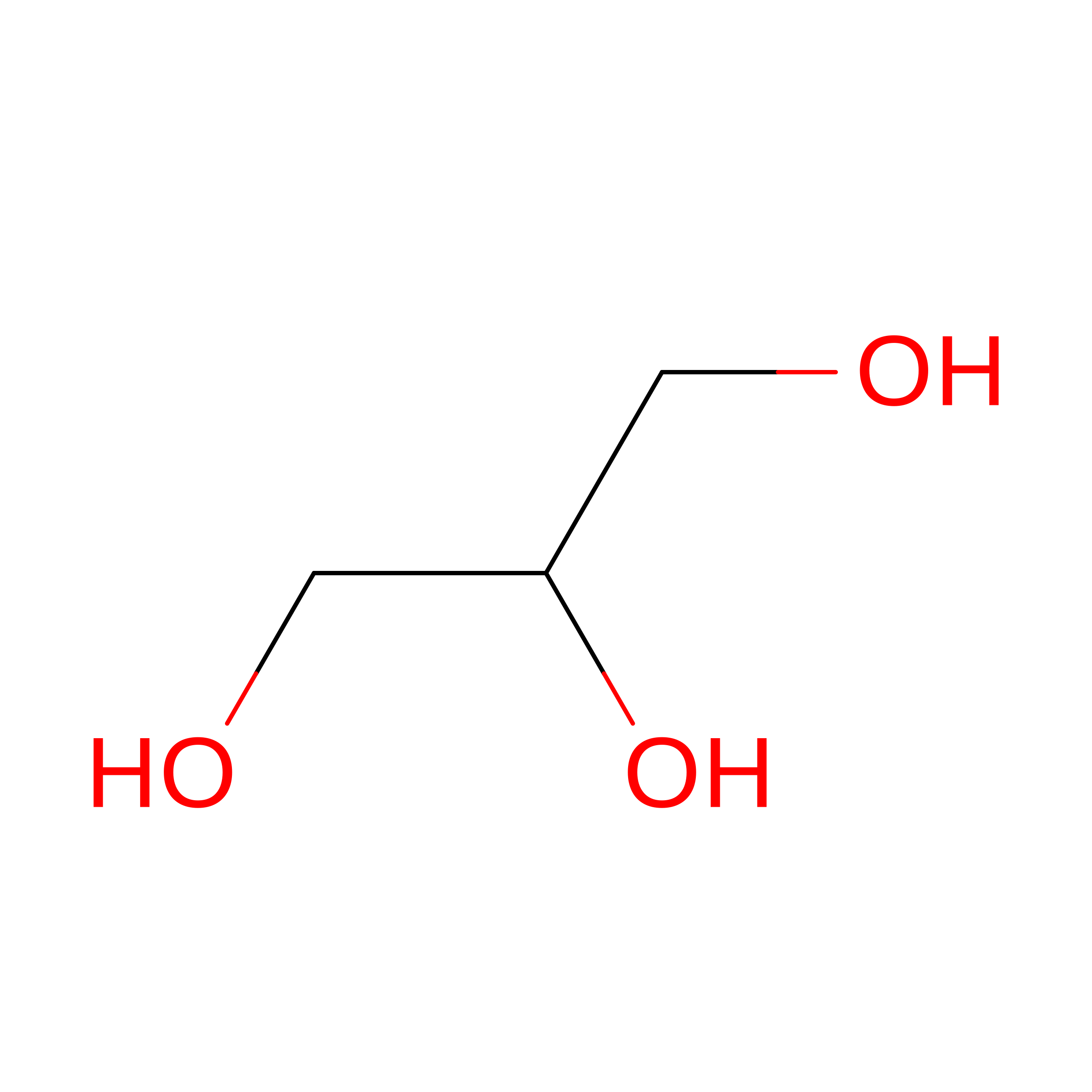
B [auth A]GLYCEROL
C3 H8 O3
PEDCQBHIVMGVHV-UHFFFAOYSA-N

Experimental Data & Validation

Experimental Data

  • Method: X-RAY DIFFRACTION
  • Resolution: 1.45 Å
  • R-Value Free:  0.168 (Depositor), 0.180 (DCC) 
  • R-Value Work:  0.157 (Depositor), 0.164 (DCC) 
  • R-Value Observed: 0.158 (Depositor) 
Space Group: C 2 2 21
Unit Cell:
Length ( Å )Angle ( ˚ )
a = 68.175α = 90
b = 76.898β = 90
c = 64.996γ = 90
Software Package:
Software NamePurpose
ADSCdata collection
PHASERphasing
REFMACrefinement
MOSFLMdata reduction
SCALAdata scaling

Structure Validation

View Full Validation Report


Entry History 

Deposition Data

Revision History  (Full details and data files)

  • Version 1.0: 2010-05-26
    Type: Initial release
  • Version 1.1: 2011-07-13
    Changes: Version format compliance
  • Version 1.2: 2023-11-01
    Changes: Data collection, Database references, Derived calculations, Refinement description
  • Version 1.3: 2024-11-20
    Changes: Structure summary