3KZK | pdb_00003kzk

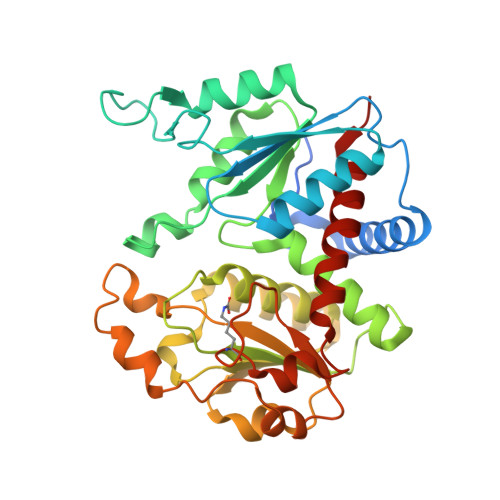
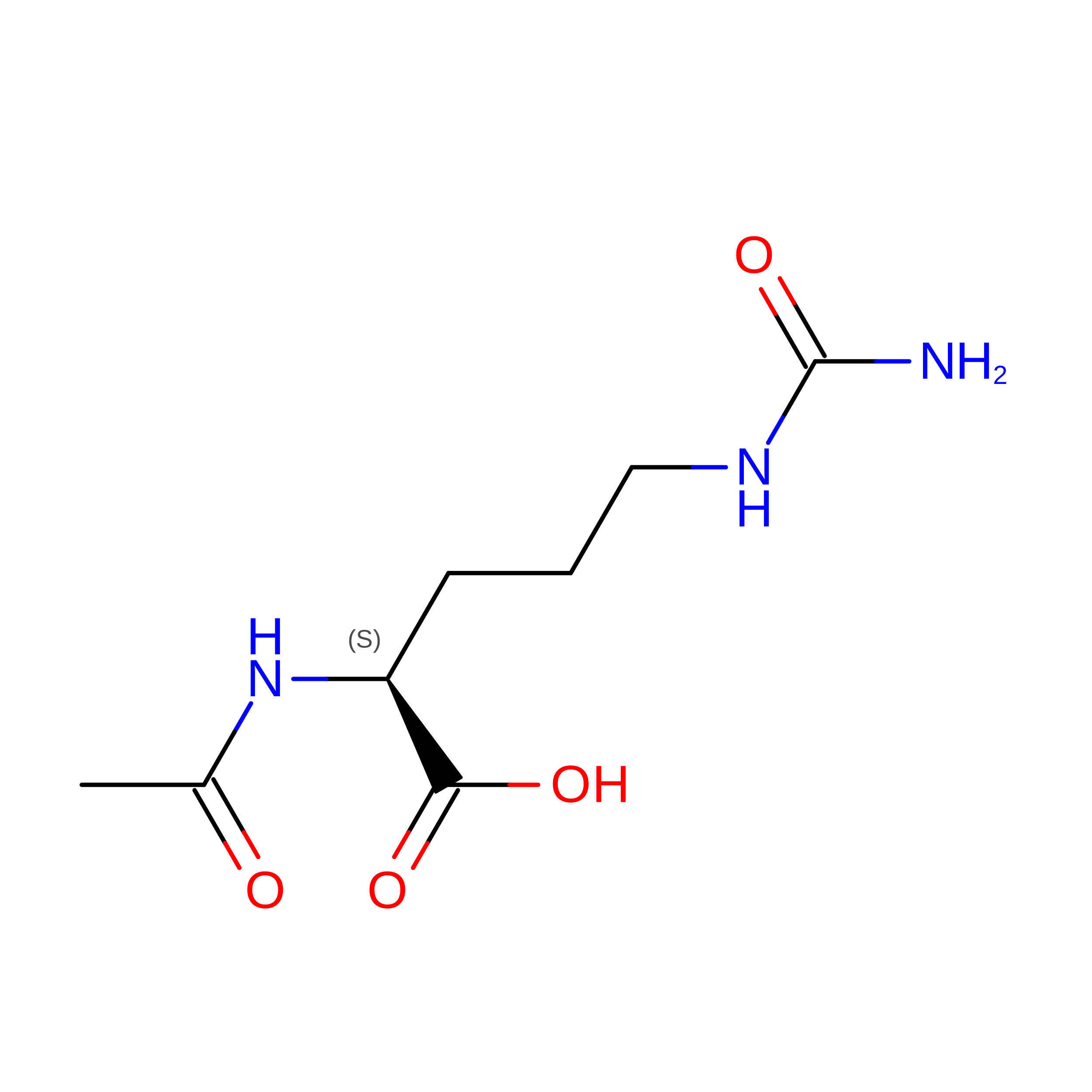
Crystal structure of acetylornithine transcarbamylase complexed with acetylcitrulline


Experimental Data Snapshot

  • Method: X-RAY DIFFRACTION
  • Resolution: 1.90 Å
  • R-Value Free: 
    0.247 (Depositor), 0.240 (DCC) 
  • R-Value Work: 
    0.219 (Depositor), 0.214 (DCC) 
  • R-Value Observed: 
    0.219 (Depositor) 

Starting Model: experimental
View more details

wwPDB Validation 3D Report Full Report

Validation slider image for 3KZK

Ligand Structure Quality Assessment 


This is version 1.4 of the entry. See complete history

Literature

Crystal structure of N-acetylornithine transcarbamylase from Xanthomonas campestris: a novel enzyme in a new arginine biosynthetic pathway found in several eubacteria.

Shi, D.Morizono, H.Yu, X.Roth, L.Caldovic, L.Allewell, N.M.Malamy, M.H.Tuchman, M.

(2005) J Biological Chem 280: 14366-14369

  • DOI: https://doi.org/10.1074/jbc.C500005200
  • Primary Citation Related Structures: 
    3KZC, 3KZK

  • PubMed Abstract: 

    We have identified in Xanthomonas campestris a novel N-acetylornithine transcarbamylase that replaces ornithine transcarbamylase in the canonic arginine biosynthetic pathway of several Eubacteria. The crystal structures of the protein in the presence and absence of the reaction product, N-acetylcitrulline, were determined. This new family of transcarbamylases lacks the DxxSMG motif that is characteristic of all ornithine transcarbamylases (OTCases) and contains a novel proline-rich loop that forms part of the active site. The specificity for N-acetylornithine is conferred by hydrogen bonding with residues in the proline-rich loop via water molecules and by hydrophobic interactions with residues from the adjacent 80's, 120's, and proline-rich loops. This novel protein structure provides a starting point for rational design of specific analogs that may be useful in combating human and plant pathogens that utilize acetylornithine transcarbamylase rather than ornithine transcarbamylase.


  • Organizational Affiliation
    • Children's Research Institute, Children's National Medical Center, Washington, DC 20010, USA. dshi@cnmcresearch.org <dshi@cnmcresearch.org>

Macromolecule Content 

  • Total Structure Weight: 40.54 kDa 
  • Atom Count: 2,802 
  • Modeled Residue Count: 334 
  • Deposited Residue Count: 359 
  • Unique protein chains: 1

Macromolecules

Find similar proteins by:|  3D Structure
Entity ID: 1
MoleculeChains  Sequence LengthOrganismDetailsImage
N-acetylornithine carbamoyltransferase359Xanthomonas campestris pv. campestris str. ATCC 33913Mutation(s): 0 
Gene Names: argFargF'XCC2249
EC: 2.1.3.9
UniProt
Find proteins for Q8P8J2 (Xanthomonas campestris pv. campestris (strain ATCC 33913 / DSM 3586 / NCPPB 528 / LMG 568 / P 25))
Explore Q8P8J2 
Go to UniProtKB:  Q8P8J2
Entity Groups
Sequence Clusters30% Identity50% Identity70% Identity90% Identity95% Identity100% Identity
UniProt GroupQ8P8J2
Sequence Annotations
Expand
Reference Sequence

Small Molecules

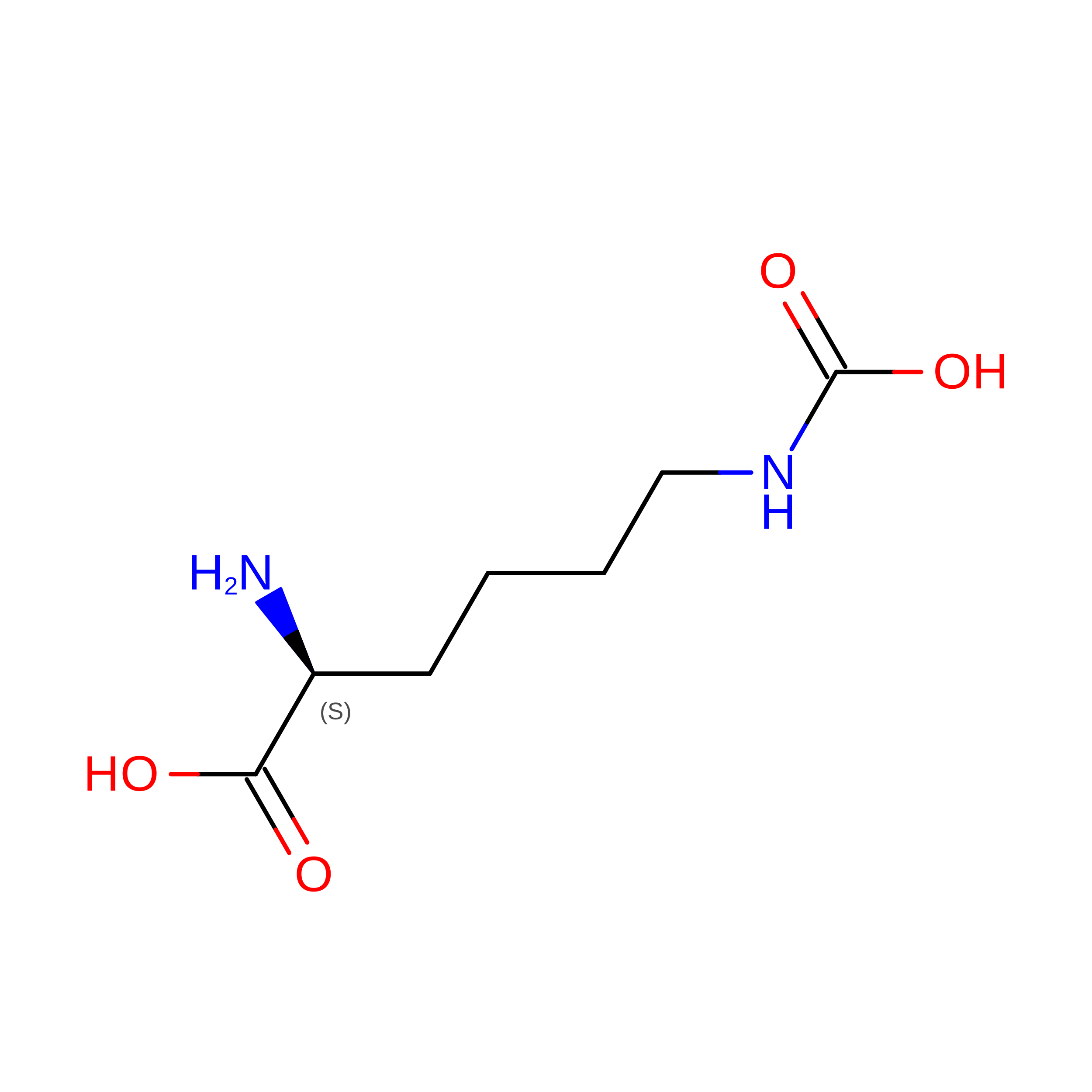
Modified Residues  1 Unique
IDChains TypeFormula2D DiagramParent
KCX
Query on KCX
A
L-PEPTIDE LINKINGC7 H14 N2 O4LYS

Experimental Data & Validation

Experimental Data

  • Method: X-RAY DIFFRACTION
  • Resolution: 1.90 Å
  • R-Value Free:  0.247 (Depositor), 0.240 (DCC) 
  • R-Value Work:  0.219 (Depositor), 0.214 (DCC) 
  • R-Value Observed: 0.219 (Depositor) 
Space Group: I 21 3
Unit Cell:
Length ( Å )Angle ( ˚ )
a = 129.446α = 90
b = 129.446β = 90
c = 129.446γ = 90
Software Package:
Software NamePurpose
CNSrefinement
PDB_EXTRACTdata extraction
DENZOdata reduction
SCALEPACKdata scaling

Structure Validation

View Full Validation Report


Ligand Structure Quality Assessment 


Entry History 

Deposition Data

Revision History  (Full details and data files)

  • Version 1.0: 2010-03-31
    Type: Initial release
  • Version 1.1: 2011-07-13
    Changes: Version format compliance
  • Version 1.2: 2017-11-01
    Changes: Refinement description
  • Version 1.3: 2023-09-06
    Changes: Data collection, Database references, Derived calculations, Refinement description
  • Version 1.4: 2023-11-22
    Changes: Data collection