3KU2 | pdb_00003ku2

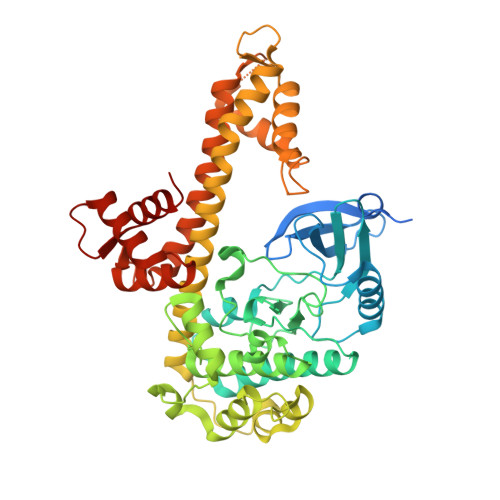
Crystal Structure of inactivated form of CDPK1 from toxoplasma gondii, TGME49.101440


Experimental Data Snapshot

  • Method: X-RAY DIFFRACTION
  • Resolution: 2.30 Å
  • R-Value Free: 
    0.236 (Depositor), 0.228 (DCC) 
  • R-Value Work: 
    0.198 (Depositor) 

Starting Model: experimental
View more details

wwPDB Validation 3D Report Full Report

Validation slider image for 3KU2

Ligand Structure Quality Assessment 


This is version 1.5 of the entry. See complete history

Literature

Structures of apicomplexan calcium-dependent protein kinases reveal mechanism of activation by calcium.

Wernimont, A.K.Artz, J.D.Finerty, P.Lin, Y.H.Amani, M.Allali-Hassani, A.Senisterra, G.Vedadi, M.Tempel, W.Mackenzie, F.Chau, I.Lourido, S.Sibley, L.D.Hui, R.

(2010) Nat Struct Mol Biol 17: 596-601

  • DOI: https://doi.org/10.1038/nsmb.1795
  • Primary Citation Related Structures: 
    3HX4, 3HZT, 3IGO, 3KU2

  • PubMed Abstract: 

    Calcium-dependent protein kinases (CDPKs) have pivotal roles in the calcium-signaling pathway in plants, ciliates and apicomplexan parasites and comprise a calmodulin-dependent kinase (CaMK)-like kinase domain regulated by a calcium-binding domain in the C terminus. To understand this intramolecular mechanism of activation, we solved the structures of the autoinhibited (apo) and activated (calcium-bound) conformations of CDPKs from the apicomplexan parasites Toxoplasma gondii and Cryptosporidium parvum. In the apo form, the C-terminal CDPK activation domain (CAD) resembles a calmodulin protein with an unexpected long helix in the N terminus that inhibits the kinase domain in the same manner as CaMKII. Calcium binding triggers the reorganization of the CAD into a highly intricate fold, leading to its relocation around the base of the kinase domain to a site remote from the substrate binding site. This large conformational change constitutes a distinct mechanism in calcium signal-transduction pathways.


  • Organizational Affiliation
    • Structural Genomics Consortium, University of Toronto, Toronto, Ontario, Canada.

Macromolecule Content 

  • Total Structure Weight: 57.84 kDa 
  • Atom Count: 3,701 
  • Modeled Residue Count: 457 
  • Deposited Residue Count: 507 
  • Unique protein chains: 1

Macromolecules

Find similar proteins by:|  3D Structure
Entity ID: 1
MoleculeChains  Sequence LengthOrganismDetailsImage
Calmodulin-domain protein kinase 1507Toxoplasma gondiiMutation(s): 0 
Gene Names: CDPK1TGME49_101440
EC: 2.7.11.1
UniProt
Find proteins for Q9BJF5 (Toxoplasma gondii)
Explore Q9BJF5 
Go to UniProtKB:  Q9BJF5
Entity Groups
Sequence Clusters30% Identity50% Identity70% Identity90% Identity95% Identity100% Identity
UniProt GroupQ9BJF5
Sequence Annotations
Expand
Reference Sequence

Experimental Data & Validation

Experimental Data

  • Method: X-RAY DIFFRACTION
  • Resolution: 2.30 Å
  • R-Value Free:  0.236 (Depositor), 0.228 (DCC) 
  • R-Value Work:  0.198 (Depositor) 
Space Group: P 1 21 1
Unit Cell:
Length ( Å )Angle ( ˚ )
a = 48.01α = 90
b = 72.912β = 96.26
c = 65.018γ = 90
Software Package:
Software NamePurpose
BUSTERrefinement
SCALEPACKdata scaling
PHASERphasing
REFMACrefinement
PDB_EXTRACTdata extraction
HKL-2000data reduction
HKL-2000data scaling
DENZOdata reduction

Structure Validation

View Full Validation Report


Ligand Structure Quality Assessment 


Entry History 

Revision History  (Full details and data files)

  • Version 1.0: 2010-02-16
    Type: Initial release
  • Version 1.1: 2011-07-13
    Changes: Version format compliance
  • Version 1.2: 2017-11-01
    Changes: Refinement description
  • Version 1.3: 2018-01-24
    Changes: Structure summary
  • Version 1.4: 2019-07-17
    Changes: Data collection, Refinement description
  • Version 1.5: 2023-09-06
    Changes: Data collection, Database references, Derived calculations, Refinement description