3KFK | pdb_00003kfk

Crystal structures of a group II chaperonin from Methanococcus maripaludis


Experimental Data Snapshot

  • Method: X-RAY DIFFRACTION
  • Resolution: 6.00 Å
  • R-Value Free: 
    0.270 (Depositor), 0.337 (DCC) 
  • R-Value Work: 
    0.241 (Depositor) 
  • R-Value Observed: 
    0.242 (Depositor) 

Starting Model: experimental
View more details

wwPDB Validation 3D Report Full Report

Validation slider image for 3KFK

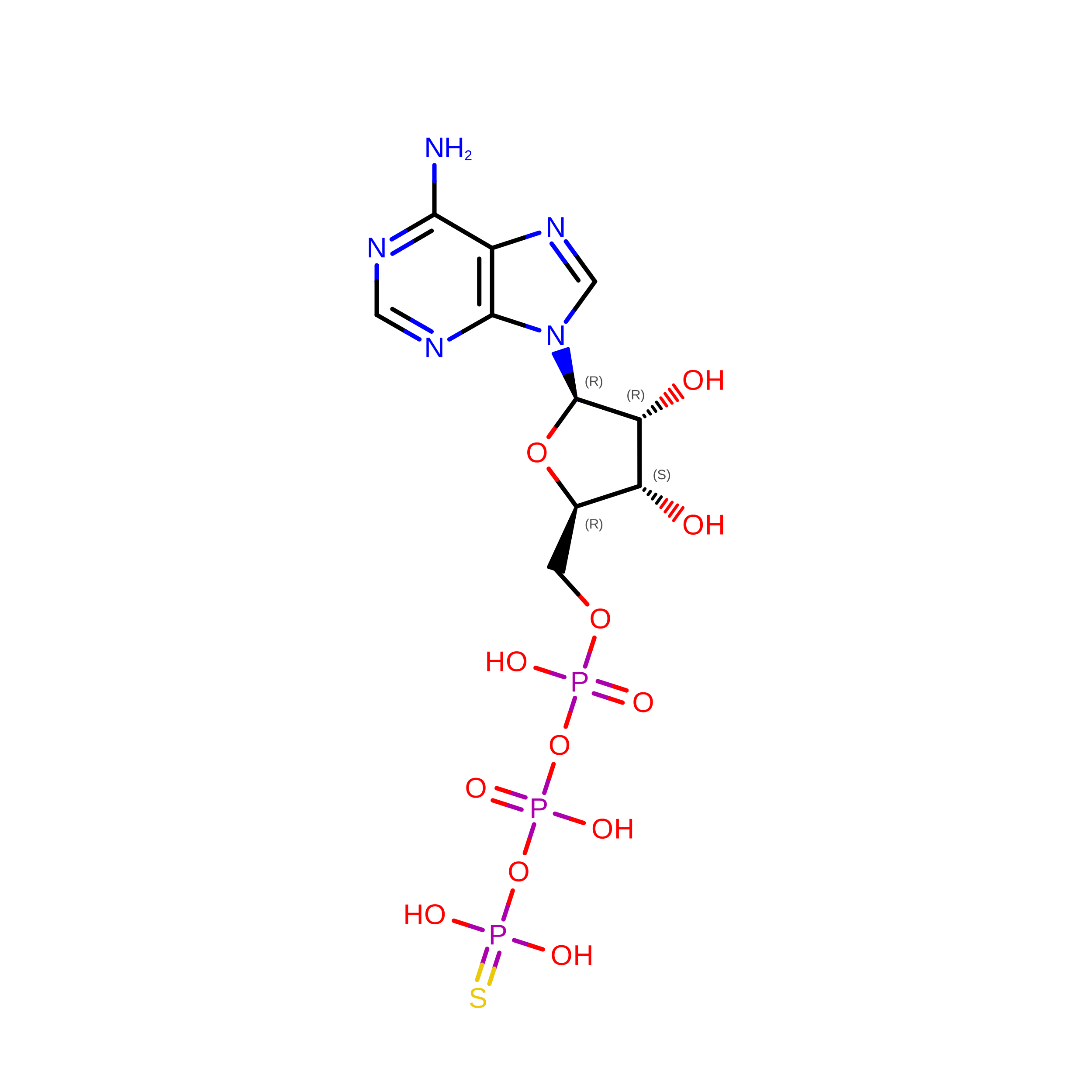
Ligand Structure Quality Assessment 


This is version 1.3 of the entry. See complete history

Literature

Crystal structures of a group II chaperonin reveal the open and closed states associated with the protein folding cycle.

Pereira, J.H.Ralston, C.Y.Douglas, N.R.Meyer, D.Knee, K.M.Goulet, D.R.King, J.A.Frydman, J.Adams, P.D.

(2010) J Biological Chem 285: 27958-27966

  • DOI: https://doi.org/10.1074/jbc.M110.125344
  • Primary Citation Related Structures: 
    3KFB, 3KFE, 3KFK

  • PubMed Abstract: 

    Chaperonins are large protein complexes consisting of two stacked multisubunit rings, which open and close in an ATP-dependent manner to create a protected environment for protein folding. Here, we describe the first crystal structure of a group II chaperonin in an open conformation. We have obtained structures of the archaeal chaperonin from Methanococcus maripaludis in both a peptide acceptor (open) state and a protein folding (closed) state. In contrast with group I chaperonins, in which the equatorial domains share a similar conformation between the open and closed states and the largest motions occurs at the intermediate and apical domains, the three domains of the archaeal chaperonin subunit reorient as a single rigid body. The large rotation observed from the open state to the closed state results in a 65% decrease of the folding chamber volume and creates a highly hydrophilic surface inside the cage. These results suggest a completely distinct closing mechanism in the group II chaperonins as compared with the group I chaperonins.


  • Organizational Affiliation
    • Physical Biosciences Division, Lawrence Berkeley National Laboratory, Berkeley, California 94720, USA.

Macromolecule Content 

  • Total Structure Weight: 224.55 kDa 
  • Atom Count: 14,619 
  • Modeled Residue Count: 1,945 
  • Deposited Residue Count: 2,084 
  • Unique protein chains: 1

Macromolecules

Find similar proteins by:|  3D Structure
Entity ID: 1
MoleculeChains  Sequence LengthOrganismDetailsImage
Chaperonin
A, B, C, D
521Methanococcus maripaludisMutation(s): 4 
Gene Names: hsp60MMP1515
EC: 3.6.1 (UniProt), 5.6.1.7 (UniProt)
UniProt
Find proteins for Q6LX38 (Methanococcus maripaludis (strain DSM 14266 / JCM 13030 / NBRC 101832 / S2 / LL))
Explore Q6LX38 
Go to UniProtKB:  Q6LX38
Entity Groups
Sequence Clusters30% Identity50% Identity70% Identity90% Identity95% Identity100% Identity
UniProt GroupQ6LX38
Sequence Annotations
Expand
Reference Sequence

Experimental Data & Validation

Experimental Data

  • Method: X-RAY DIFFRACTION
  • Resolution: 6.00 Å
  • R-Value Free:  0.270 (Depositor), 0.337 (DCC) 
  • R-Value Work:  0.241 (Depositor) 
  • R-Value Observed: 0.242 (Depositor) 
Space Group: I 2 2 2
Unit Cell:
Length ( Å )Angle ( ˚ )
a = 150.533α = 90
b = 209.527β = 90
c = 266.862γ = 90
Software Package:
Software NamePurpose
HKL-2000data collection
PHASERphasing
PHENIXrefinement
HKL-2000data reduction
HKL-2000data scaling

Structure Validation

View Full Validation Report


Ligand Structure Quality Assessment 


Entry History 

Deposition Data

Revision History  (Full details and data files)

  • Version 1.0: 2010-06-23
    Type: Initial release
  • Version 1.1: 2011-07-13
    Changes: Version format compliance
  • Version 1.2: 2023-09-06
    Changes: Data collection, Database references, Derived calculations, Refinement description
  • Version 1.3: 2024-11-06
    Changes: Structure summary