3KDY | pdb_00003kdy

X-ray crystal structure of tyrosine aminomutase mutant construct


Experimental Data Snapshot

  • Method: X-RAY DIFFRACTION
  • Resolution: 2.20 Å
  • R-Value Free: 
    0.265 (Depositor), 0.264 (DCC) 
  • R-Value Work: 
    0.239 (Depositor), 0.238 (DCC) 
  • R-Value Observed: 
    0.239 (Depositor) 

Starting Model: experimental
View more details

wwPDB Validation 3D Report Full Report

Validation slider image for 3KDY

This is version 3.0 of the entry. See complete history

Literature

Probing the active site of MIO-dependent aminomutases, key catalysts in the biosynthesis of beta-amino acids incorporated in secondary metabolites

Cooke, H.A.Bruner, S.D.

(2010) Biopolymers 93: 802-810

  • DOI: https://doi.org/10.1002/bip.21500
  • Primary Citation Related Structures: 
    3KDY, 3KDZ

  • PubMed Abstract: 

    The tyrosine aminomutase SgTAM produces (S)-ss-tyrosine from L-tyrosine in the biosynthesis of the enediyne antitumor antibiotic C-1027. This conversion is promoted by the methylideneimidazole-5-one (MIO) prosthetic group. MIO was first identified in the homologous family of ammonia lyases, which deaminate aromatic amino acids to form alpha,ss-unsaturated carboxylates. Studies of substrate specificity have been described for lyases but there have been limited reports in altering the substrate specificity of aminomutases. Furthermore, it remains unclear as to what structural properties are responsible for catalyzing the presumed readdition of the amino group into the alpha,ss-unsaturated intermediates to form ss-amino acids. Attempts to elucidate specificity and mechanistic determinants of SgTAM have also proved to be difficult as it is recalcitrant to perturbations to the active site via mutagenesis. An X-ray cocrystal structure of the SgTAM mutant of the catalytic base with L-tyrosine verified important substrate binding residues as well as the enzymatic base. Further mutagenesis revealed that removal of these crucial interactions renders the enzyme inactive. Proposed structural determinants for mutase activity probed via mutagenesis, time-point assays and X-ray crystallography revealed a complicated role for these residues in maintaining key quaternary structure properties that aid in catalysis.


  • Organizational Affiliation
    • Department of Chemistry, Boston College, Chestnut Hill, MA 02467-3860, USA. bruner@ufl.edu

Macromolecule Content 

  • Total Structure Weight: 116.22 kDa 
  • Atom Count: 8,488 
  • Modeled Residue Count: 1,054 
  • Deposited Residue Count: 1,074 
  • Unique protein chains: 1

Macromolecules

Find similar proteins by:|  3D Structure
Entity ID: 1
MoleculeChains  Sequence LengthOrganismDetailsImage
Histidine ammonia-lyase
A, B
537Streptomyces globisporusMutation(s): 2 
Gene Names: sgcC4
EC: 4.3.1.3 (PDB Primary Data), 4.3.1.23 (UniProt), 5.4.3.6 (UniProt)
UniProt
Find proteins for Q8GMG0 (Streptomyces globisporus)
Explore Q8GMG0 
Go to UniProtKB:  Q8GMG0
Entity Groups
Sequence Clusters30% Identity50% Identity70% Identity90% Identity95% Identity100% Identity
UniProt GroupQ8GMG0
Sequence Annotations
Expand
Reference Sequence

Small Molecules

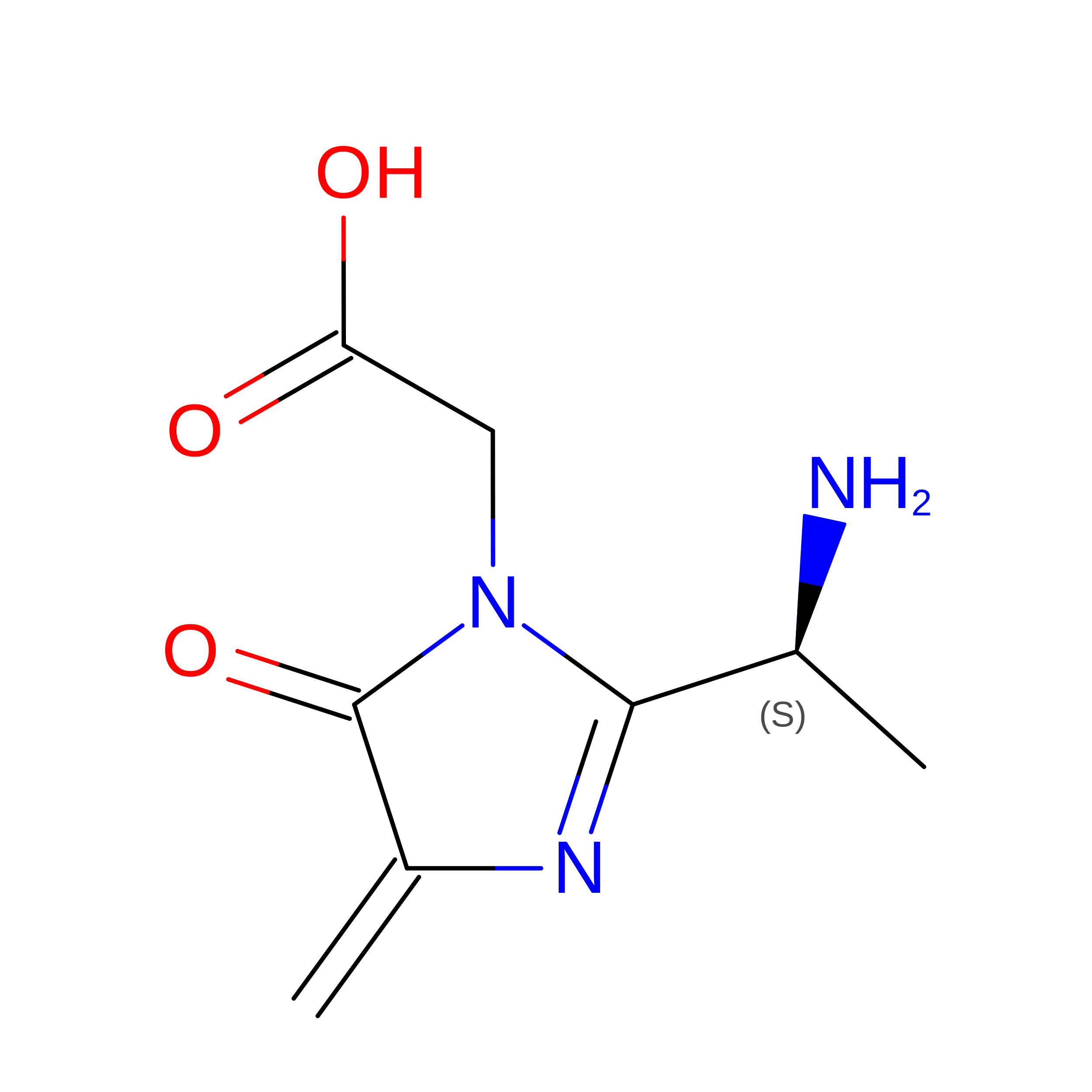
Modified Residues  1 Unique
IDChains TypeFormula2D DiagramParent
MDO
Query on MDO
A, B
L-PEPTIDE LINKINGC8 H11 N3 O3ALA, SER, GLY

Experimental Data & Validation

Experimental Data

  • Method: X-RAY DIFFRACTION
  • Resolution: 2.20 Å
  • R-Value Free:  0.265 (Depositor), 0.264 (DCC) 
  • R-Value Work:  0.239 (Depositor), 0.238 (DCC) 
  • R-Value Observed: 0.239 (Depositor) 
Space Group: P 21 21 2
Unit Cell:
Length ( Å )Angle ( ˚ )
a = 92.583α = 90
b = 145.881β = 90
c = 74.908γ = 90
Software Package:
Software NamePurpose
CBASSdata collection
CNSrefinement
HKL-2000data reduction
SCALEPACKdata scaling
CNSphasing

Structure Validation

View Full Validation Report


Entry History 

Deposition Data

Revision History  (Full details and data files)

  • Version 1.0: 2010-07-07
    Type: Initial release
  • Version 1.1: 2011-07-13
    Changes: Version format compliance
  • Version 1.2: 2021-10-13
    Changes: Database references, Derived calculations
  • Version 1.3: 2023-09-06
    Changes: Data collection, Refinement description
  • Version 2.0: 2023-11-15
    Changes: Atomic model, Data collection, Derived calculations
  • Version 2.1: 2024-11-27
    Changes: Structure summary
  • Version 3.0: 2026-03-18
    Changes: Polymer sequence