3KDI | pdb_00003kdi

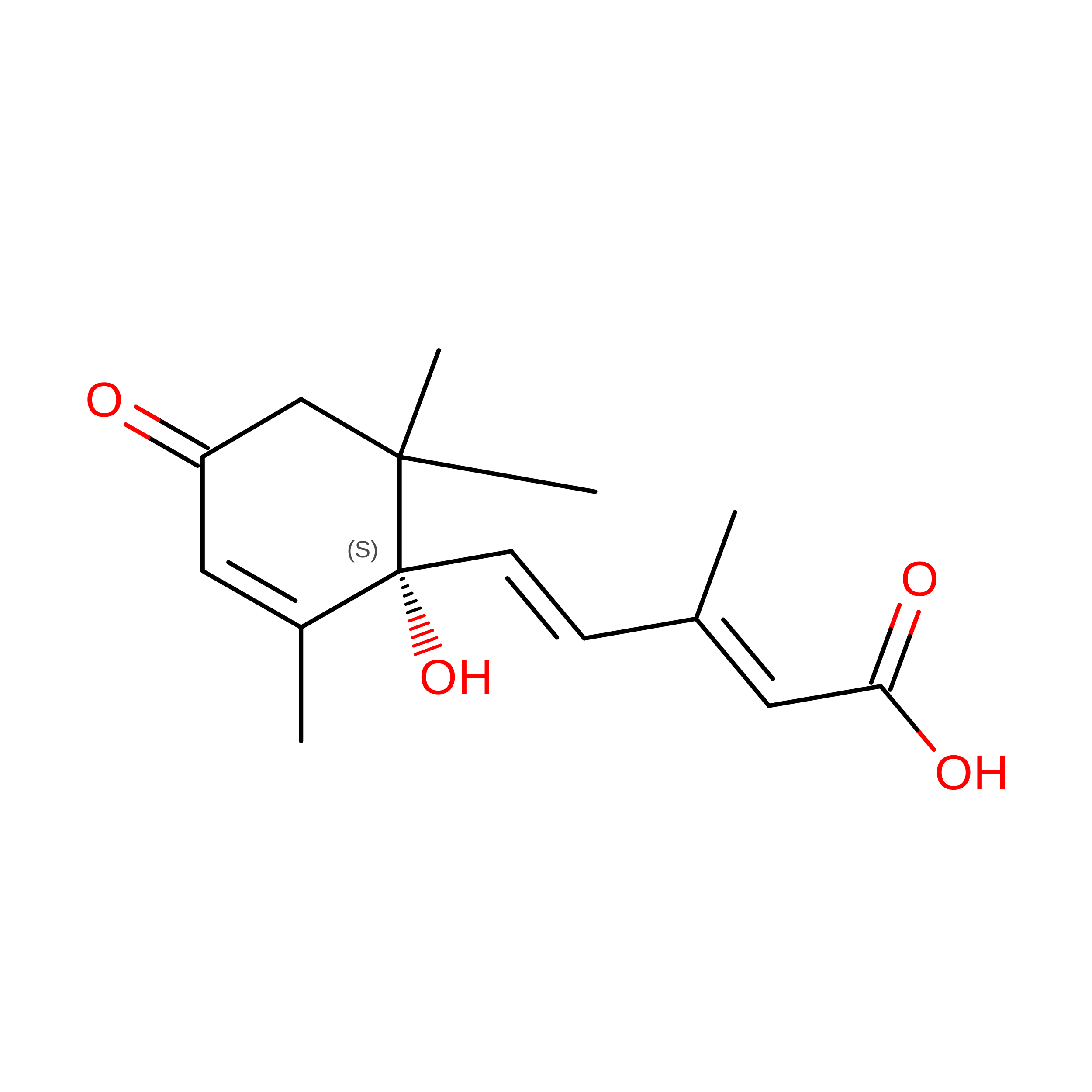
Structure of (+)-ABA bound PYL2


Experimental Data Snapshot

  • Method: X-RAY DIFFRACTION
  • Resolution: 2.38 Å
  • R-Value Free: 
    0.281 (Depositor), 0.284 (DCC) 
  • R-Value Work: 
    0.226 (Depositor), 0.223 (DCC) 
  • R-Value Observed: 
    0.228 (Depositor) 

Starting Model: experimental
View more details

wwPDB Validation 3D Report Full Report

Validation slider image for 3KDI

Ligand Structure Quality Assessment 


This is version 1.2 of the entry. See complete history

Literature

Structural insights into the mechanism of abscisic acid signaling by PYL proteins

Yin, P.Fan, H.Hao, Q.Yuan, X.Wu, D.Pang, Y.Yan, C.Li, W.Wang, J.Yan, N.

(2009) Nat Struct Mol Biol 16: 1230-1236

  • DOI: https://doi.org/10.1038/nsmb.1730
  • Primary Citation Related Structures: 
    3KDH, 3KDI, 3KDJ

  • PubMed Abstract: 

    Abscisic acid (ABA) is an important phytohormone that regulates plant stress responses. Proteins from the PYR-PYL-RCAR family were recently identified as ABA receptors. Upon binding to ABA, a PYL protein associates with type 2C protein phosphatases (PP2Cs) such as ABI1 and ABI2, inhibiting their activity; the molecular mechanisms by which PYLs mediate ABA signaling remain unknown, however. Here we report three crystal structures: apo-PYL2, (+)-ABA-bound PYL2 and (+)-ABA-bound PYL1 in complex with phosphatase ABI1. Apo-PYL2 contains a pocket surrounded by four highly conserved surface loops. In response to ABA binding, loop CL2 closes onto the pocket, creating a surface that recognizes ABI1. In the ternary complex, the CL2 loop is located near the active site of ABI1, blocking the entry of substrate proteins. Together, our data reveal the mechanisms by which ABA regulates PYL-mediated inhibition of PP2Cs.


  • Organizational Affiliation
    • State Key Laboratory of Bio-membrane and Membrane Biotechnology, TsinghuaUniversity, Beijing, China.

Macromolecule Content 

  • Total Structure Weight: 21.57 kDa 
  • Atom Count: 1,466 
  • Modeled Residue Count: 181 
  • Deposited Residue Count: 190 
  • Unique protein chains: 1

Macromolecules

Find similar proteins by:|  3D Structure
Entity ID: 1
MoleculeChains  Sequence LengthOrganismDetailsImage
Putative uncharacterized protein At2g26040190Arabidopsis thalianaMutation(s): 0 
UniProt
Find proteins for O80992 (Arabidopsis thaliana)
Explore O80992 
Go to UniProtKB:  O80992
Entity Groups
Sequence Clusters30% Identity50% Identity70% Identity90% Identity95% Identity100% Identity
UniProt GroupO80992
Sequence Annotations
Expand
Reference Sequence

Small Molecules

Ligands 1 Unique
IDChains Name / Formula / InChI Key2D Diagram3D Interactions
A8S

Query on A8S


Download:Ideal Coordinates CCD File
B [auth A](2Z,4E)-5-[(1S)-1-hydroxy-2,6,6-trimethyl-4-oxocyclohex-2-en-1-yl]-3-methylpenta-2,4-dienoic acid
C15 H20 O4
JLIDBLDQVAYHNE-YKALOCIXSA-N

Experimental Data & Validation

Experimental Data

  • Method: X-RAY DIFFRACTION
  • Resolution: 2.38 Å
  • R-Value Free:  0.281 (Depositor), 0.284 (DCC) 
  • R-Value Work:  0.226 (Depositor), 0.223 (DCC) 
  • R-Value Observed: 0.228 (Depositor) 
Space Group: P 61 2 2
Unit Cell:
Length ( Å )Angle ( ˚ )
a = 60.922α = 90
b = 60.922β = 90
c = 253.382γ = 120
Software Package:
Software NamePurpose
BSSdata collection
PHASERphasing
PHENIXrefinement
DENZOdata reduction
SCALEPACKdata scaling

Structure Validation

View Full Validation Report


Ligand Structure Quality Assessment 


Entry History 

Deposition Data

Revision History  (Full details and data files)

  • Version 1.0: 2009-11-10
    Type: Initial release
  • Version 1.1: 2011-07-13
    Changes: Non-polymer description, Version format compliance
  • Version 1.2: 2023-11-01
    Changes: Data collection, Database references, Derived calculations, Refinement description, Structure summary