3K8X | pdb_00003k8x

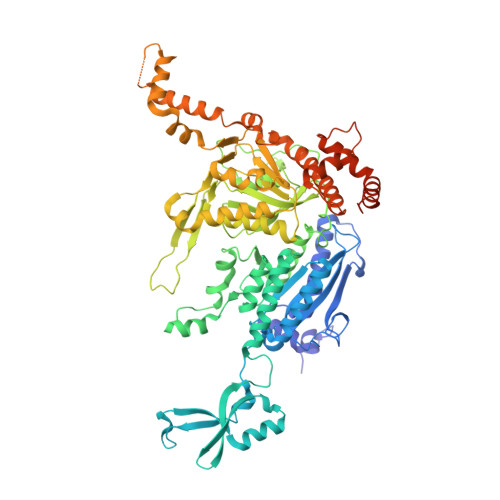
Crystal structure of the carboxyltransferase domain of acetyl-coenzyme A carboxylase in complex with tepraloxydim


Experimental Data Snapshot

  • Method: X-RAY DIFFRACTION
  • Resolution: 2.30 Å
  • R-Value Free: 
    0.221 (Depositor), 0.219 (DCC) 
  • R-Value Work: 
    0.187 (Depositor) 
  • R-Value Observed: 
    0.189 (Depositor) 

wwPDB Validation 3D Report Full Report

Validation slider image for 3K8X

Ligand Structure Quality Assessment 


This is version 1.2 of the entry. See complete history

Literature

A different mechanism for the inhibition of the carboxyltransferase domain of acetyl-coenzyme A carboxylase by tepraloxydim.

Xiang, S.Callaghan, M.M.Watson, K.G.Tong, L.

(2009) Proc Natl Acad Sci U S A 106: 20723-20727

  • DOI: https://doi.org/10.1073/pnas.0908431106
  • Primary Citation Related Structures: 
    3K8X

  • PubMed Abstract: 

    Acetyl-CoA carboxylases (ACCs) are crucial metabolic enzymes and are attractive targets for drug discovery. Haloxyfop and tepraloxydim belong to two distinct classes of commercial herbicides and kill sensitive plants by inhibiting the carboxyltransferase (CT) activity of ACC. Our earlier structural studies showed that haloxyfop is bound near the active site of the CT domain, at the interface of its dimer, and a large conformational change in the dimer interface is required for haloxyfop binding. We report here the crystal structure at 2.3 A resolution of the CT domain of yeast ACC in complex with tepraloxydim. The compound has a different mechanism of inhibiting the CT activity compared to haloxyfop, as well as the mammalian ACC inhibitor CP-640186. Tepraloxydim probes a different region of the dimer interface and requires only small but important conformational changes in the enzyme, in contrast to haloxyfop. The binding mode of tepraloxydim explains the structure-activity relationship of these inhibitors, and provides a molecular basis for their distinct sensitivity to some of the resistance mutations, as compared to haloxyfop. Despite the chemical diversity between haloxyfop and tepraloxydim, the compounds do share two binding interactions to the enzyme, which may be important anchoring points for the development of ACC inhibitors.


  • Organizational Affiliation
    • Department of Biological Sciences, Columbia University, New York, NY 10027, USA.

Macromolecule Content 

  • Total Structure Weight: 258.66 kDa 
  • Atom Count: 17,693 
  • Modeled Residue Count: 2,045 
  • Deposited Residue Count: 2,274 
  • Unique protein chains: 1

Macromolecules

Find similar proteins by:|  3D Structure
Entity ID: 1
MoleculeChains  Sequence LengthOrganismDetailsImage
Acetyl-CoA carboxylase
A, B, C
758Saccharomyces cerevisiaeMutation(s): 0 
Gene Names: ACC1ACETYL-COA CARBOXYLASEFAS3N3175YNR016C
EC: 6.4.1.2 (PDB Primary Data), 6.3.4.14 (PDB Primary Data)
UniProt
Find proteins for Q00955 (Saccharomyces cerevisiae (strain ATCC 204508 / S288c))
Explore Q00955 
Go to UniProtKB:  Q00955
Entity Groups
Sequence Clusters30% Identity50% Identity70% Identity90% Identity95% Identity100% Identity
UniProt GroupQ00955
Sequence Annotations
Expand
Reference Sequence

Small Molecules

Ligands 1 Unique
IDChains Name / Formula / InChI Key2D Diagram3D Interactions
B89

Query on B89


Download:Ideal Coordinates CCD File
D [auth A],
E [auth B],
F [auth C]
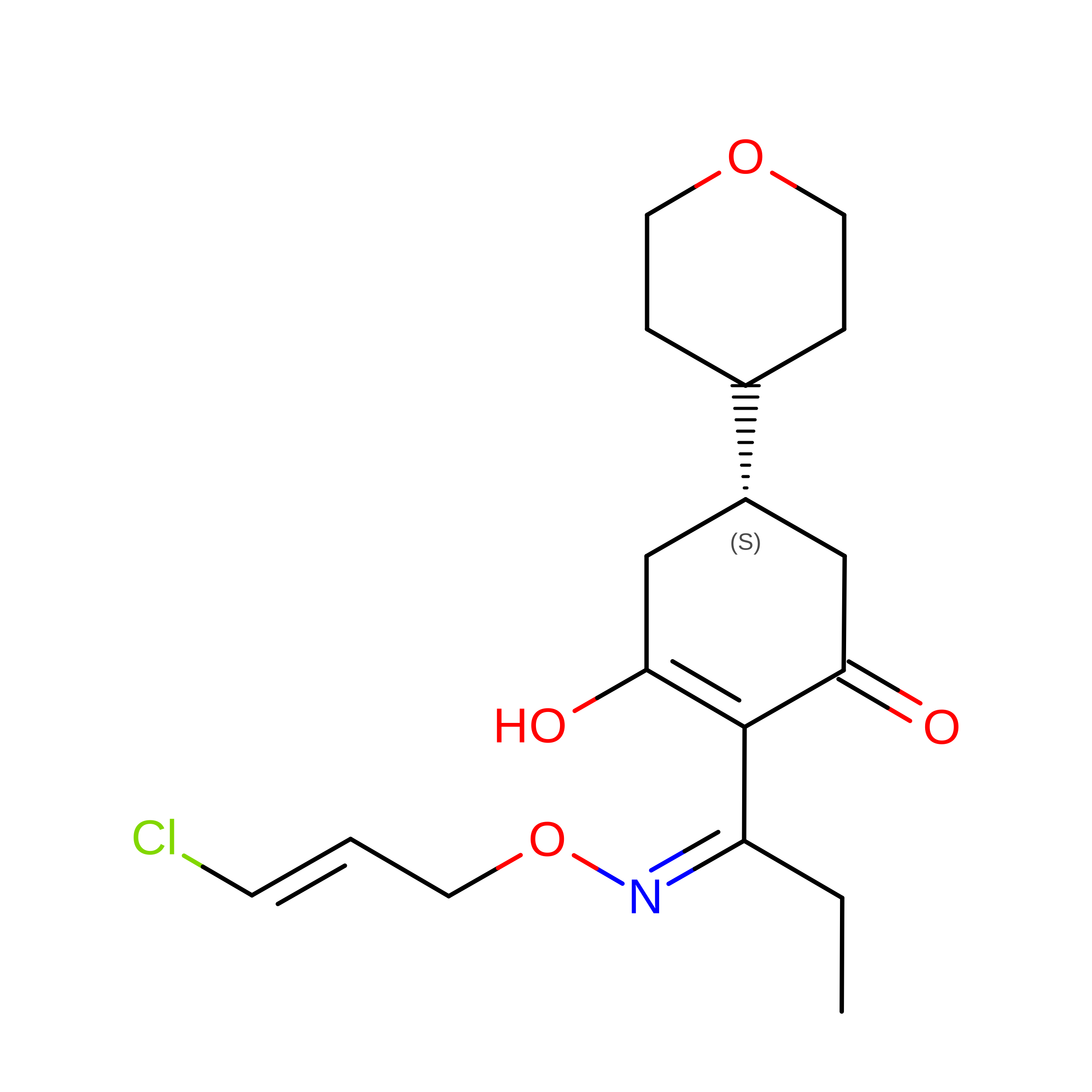
(5S)-2-[(1E)-N-{[(2E)-3-chloroprop-2-en-1-yl]oxy}propanimidoyl]-3-hydroxy-5-(tetrahydro-2H-pyran-4-yl)cyclohex-2-en-1-one
C17 H24 Cl N O4
IOYNQIMAUDJVEI-FGWLPLFYSA-N

Experimental Data & Validation

Experimental Data

  • Method: X-RAY DIFFRACTION
  • Resolution: 2.30 Å
  • R-Value Free:  0.221 (Depositor), 0.219 (DCC) 
  • R-Value Work:  0.187 (Depositor) 
  • R-Value Observed: 0.189 (Depositor) 
Space Group: C 1 2 1
Unit Cell:
Length ( Å )Angle ( ˚ )
a = 247.303α = 90
b = 124.797β = 94.32
c = 145.369γ = 90
Software Package:
Software NamePurpose
REFMACrefinement
PDB_EXTRACTdata extraction
CBASSdata collection
HKL-2000data reduction
SCALEPACKdata scaling

Structure Validation

View Full Validation Report


Ligand Structure Quality Assessment 


Entry History 

Deposition Data

Revision History  (Full details and data files)

  • Version 1.0: 2009-12-01
    Type: Initial release
  • Version 1.1: 2011-07-13
    Changes: Version format compliance
  • Version 1.2: 2024-02-21
    Changes: Data collection, Database references, Derived calculations