3JUX | pdb_00003jux

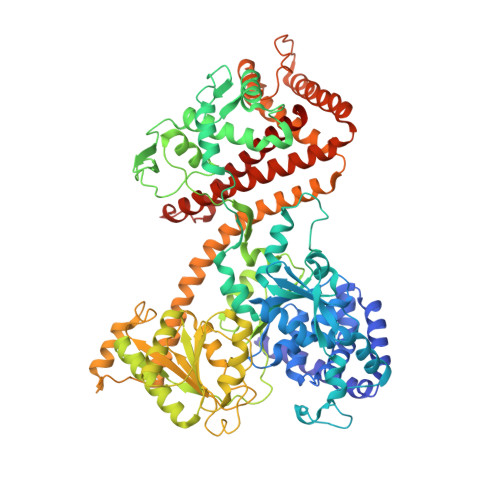
Structure of the translocation ATPase SecA from Thermotoga maritima


Experimental Data Snapshot

  • Method: X-RAY DIFFRACTION
  • Resolution: 3.10 Å
  • R-Value Free: 
    0.303 (Depositor), 0.300 (DCC) 
  • R-Value Work: 
    0.227 (Depositor), 0.223 (DCC) 

Starting Model: experimental
View more details

wwPDB Validation 3D Report Full Report

Validation slider image for 3JUX

Ligand Structure Quality Assessment 


This is version 1.2 of the entry. See complete history

Literature

Conformational flexibility and peptide interaction of the translocation ATPase SecA.

Zimmer, J.Rapoport, T.A.

(2009) J Mol Biology 394: 606-612

  • DOI: https://doi.org/10.1016/j.jmb.2009.10.024
  • Primary Citation Related Structures: 
    3JUX, 3JV2

  • PubMed Abstract: 

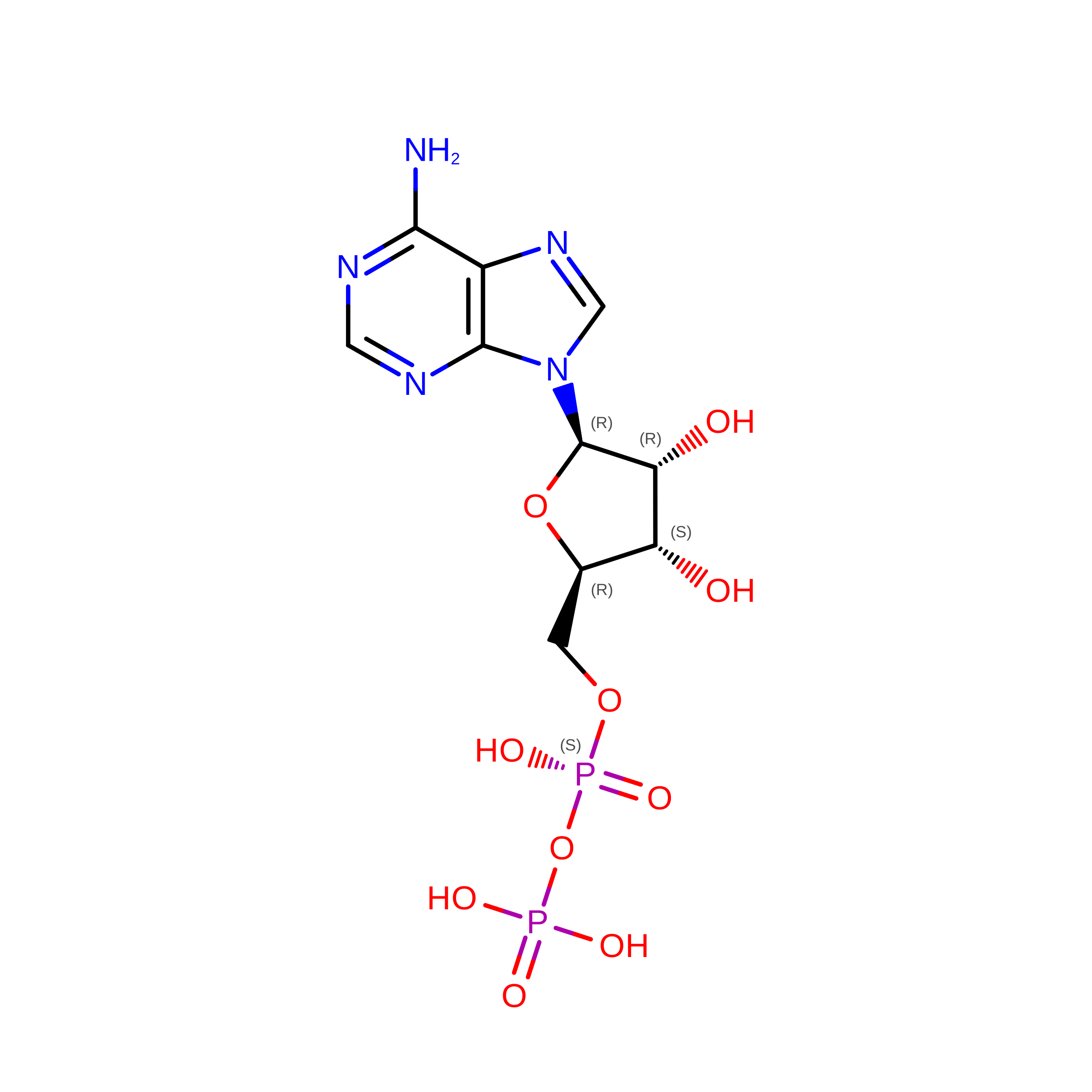
    The SecA ATPase forms a functional complex with the protein-conducting SecY channel to translocate polypeptides across the bacterial cell membrane. SecA recognizes the translocation substrate and catalyzes its unidirectional movement through the SecY channel. The recent crystal structure of the Thermotoga maritima SecA-SecYEG complex shows the ATPase in a conformation where the nucleotide-binding domains (NBDs) have closed around a bound ADP-BeFx complex and SecA's polypeptide-binding clamp is shut. Here, we present the crystal structure of T. maritima SecA in isolation, determined in its ADP-bound form at 3.1 A resolution. SecA alone has a drastically different conformation in which the nucleotide-binding pocket between NBD1 and NBD2 is open and the preprotein cross-linking domain has rotated away from both NBDs, thereby opening the polypeptide-binding clamp. To investigate how this clamp binds polypeptide substrates, we also determined a structure of Bacillus subtilis SecA in complex with a peptide at 2.5 A resolution. This structure shows that the peptide augments the highly conserved beta-sheet at the back of the clamp. Taken together, these structures suggest a mechanism by which ATP hydrolysis can lead to polypeptide translocation.


  • Organizational Affiliation
    • Howard Hughes Medical Institute and Department of Cell Biology, Harvard Medical School, 240 Longwood Avenue, Boston, MA 02115, USA.

Macromolecule Content 

  • Total Structure Weight: 95.38 kDa 
  • Atom Count: 6,619 
  • Modeled Residue Count: 813 
  • Deposited Residue Count: 822 
  • Unique protein chains: 1

Macromolecules

Find similar proteins by:|  3D Structure
Entity ID: 1
MoleculeChains  Sequence LengthOrganismDetailsImage
Protein translocase subunit secA822Thermotoga maritimaMutation(s): 0 
Gene Names: secATM_1578
EC: 7.4.2.8
UniProt
Find proteins for Q9X1R4 (Thermotoga maritima (strain ATCC 43589 / DSM 3109 / JCM 10099 / NBRC 100826 / MSB8))
Explore Q9X1R4 
Go to UniProtKB:  Q9X1R4
Entity Groups
Sequence Clusters30% Identity50% Identity70% Identity90% Identity95% Identity100% Identity
UniProt GroupQ9X1R4
Sequence Annotations
Expand
Reference Sequence

Small Molecules

Experimental Data & Validation

Experimental Data

  • Method: X-RAY DIFFRACTION
  • Resolution: 3.10 Å
  • R-Value Free:  0.303 (Depositor), 0.300 (DCC) 
  • R-Value Work:  0.227 (Depositor), 0.223 (DCC) 
Space Group: P 21 21 21
Unit Cell:
Length ( Å )Angle ( ˚ )
a = 64.533α = 90
b = 119.403β = 90
c = 120.82γ = 90
Software Package:
Software NamePurpose
HKL-2000data collection
PHASERphasing
REFMACrefinement
HKL-2000data reduction
HKL-2000data scaling

Structure Validation

View Full Validation Report


Ligand Structure Quality Assessment 


Entry History 

Deposition Data

  • Released Date: 2009-10-20 
  • Deposition Author(s): Zimmer, J.

Revision History  (Full details and data files)

  • Version 1.0: 2009-10-20
    Type: Initial release
  • Version 1.1: 2011-07-13
    Changes: Version format compliance
  • Version 1.2: 2023-09-06
    Changes: Data collection, Database references, Derived calculations, Refinement description