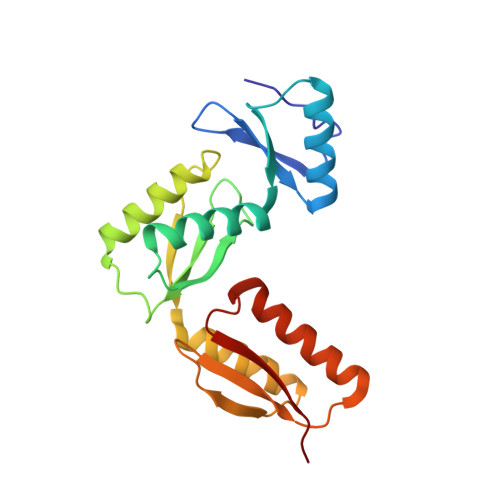
3J1X | pdb_00003j1x

A refined model of the prototypical Salmonella typhimurium T3SS basal body reveals the molecular basis for its assembly


Experimental Data Snapshot

  • Method: ELECTRON MICROSCOPY
  • Resolution: 11.7 Å
  • Aggregation State: PARTICLE 
  • Reconstruction Method: SINGLE PARTICLE 

Starting Model: experimental
View more details

wwPDB Validation 3D Report Full Report

Validation slider image for 3J1X

This is version 1.2 of the entry. See complete history

Literature

A Refined Model of the Prototypical Salmonella SPI-1 T3SS Basal Body Reveals the Molecular Basis for Its Assembly.

Bergeron, J.R.Worrall, L.J.Sgourakis, N.G.Dimaio, F.Pfuetzner, R.A.Felise, H.B.Vuckovic, M.Yu, A.C.Miller, S.I.Baker, D.Strynadka, N.C.

(2013) PLoS Pathog 9: e1003307-e1003307

  • DOI: https://doi.org/10.1371/journal.ppat.1003307
  • Primary Citation Related Structures: 
    3J1V, 3J1W, 3J1X, 4G08, 4G1I, 4G2S

  • PubMed Abstract: 

    The T3SS injectisome is a syringe-shaped macromolecular assembly found in pathogenic Gram-negative bacteria that allows for the direct delivery of virulence effectors into host cells. It is composed of a "basal body", a lock-nut structure spanning both bacterial membranes, and a "needle" that protrudes away from the bacterial surface. A hollow channel spans throughout the apparatus, permitting the translocation of effector proteins from the bacterial cytosol to the host plasma membrane. The basal body is composed largely of three membrane-embedded proteins that form oligomerized concentric rings. Here, we report the crystal structures of three domains of the prototypical Salmonella SPI-1 basal body, and use a new approach incorporating symmetric flexible backbone docking and EM data to produce a model for their oligomeric assembly. The obtained models, validated by biochemical and in vivo assays, reveal the molecular details of the interactions driving basal body assembly, and notably demonstrate a conserved oligomerization mechanism.


  • Organizational Affiliation
    • Department of Biochemistry and Molecular Biology, and Centre for Blood Research, University of British Columbia, Vancouver, British Columbia, Canada.

Macromolecule Content 

  • Total Structure Weight: 537.2 kDa 
  • Atom Count: 37,896 
  • Modeled Residue Count: 4,584 
  • Deposited Residue Count: 4,584 
  • Unique protein chains: 1

Macromolecules

Find similar proteins by:|  3D Structure
Entity ID: 1
MoleculeChains  Sequence LengthOrganismDetailsImage
Protein PrgH
A, B, C, D, E
A, B, C, D, E, F, G, H, I, J, K, L, M, N, O, P, Q, R, S, T, U, V, W, X
191Salmonella enterica subsp. enterica serovar TyphimuriumMutation(s): 0 
UniProt
Find proteins for P41783 (Salmonella typhimurium (strain LT2 / SGSC1412 / ATCC 700720))
Explore P41783 
Go to UniProtKB:  P41783
Entity Groups
Sequence Clusters30% Identity50% Identity70% Identity90% Identity95% Identity100% Identity
UniProt GroupP41783
Sequence Annotations
Expand
Reference Sequence

Experimental Data & Validation

Experimental Data

  • Method: ELECTRON MICROSCOPY
  • Resolution: 11.7 Å
  • Aggregation State: PARTICLE 
  • Reconstruction Method: SINGLE PARTICLE 
EM Software:
TaskSoftware PackageVersion
RECONSTRUCTIONIMAGIC

Structure Validation

View Full Validation Report


Entry History 

Deposition Data

Revision History  (Full details and data files)

  • Version 1.0: 2013-05-22
    Type: Initial release
  • Version 1.1: 2018-07-18
    Changes: Data collection
  • Version 1.2: 2024-02-21
    Changes: Data collection, Database references, Refinement description