3J15 | pdb_00003j15

Model of ribosome-bound archaeal Pelota and ABCE1


Experimental Data Snapshot

  • Method: ELECTRON MICROSCOPY
  • Resolution: 6.60 Å
  • Aggregation State: PARTICLE 
  • Reconstruction Method: SINGLE PARTICLE 

wwPDB Validation 3D Report Full Report

Validation slider image for 3J15

This is version 1.8 of the entry. See complete history

Literature

Structural basis of highly conserved ribosome recycling in eukaryotes and archaea.

Becker, T.Franckenberg, S.Wickles, S.Shoemaker, C.J.Anger, A.M.Armache, J.-P.Sieber, H.Ungewickell, C.Berninghausen, O.Daberkow, I.Karcher, A.Thomm, M.Hopfner, K.P.Green, R.Beckmann, R.

(2012) Nature 482: 501-506

  • DOI: https://doi.org/10.1038/nature10829
  • Primary Citation Related Structures: 
    3J15, 3J16

  • PubMed Abstract: 

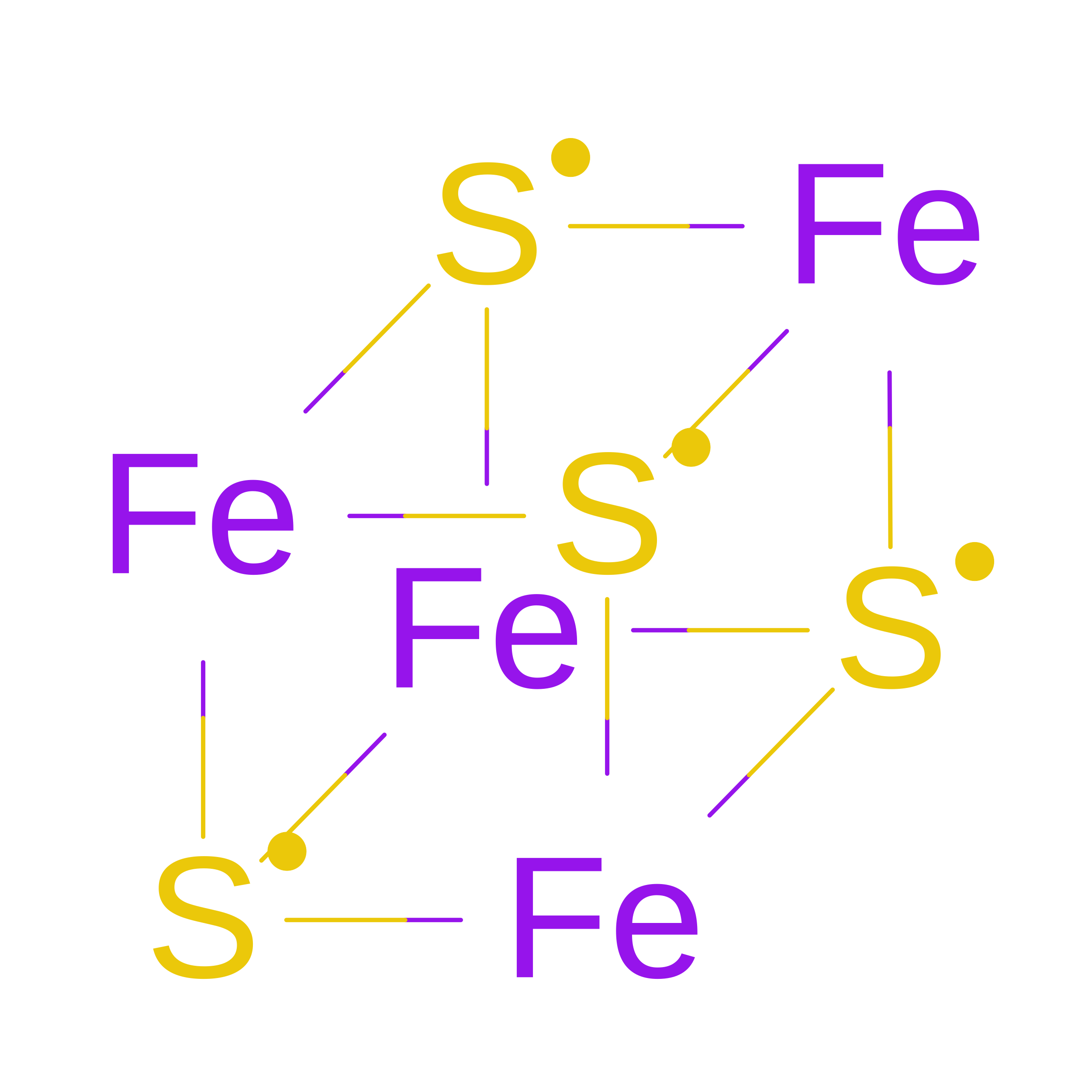
    Ribosome-driven protein biosynthesis is comprised of four phases: initiation, elongation, termination and recycling. In bacteria, ribosome recycling requires ribosome recycling factor and elongation factor G, and several structures of bacterial recycling complexes have been determined. In the eukaryotic and archaeal kingdoms, however, recycling involves the ABC-type ATPase ABCE1 and little is known about its structural basis. Here we present cryo-electron microscopy reconstructions of eukaryotic and archaeal ribosome recycling complexes containing ABCE1 and the termination factor paralogue Pelota. These structures reveal the overall binding mode of ABCE1 to be similar to canonical translation factors. Moreover, the iron-sulphur cluster domain of ABCE1 interacts with and stabilizes Pelota in a conformation that reaches towards the peptidyl transferase centre, thus explaining how ABCE1 may stimulate peptide-release activity of canonical termination factors. Using the mechanochemical properties of ABCE1, a conserved mechanism in archaea and eukaryotes is suggested that couples translation termination to recycling, and eventually to re-initiation.


  • Organizational Affiliation
    • Gene Center and Center for integrated Protein Science Munich, Department of Biochemistry, University of Munich, Feodor-Lynen-Straße 25, 81377 Munich, Germany. becker@lmb.uni-muenchen.de

Macromolecule Content 

  • Total Structure Weight: 109.52 kDa 
  • Atom Count: 7,660 
  • Modeled Residue Count: 950 
  • Deposited Residue Count: 950 
  • Unique protein chains: 2

Macromolecules

Find similar proteins by:|  3D Structure
Entity ID: 1
MoleculeChains  Sequence LengthOrganismDetailsImage
Protein pelota357Thermococcus kodakarensisMutation(s): 0 
Gene Names: pelATK0964
EC: 3.1
UniProt
Find proteins for Q5JIB9 (Thermococcus kodakarensis (strain ATCC BAA-918 / JCM 12380 / KOD1))
Explore Q5JIB9 
Go to UniProtKB:  Q5JIB9
Entity Groups
Sequence Clusters30% Identity50% Identity70% Identity90% Identity95% Identity100% Identity
UniProt GroupQ5JIB9
Sequence Annotations
Expand
Reference Sequence
Find similar proteins by:|  3D Structure
Entity ID: 2
MoleculeChains  Sequence LengthOrganismDetailsImage
ABC transporter ATP-binding protein593Pyrococcus furiosusMutation(s): 0 

Experimental Data & Validation

Experimental Data

  • Method: ELECTRON MICROSCOPY
  • Resolution: 6.60 Å
  • Aggregation State: PARTICLE 
  • Reconstruction Method: SINGLE PARTICLE 
EM Software:
TaskSoftware PackageVersion
RECONSTRUCTIONSPIDER

Structure Validation

View Full Validation Report


Entry History 

Revision History  (Full details and data files)

  • Version 1.0: 2012-02-22
    Type: Initial release
  • Version 1.1: 2012-02-29
    Changes: Database references
  • Version 1.2: 2012-03-28
    Changes: Database references
  • Version 1.3: 2012-04-18
    Changes: Database references
  • Version 1.4: 2014-07-23
    Changes: Other
  • Version 1.5: 2017-09-06
    Changes: Data collection
  • Version 1.6: 2018-07-18
    Changes: Data collection
  • Version 1.7: 2018-08-22
    Changes: Data collection, Database references, Source and taxonomy, Structure summary
  • Version 1.8: 2024-10-30
    Changes: Data collection, Database references, Derived calculations, Structure summary