3IU4 | pdb_00003iu4

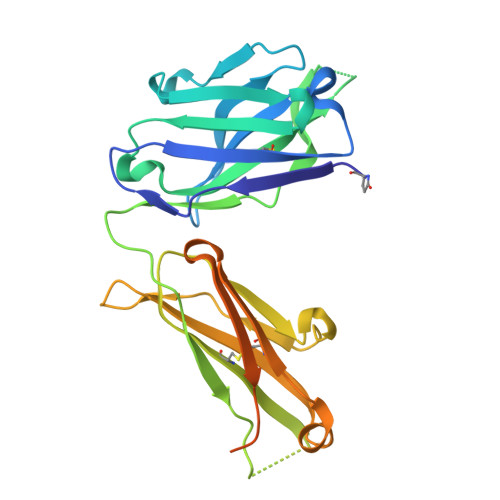
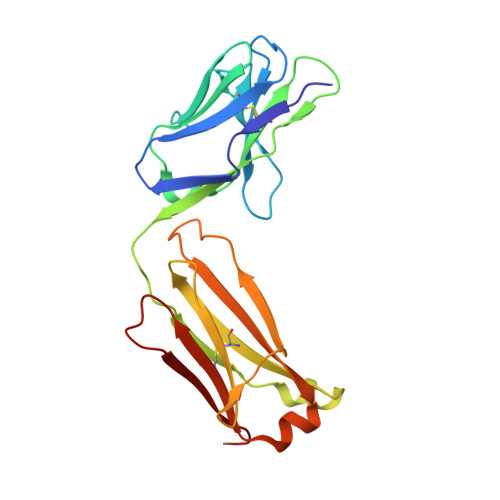
anti NeuGcGM3 ganglioside chimeric antibody chP3


Experimental Data Snapshot

  • Method: X-RAY DIFFRACTION
  • Resolution: 1.75 Å
  • R-Value Free: 
    0.234 (Depositor), 0.227 (DCC) 
  • R-Value Work: 
    0.194 (Depositor), 0.190 (DCC) 
  • R-Value Observed: 
    0.196 (Depositor) 

Starting Model: experimental
View more details

wwPDB Validation 3D Report Full Report

Validation slider image for 3IU4

This is version 2.2 of the entry. See complete history

Literature

Crystal structure of an anti-ganglioside antibody, and modelling of the functional mimicry of its NeuGc-GM3 antigen by an anti-idiotypic antibody.

Talavera, A.Eriksson, A.Okvist, M.Lopez-Requena, A.Fernandez-Marrero, Y.Perez, R.Moreno, E.Krengel, U.

(2009) Mol Immunol 46: 3466-3475

  • DOI: https://doi.org/10.1016/j.molimm.2009.07.032
  • Primary Citation Related Structures: 
    3IU4

  • PubMed Abstract: 

    N-Glycolylated (NeuGc) gangliosides are tumor-specific antigens and as such represent attractive targets for cancer immunotherapy. The chimeric antibody chP3 selectively recognizes a broad variety of NeuGc gangliosides, showing no cross-reactivity to the highly similar N-acetylated (NeuAc) gangliosides that are common cellular antigens in humans. Here, we report the crystal structure of the chP3 Fab and its computer-docking model with the trisaccharide NeuGcalpha3Galbeta4Glcbeta, which represents the carbohydrate moiety of the tumor-antigen NeuGc-GM3. The interaction involves only the heavy chain of the chP3 antibody. The modelled complex is consistent with all available experimental data and shows good surface complementarity. The negatively charged sialic acid residue NeuGc is buried in a pocket flanked by two arginine residues, VH Arg31 and VH Arg100A. We have further investigated the interaction of chP3 with its anti-idiotypic antibody, 1E10 (also known as Racotumomab), currently in clinical trials as a cancer vaccine. While many of the chP3 residues predicted to interact with the NeuGc ganglioside also feature prominently in the modelled complex of chP3 and 1E10, we do not observe structural mimicry. Rather, we suspect that the anti-idiotype 1E10 may serve as an imprint of the structural characteristics of the chP3 idiotype and, consequently, give rise to antibodies with P3-like properties upon immunization.


  • Organizational Affiliation
    • Center of Molecular Immunology, Havana, Cuba.

Macromolecule Content 

  • Total Structure Weight: 51.72 kDa 
  • Atom Count: 3,789 
  • Modeled Residue Count: 429 
  • Deposited Residue Count: 476 
  • Unique protein chains: 2

Macromolecules

Find similar proteins by:|  3D Structure
Entity ID: 1
MoleculeChains  Sequence LengthOrganismDetailsImage
chP3 Fab heavy chainA [auth H]263Mus musculusHomo sapiens
This entity is chimeric
Mutation(s): 0 
Find similar proteins by:|  3D Structure
Entity ID: 2
MoleculeChains  Sequence LengthOrganismDetailsImage
chP3 Fab light chainB [auth L]213Mus musculusHomo sapiens
This entity is chimeric
Mutation(s): 0 

Experimental Data & Validation

Experimental Data

  • Method: X-RAY DIFFRACTION
  • Resolution: 1.75 Å
  • R-Value Free:  0.234 (Depositor), 0.227 (DCC) 
  • R-Value Work:  0.194 (Depositor), 0.190 (DCC) 
  • R-Value Observed: 0.196 (Depositor) 
Space Group: I 4 2 2
Unit Cell:
Length ( Å )Angle ( ˚ )
a = 153.45α = 90
b = 153.45β = 90
c = 111.48γ = 90
Software Package:
Software NamePurpose
ADSCdata collection
MOLREPphasing
REFMACrefinement
MOSFLMdata reduction
SCALAdata scaling

Structure Validation

View Full Validation Report


Entry History 

Deposition Data

Revision History  (Full details and data files)

  • Version 1.0: 2009-12-08
    Type: Initial release
  • Version 1.1: 2011-07-13
    Changes: Version format compliance
  • Version 2.0: 2019-12-25
    Changes: Derived calculations, Polymer sequence
  • Version 2.1: 2023-09-06
    Changes: Data collection, Database references, Derived calculations, Refinement description
  • Version 2.2: 2024-11-20
    Changes: Structure summary