3ID0 | pdb_00003id0

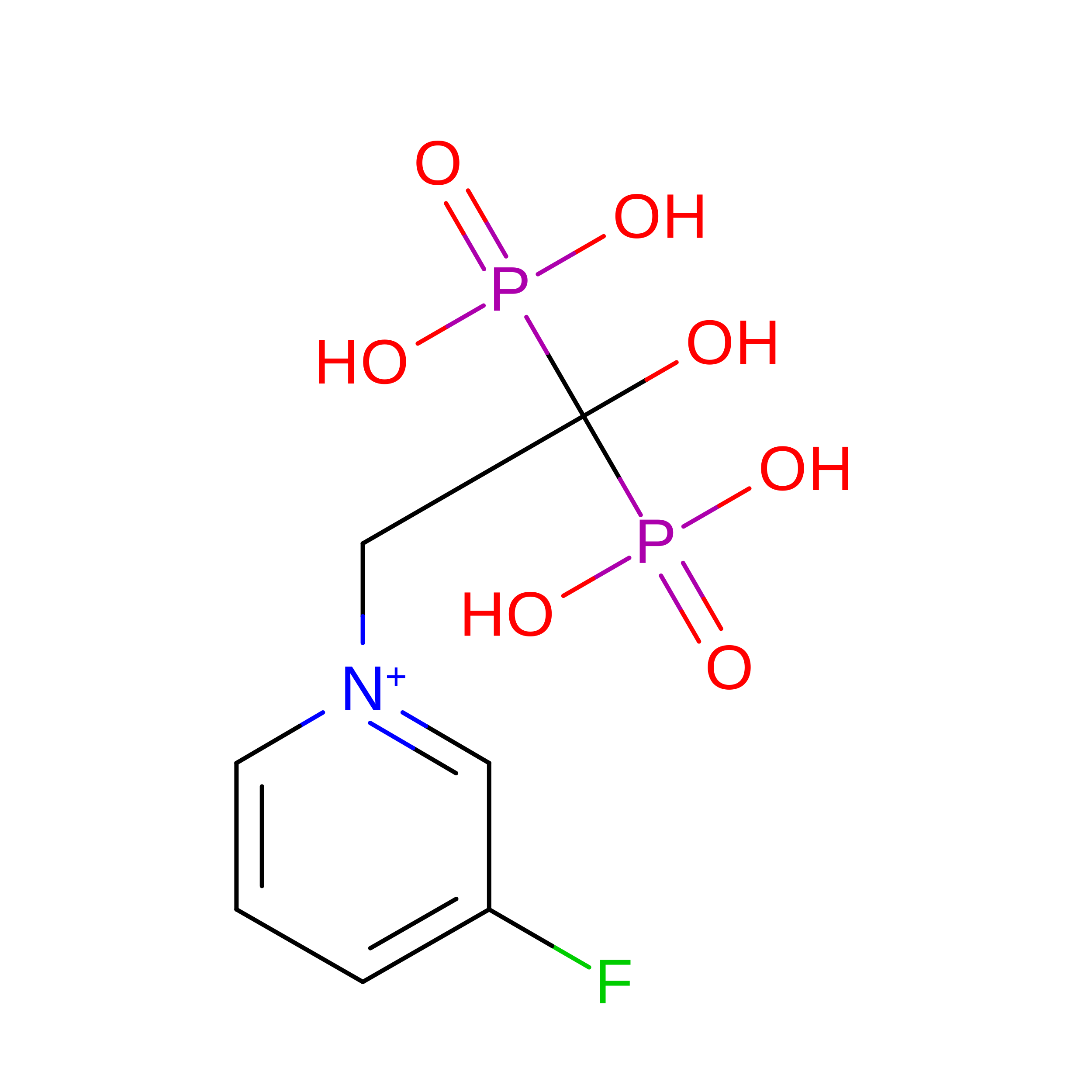
Trypanosoma cruzi farnesyl diphosphate synthase homodimer in complex with 3-Fluoro-1-(2-hydroxy-2,2-bisphosphono-ethyl)pyridinium


Experimental Data Snapshot

  • Method: X-RAY DIFFRACTION
  • Resolution: 2.81 Å
  • R-Value Free: 
    0.280 (Depositor), 0.273 (DCC) 
  • R-Value Work: 
    0.217 (Depositor), 0.209 (DCC) 
  • R-Value Observed: 
    0.220 (Depositor) 

wwPDB Validation 3D Report Full Report

Validation slider image for 3ID0

Ligand Structure Quality Assessment 


This is version 1.3 of the entry. See complete history

Literature

Binding of nitrogen-containing bisphosphonates (N-BPs) to the Trypanosoma cruzi farnesyl diphosphate synthase homodimer.

Huang, C.H.Gabelli, S.B.Oldfield, E.Amzel, L.M.

(2010) Proteins 78: 888-899

  • DOI: https://doi.org/10.1002/prot.22614
  • Primary Citation Related Structures: 
    3IBA, 3ICK, 3ICM, 3ICN, 3ICZ, 3ID0

  • PubMed Abstract: 

    Bisphosphonates (BPs) are a class of compounds that have been used extensively in the treatment of osteoporosis and malignancy-related hypercalcemia. Some of these compounds act through inhibition of farnesyl diphosphate synthase (FPPS), a key enzyme in the synthesis of isoprenoids. Recently, nitrogen-containing bisphosphonates (N-BPs) used in bone resorption therapy have been shown to be active against Trypanosoma cruzi, the parasite that causes American trypanosomiasis (Chagas disease), suggesting that they may be used as anti-trypanosomal agents. The crystal structures of TcFPPS in complex with substrate (isopentenyl diphosphate, IPP) and five N-BP inhibitors show that the C-1 hydroxyl and the nitrogen-containing groups of the inhibitors alter the binding of IPP and the conformation of two TcFPPS residues, Tyr94 and Gln167. Isothermal titration calorimetry experiments suggest that binding of the first N-BPs to the homodimeric TcFPPS changes the binding properties of the second site. This mechanism of binding of N-BPs to TcFPPS is different to that reported for the binding of the same compounds to human FPPS. Proteins 2010. (c) 2009 Wiley-Liss, Inc.


  • Organizational Affiliation
    • Department of Biophysics and Biophysical Chemistry, Johns Hopkins University School of Medicine, Baltimore, Maryland 21205, USA.

Macromolecule Content 

  • Total Structure Weight: 41.79 kDa 
  • Atom Count: 2,961 
  • Modeled Residue Count: 362 
  • Deposited Residue Count: 362 
  • Unique protein chains: 1

Macromolecules

Find similar proteins by:|  3D Structure
Entity ID: 1
MoleculeChains  Sequence LengthOrganismDetailsImage
Farnesyl pyrophosphate synthase362Trypanosoma cruziMutation(s): 0 
Gene Names: FPPS
EC: 2.5.1.10
UniProt
Find proteins for Q8WS25 (Trypanosoma cruzi)
Explore Q8WS25 
Go to UniProtKB:  Q8WS25
Entity Groups
Sequence Clusters30% Identity50% Identity70% Identity90% Identity95% Identity100% Identity
UniProt GroupQ8WS25
Sequence Annotations
Expand
Reference Sequence

Experimental Data & Validation

Experimental Data

  • Method: X-RAY DIFFRACTION
  • Resolution: 2.81 Å
  • R-Value Free:  0.280 (Depositor), 0.273 (DCC) 
  • R-Value Work:  0.217 (Depositor), 0.209 (DCC) 
  • R-Value Observed: 0.220 (Depositor) 
Space Group: P 61 2 2
Unit Cell:
Length ( Å )Angle ( ˚ )
a = 58.197α = 90
b = 58.197β = 90
c = 390.223γ = 120
Software Package:
Software NamePurpose
DENZOdata reduction
SCALEPACKdata scaling
REFMACrefinement
PDB_EXTRACTdata extraction

Structure Validation

View Full Validation Report


Ligand Structure Quality Assessment 


Entry History 

Deposition Data

Revision History  (Full details and data files)

  • Version 1.0: 2010-02-09
    Type: Initial release
  • Version 1.1: 2011-07-13
    Changes: Version format compliance
  • Version 1.2: 2017-11-01
    Changes: Refinement description
  • Version 1.3: 2024-02-21
    Changes: Data collection, Database references, Derived calculations