3HZU | pdb_00003hzu

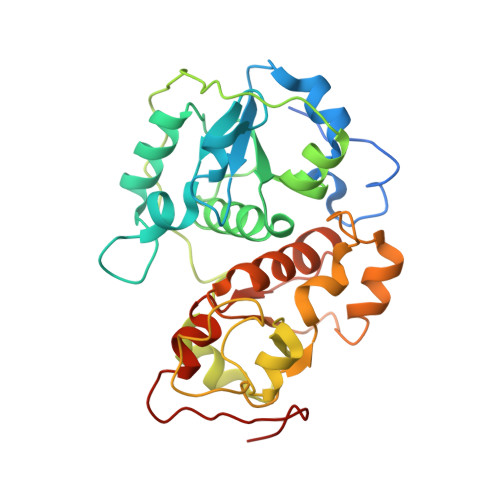
Crystal structure of probable thiosulfate sulfurtransferase SSEA (rhodanese) from Mycobacterium tuberculosis


Experimental Data Snapshot

  • Method: X-RAY DIFFRACTION
  • Resolution: 2.10 Å
  • R-Value Free: 
    0.249 (Depositor), 0.244 (DCC) 
  • R-Value Work: 
    0.205 (Depositor), 0.207 (DCC) 
  • R-Value Observed: 
    0.208 (Depositor) 

Starting Model: experimental
View more details

wwPDB Validation 3D Report Full Report

Validation slider image for 3HZU

This is version 1.5 of the entry. See complete history

Literature

Mycobacterium thermoresistibile as a source of thermostable orthologs of Mycobacterium tuberculosis proteins.

Edwards, T.E.Liao, R.Phan, I.Myler, P.J.Grundner, C.

(2012) Protein Sci 21: 1093-1096

  • DOI: https://doi.org/10.1002/pro.2084
  • Primary Citation Related Structures: 
    3HZU, 3P3A

  • PubMed Abstract: 

    The genus Mycobacterium comprises major human pathogens such as the causative agent of tuberculosis, Mycobacterium tuberculosis (Mtb), and many environmental species. Tuberculosis claims ~1.5 million lives every year, and drug resistant strains of Mtb are rapidly emerging. To aid the development of new tuberculosis drugs, major efforts are currently under way to determine crystal structures of Mtb drug targets and proteins involved in pathogenicity. However, a major obstacle to obtaining crystal structures is the generation of well-diffracting crystals. Proteins from thermophiles can have better crystallization and diffraction properties than proteins from mesophiles, but their sequences and structures are often divergent. Here, we establish a thermophilic mycobacterial model organism, Mycobacterium thermoresistibile (Mth), for the study of Mtb proteins. Mth tolerates higher temperatures than Mtb or other environmental mycobacteria such as M. smegmatis. Mth proteins are on average more soluble than Mtb proteins, and comparison of the crystal structures of two pairs of orthologous proteins reveals nearly identical folds, indicating that Mth structures provide good surrogates for Mtb structures. This study introduces a thermophile as a source of protein for the study of a closely related human pathogen and marks a new approach to solving challenging mycobacterial protein structures.


  • Organizational Affiliation
    • Emerald BioStructures, Bainbridge Island, Washington 98110, USA.

Macromolecule Content 

  • Total Structure Weight: 35.84 kDa 
  • Atom Count: 2,478 
  • Modeled Residue Count: 292 
  • Deposited Residue Count: 318 
  • Unique protein chains: 1

Macromolecules

Find similar proteins by:|  3D Structure
Entity ID: 1
MoleculeChains  Sequence LengthOrganismDetailsImage
Thiosulfate sulfurtransferase sseA318Mycobacterium tuberculosisMutation(s): 0 
Gene Names: sseARv3283MT3382MTCY71.23
EC: 2.8.1.1
UniProt
Find proteins for P9WHF7 (Mycobacterium tuberculosis (strain ATCC 25618 / H37Rv))
Explore P9WHF7 
Go to UniProtKB:  P9WHF7
Entity Groups
Sequence Clusters30% Identity50% Identity70% Identity90% Identity95% Identity100% Identity
UniProt GroupP9WHF7
Sequence Annotations
Expand
Reference Sequence

Experimental Data & Validation

Experimental Data

  • Method: X-RAY DIFFRACTION
  • Resolution: 2.10 Å
  • R-Value Free:  0.249 (Depositor), 0.244 (DCC) 
  • R-Value Work:  0.205 (Depositor), 0.207 (DCC) 
  • R-Value Observed: 0.208 (Depositor) 
Space Group: P 21 21 2
Unit Cell:
Length ( Å )Angle ( ˚ )
a = 90.73α = 90
b = 88.327β = 90
c = 36.794γ = 90
Software Package:
Software NamePurpose
DENZOdata reduction
SCALEPACKdata scaling
MOLREPphasing
REFMACrefinement
PDB_EXTRACTdata extraction
HKL-2000data reduction
HKL-2000data scaling

Structure Validation

View Full Validation Report


Entry History 

Deposition Data

Revision History  (Full details and data files)

  • Version 1.0: 2009-07-07
    Type: Initial release
  • Version 1.1: 2011-07-13
    Changes: Non-polymer description, Version format compliance
  • Version 1.2: 2012-06-27
    Changes: Database references
  • Version 1.3: 2015-04-22
    Changes: Database references
  • Version 1.4: 2017-11-01
    Changes: Refinement description
  • Version 1.5: 2023-09-06
    Changes: Data collection, Database references, Derived calculations, Refinement description