3GQ1 | pdb_00003gq1

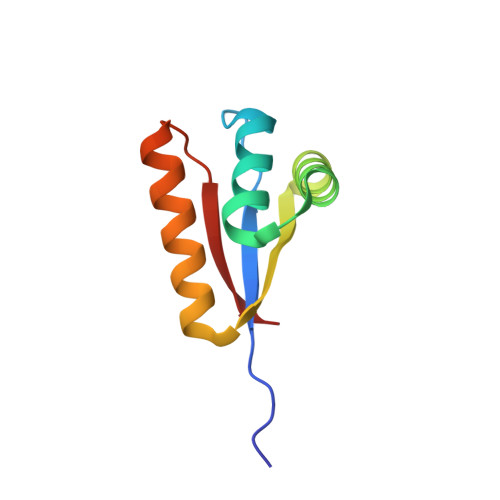
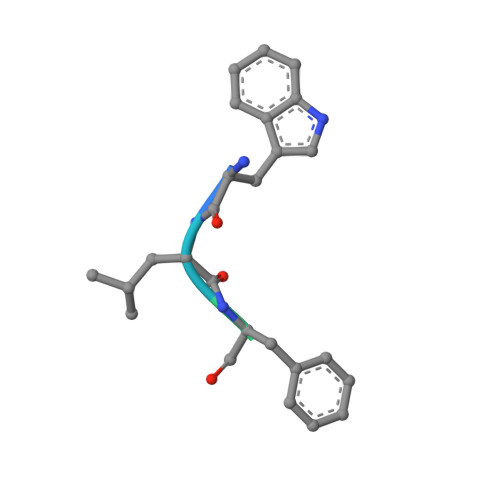
The structure of the caulobacter crescentus clpS protease adaptor protein in complex with a WLFVQRDSKE decapeptide


Experimental Data Snapshot

  • Method: X-RAY DIFFRACTION
  • Resolution: 1.50 Å
  • R-Value Free: 
    0.180 (Depositor), 0.172 (DCC) 
  • R-Value Work: 
    0.160 (Depositor), 0.146 (DCC) 
  • R-Value Observed: 
    0.161 (Depositor) 

wwPDB Validation 3D Report Full Report

Validation slider image for 3GQ1

This is version 1.3 of the entry. See complete history

Literature

Molecular basis of substrate selection by the N-end rule adaptor protein ClpS.

Roman-Hernandez, G.Grant, R.A.Sauer, R.T.Baker, T.A.

(2009) Proc Natl Acad Sci U S A 106: 8888-8893

  • DOI: https://doi.org/10.1073/pnas.0903614106
  • Primary Citation Related Structures: 
    3G19, 3G1B, 3GQ0, 3GQ1, 3GW1

  • PubMed Abstract: 

    The N-end rule is a conserved degradation pathway that relates the stability of a protein to its N-terminal amino acid. Here, we present crystal structures of ClpS, the bacterial N-end rule adaptor, alone and engaged with peptides containing N-terminal phenylalanine, leucine, and tryptophan. These structures, together with a previous structure of ClpS bound to an N-terminal tyrosine, illustrate the molecular basis of recognition of the complete set of primary N-end rule amino acids. In each case, the alpha-amino group and side chain of the N-terminal residue are the major determinants of recognition. The binding pocket for the N-end residue is preformed in the free adaptor, and only small adjustments are needed to accommodate N-end rule residues having substantially different sizes and shapes. M53A ClpS is known to mediate degradation of an expanded repertoire of substrates, including those with N-terminal valine or isoleucine. A structure of Met53A ClpS engaged with an N-end rule tryptophan reveals an essentially wild-type mechanism of recognition, indicating that the Met(53) side chain directly enforces specificity by clashing with and excluding beta-branched side chains. Finally, experimental and structural data suggest mechanisms that make proteins with N-terminal methionine bind very poorly to ClpS, explaining why these high-abundance proteins are not degraded via the N-end rule pathway in the cell.


  • Organizational Affiliation
    • Department of Biology, Massachusetts Institute of Technology, Cambridge, MA 02139, USA.

Macromolecule Content 

  • Total Structure Weight: 22.53 kDa 
  • Atom Count: 1,721 
  • Modeled Residue Count: 176 
  • Deposited Residue Count: 190 
  • Unique protein chains: 2

Macromolecules

Find similar proteins by:|  3D Structure
Entity ID: 1
MoleculeChains  Sequence LengthOrganismDetailsImage
ATP-dependent Clp protease adapter protein clpS
A, B
85Caulobacter vibrioidesMutation(s): 0 
Gene Names: CC_2467clpS
UniProt
Find proteins for Q9A5I0 (Caulobacter vibrioides (strain ATCC 19089 / CIP 103742 / CB 15))
Explore Q9A5I0 
Go to UniProtKB:  Q9A5I0
Entity Groups
Sequence Clusters30% Identity50% Identity70% Identity90% Identity95% Identity100% Identity
UniProt GroupQ9A5I0
Sequence Annotations
Expand
Reference Sequence
Find similar proteins by:  Sequence   |   3D Structure  
Entity ID: 2
MoleculeChains  Sequence LengthOrganismDetailsImage
WLFVQRDSKE peptide
C, D
10N/AMutation(s): 0 

Small Molecules

Ligands 1 Unique
IDChains Name / Formula / InChI Key2D Diagram3D Interactions
MG

Query on MG


Download:Ideal Coordinates CCD File
E [auth A]MAGNESIUM ION
Mg
JLVVSXFLKOJNIY-UHFFFAOYSA-N

Experimental Data & Validation

Experimental Data

  • Method: X-RAY DIFFRACTION
  • Resolution: 1.50 Å
  • R-Value Free:  0.180 (Depositor), 0.172 (DCC) 
  • R-Value Work:  0.160 (Depositor), 0.146 (DCC) 
  • R-Value Observed: 0.161 (Depositor) 
Space Group: P 1 21 1
Unit Cell:
Length ( Å )Angle ( ˚ )
a = 33.533α = 90
b = 53.905β = 110.33
c = 45.039γ = 90
Software Package:
Software NamePurpose
DENZOdata reduction
SCALEPACKdata scaling
PHASERphasing
PHENIXrefinement
PDB_EXTRACTdata extraction
HKL-2000data collection

Structure Validation

View Full Validation Report


Entry History 

Deposition Data

Revision History  (Full details and data files)

  • Version 1.0: 2009-05-05
    Type: Initial release
  • Version 1.1: 2011-07-13
    Changes: Version format compliance
  • Version 1.2: 2017-11-01
    Changes: Advisory, Refinement description
  • Version 1.3: 2024-02-21
    Changes: Advisory, Data collection, Database references, Derived calculations