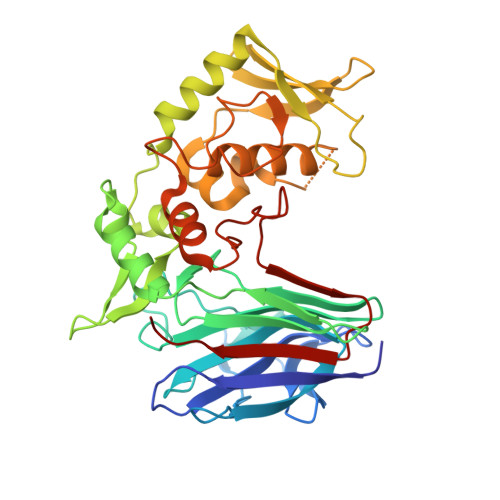
3GD9 | pdb_00003gd9

Crystal structure of laminaripentaose-producing beta-1,3-glucanase in complex with laminaritetraose


Experimental Data Snapshot

  • Method: X-RAY DIFFRACTION
  • Resolution: 1.80 Å
  • R-Value Free: 
    0.217 (Depositor), 0.218 (DCC) 
  • R-Value Work: 
    0.166 (Depositor), 0.170 (DCC) 
  • R-Value Observed: 
    0.172 (Depositor) 

Starting Model: experimental
View more details

wwPDB Validation 3D Report Full Report

Validation slider image for 3GD9

This is version 2.1 of the entry. See complete history

Literature

Structure, mechanistic action, and essential residues of a GH-64 enzyme, laminaripentaose-producing beta-1,3-glucanase.

Wu, H.M.Liu, S.W.Hsu, M.T.Hung, C.L.Lai, C.C.Cheng, W.C.Wang, H.J.Li, Y.K.Wang, W.C.

(2009) J Biological Chem 284: 26708-26715

  • DOI: https://doi.org/10.1074/jbc.M109.010983
  • Primary Citation Related Structures: 
    3GD0, 3GD9

  • PubMed Abstract: 

    Laminaripentaose-producing beta-1,3-glucanase (LPHase), a member of glycoside hydrolase family 64, cleaves a long-chain polysaccharide beta-1,3-glucan into specific pentasaccharide oligomers. The crystal structure of LPHase from Streptomyces matensis DIC-108 was solved to 1.62 A resolution using multiple-wavelength anomalous dispersion methods. The LPHase structure reveals a novel crescent-like fold; it consists of a barrel domain and a mixed (alpha/beta) domain, forming a wide-open groove between the two domains. The liganded crystal structure was also solved to 1.80 A, showing limited conformational changes. Within the wide groove, a laminaritetraose molecule is found to sit in an electronegatively charged central region and is proximal to several conserved residues including two carboxylates (Glu(154) and Asp(170)) and four other sugar-binding residues (Thr(156), Asn(158), Trp(163), and Thr(167)). Molecular modeling using a laminarihexaose as a substrate suggests roles for Glu(154) and Asp(170) as acid and base catalysts, respectively, whereas the side chains of Thr(156), Asn(158), and Trp(163) demarcate subsite +5. Site-directed mutagenesis of Glu(154) and Asp(170) confirms that both carboxylates are essential for catalysis. Together, our results suggest that LPHase uses a direct displacement mechanism involving Glu(154) and Asp(170) to cleave a beta-1,3-glucan into specific alpha-pentasaccharide oligomers.


  • Organizational Affiliation
    • Department of Life Science, Institute of Molecular and Cellular Biology, National Tsing Hua University, Hsinchu 300, Taiwan.

Macromolecule Content 

  • Total Structure Weight: 40.26 kDa 
  • Atom Count: 3,454 
  • Modeled Residue Count: 362 
  • Deposited Residue Count: 367 
  • Unique protein chains: 1

Macromolecules

Find similar proteins by:|  3D Structure
Entity ID: 1
MoleculeChains  Sequence LengthOrganismDetailsImage
Laminaripentaose-producing beta-1,3-guluase (LPHase)367Streptomyces matensisMutation(s): 0 
Gene Names: LPHase
EC: 3.2.1.39
UniProt
Find proteins for Q9Z4I2 (Streptomyces matensis)
Explore Q9Z4I2 
Go to UniProtKB:  Q9Z4I2
Entity Groups
Sequence Clusters30% Identity50% Identity70% Identity90% Identity95% Identity100% Identity
UniProt GroupQ9Z4I2
Sequence Annotations
Expand
Reference Sequence

Oligosaccharides

Help  
Entity ID: 2
MoleculeChains Length2D Diagram GlycosylationD Interactions
beta-D-glucopyranose-(1-3)-beta-D-glucopyranose-(1-3)-beta-D-glucopyranose-(1-3)-alpha-D-glucopyranose
B
4N/A
Glycosylation Resources
GlyTouCan: G38015EF
GlyCosmos: G38015EF
GlyGen: G38015EF

Experimental Data & Validation

Experimental Data

  • Method: X-RAY DIFFRACTION
  • Resolution: 1.80 Å
  • R-Value Free:  0.217 (Depositor), 0.218 (DCC) 
  • R-Value Work:  0.166 (Depositor), 0.170 (DCC) 
  • R-Value Observed: 0.172 (Depositor) 
Space Group: P 21 21 21
Unit Cell:
Length ( Å )Angle ( ˚ )
a = 45.981α = 90
b = 60.352β = 90
c = 149.118γ = 90
Software Package:
Software NamePurpose
HKL-2000data collection
MOLREPphasing
REFMACrefinement
HKL-2000data reduction
HKL-2000data scaling

Structure Validation

View Full Validation Report


Entry History 

Deposition Data

Revision History  (Full details and data files)

  • Version 1.0: 2009-07-28
    Type: Initial release
  • Version 1.1: 2011-07-13
    Changes: Version format compliance
  • Version 2.0: 2020-07-29
    Type: Remediation
    Reason: Carbohydrate remediation
    Changes: Advisory, Atomic model, Data collection, Database references, Derived calculations, Structure summary
  • Version 2.1: 2023-11-01
    Changes: Data collection, Database references, Refinement description, Structure summary