3G26 | pdb_00003g26

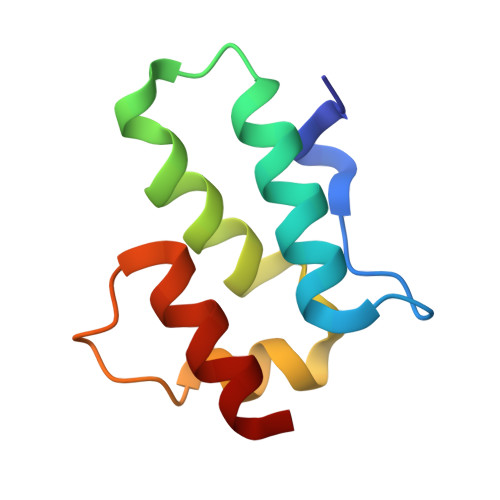
Crystal structure of the C-terminal domain of the Rous Sarcoma Virus capsid protein: Mutant A184C


Experimental Data Snapshot

  • Method: X-RAY DIFFRACTION
  • Resolution: 1.55 Å
  • R-Value Free: 
    0.214 (Depositor), 0.207 (DCC) 
  • R-Value Work: 
    0.187 (Depositor), 0.182 (DCC) 
  • R-Value Observed: 
    0.188 (Depositor) 

Starting Model: experimental
View more details

wwPDB Validation 3D Report Full Report

Validation slider image for 3G26

This is version 1.5 of the entry. See complete history

Literature

Proton-linked dimerization of a retroviral capsid protein initiates capsid assembly

Bailey, G.D.Hyun, J.K.Mitra, A.K.Kingston, R.L.

(2009) Structure 17: 737-748

  • DOI: https://doi.org/10.1016/j.str.2009.03.010
  • Primary Citation Related Structures: 
    3G0V, 3G1G, 3G1I, 3G21, 3G26, 3G28, 3G29

  • PubMed Abstract: 

    In mature retroviral particles, the capsid protein (CA) forms a shell encasing the viral replication complex. Human immunodeficiency virus (HIV) CA dimerizes in solution, through its C-terminal domain (CTD), and this interaction is important for capsid assembly. In contrast, other retroviral capsid proteins, including that of Rous sarcoma virus (RSV), do not dimerize with measurable affinity. Here we show, using X-ray crystallography and other biophysical methods, that acidification causes RSV CA to dimerize in a fashion analogous to HIV CA, and that this drives capsid assembly in vitro. A pair of aspartic acid residues, located within the CTD dimer interface, explains why dimerization is linked to proton binding. Our results show that despite overarching structural similarities, the intermolecular forces responsible for forming and stabilizing the retroviral capsid differ markedly across retroviral genera. Our data further suggest that proton binding may regulate RSV capsid assembly, or modulate stability of the assembled capsid.


  • Organizational Affiliation
    • School of Biological Sciences, University of Auckland, Auckland, New Zealand.

Macromolecule Content 

  • Total Structure Weight: 8.61 kDa 
  • Atom Count: 719 
  • Modeled Residue Count: 77 
  • Deposited Residue Count: 77 
  • Unique protein chains: 1

Macromolecules

Find similar proteins by:|  3D Structure
Entity ID: 1
MoleculeChains  Sequence LengthOrganismDetailsImage
Gag polyprotein77Rous sarcoma virus - Prague CMutation(s): 1 
Gene Names: gag
EC: 3.4.23
UniProt
Find proteins for P03322 (Rous sarcoma virus subgroup C (strain Prague))
Explore P03322 
Go to UniProtKB:  P03322
Entity Groups
Sequence Clusters30% Identity50% Identity70% Identity90% Identity95% Identity100% Identity
UniProt GroupP03322
Sequence Annotations
Expand
Reference Sequence

Small Molecules

Ligands 1 Unique
IDChains Name / Formula / InChI Key2D Diagram3D Interactions
MLA

Query on MLA


Download:Ideal Coordinates CCD File
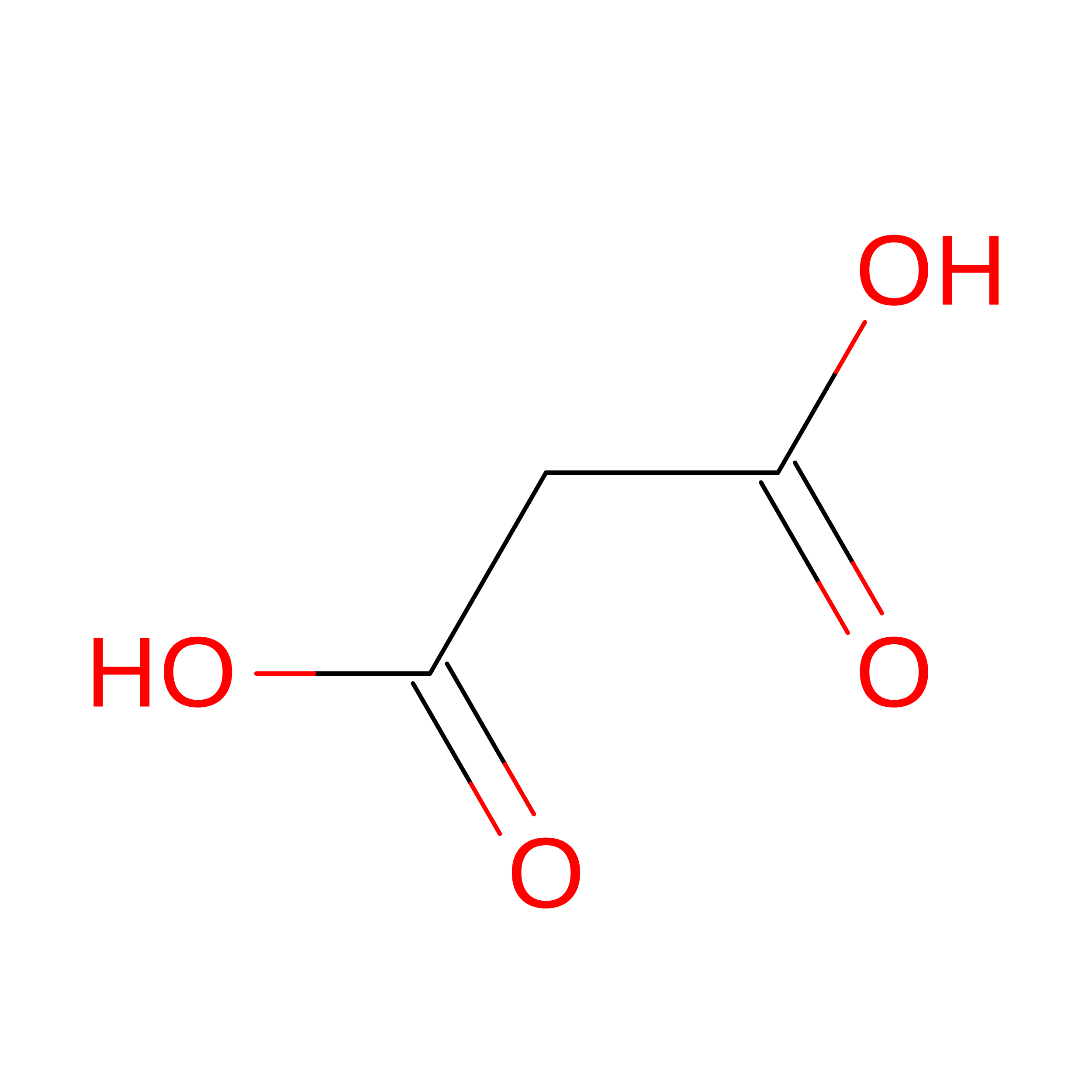
B [auth A]MALONIC ACID
C3 H4 O4
OFOBLEOULBTSOW-UHFFFAOYSA-N

Experimental Data & Validation

Experimental Data

  • Method: X-RAY DIFFRACTION
  • Resolution: 1.55 Å
  • R-Value Free:  0.214 (Depositor), 0.207 (DCC) 
  • R-Value Work:  0.187 (Depositor), 0.182 (DCC) 
  • R-Value Observed: 0.188 (Depositor) 
Space Group: P 32 2 1
Unit Cell:
Length ( Å )Angle ( ˚ )
a = 32.243α = 90
b = 32.243β = 90
c = 113.993γ = 120
Software Package:
Software NamePurpose
Blu-Icedata collection
PHASERphasing
REFMACrefinement
HKL-2000data reduction
HKL-2000data scaling

Structure Validation

View Full Validation Report


Entry History 

Deposition Data

Revision History  (Full details and data files)

  • Version 1.0: 2009-06-02
    Type: Initial release
  • Version 1.1: 2011-07-13
    Changes: Version format compliance
  • Version 1.2: 2015-04-29
    Changes: Non-polymer description
  • Version 1.3: 2021-11-10
    Changes: Database references, Derived calculations
  • Version 1.4: 2023-11-01
    Changes: Data collection, Refinement description
  • Version 1.5: 2024-10-30
    Changes: Structure summary