3FX5 | pdb_00003fx5

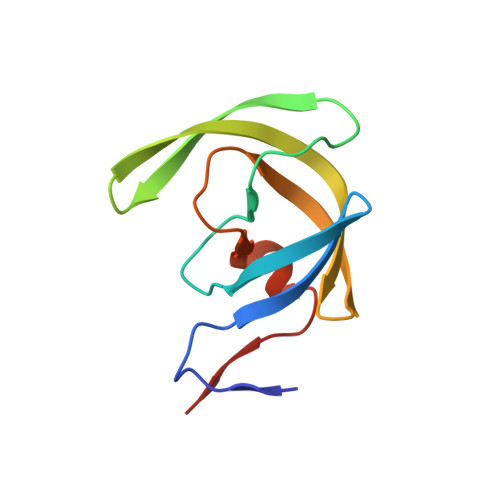
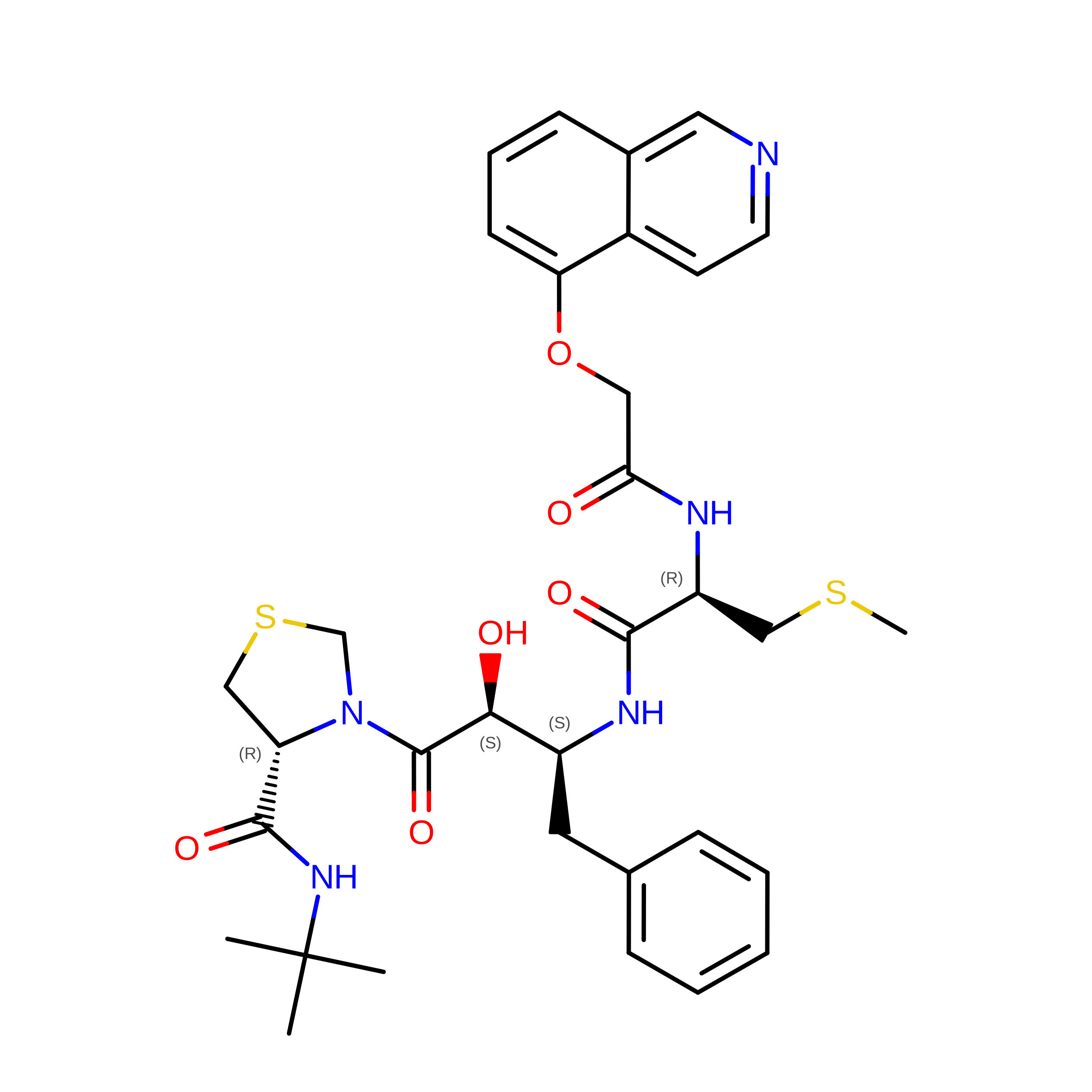
Structure of HIV-1 Protease in Complex with Potent Inhibitor KNI-272 Determined by High Resolution X-ray Crystallography


Experimental Data Snapshot

  • Method: X-RAY DIFFRACTION
  • Resolution: 0.93 Å
  • R-Value Free: 
    0.124 (Depositor) 
  • R-Value Work: 
    0.104 (Depositor), 0.101 (DCC) 

Starting Model: experimental
View more details

wwPDB Validation 3D Report Full Report

Validation slider image for 3FX5

Ligand Structure Quality Assessment 


This is version 1.4 of the entry. See complete history

Literature

Structure of HIV-1 protease in complex with potent inhibitor KNI-272 determined by high-resolution X-ray and neutron crystallography.

Adachi, M.Ohhara, T.Kurihara, K.Tamada, T.Honjo, E.Okazaki, N.Arai, S.Shoyama, Y.Kimura, K.Matsumura, H.Sugiyama, S.Adachi, H.Takano, K.Mori, Y.Hidaka, K.Kimura, T.Hayashi, Y.Kiso, Y.Kuroki, R.

(2009) Proc Natl Acad Sci U S A 

  • DOI: https://doi.org/10.1073/pnas.0809400106
  • Primary Citation Related Structures: 
    2ZYE, 3FX5

  • PubMed Abstract: 

    HIV-1 protease is a dimeric aspartic protease that plays an essential role in viral replication. To further understand the catalytic mechanism and inhibitor recognition of HIV-1 protease, we need to determine the locations of key hydrogen atoms in the catalytic aspartates Asp-25 and Asp-125. The structure of HIV-1 protease in complex with transition-state analog KNI-272 was determined by combined neutron crystallography at 1.9-A resolution and X-ray crystallography at 1.4-A resolution. The resulting structural data show that the catalytic residue Asp-25 is protonated and that Asp-125 (the catalytic residue from the corresponding diad-related molecule) is deprotonated. The proton on Asp-25 makes a hydrogen bond with the carbonyl group of the allophenylnorstatine (Apns) group in KNI-272. The deprotonated Asp-125 bonds to the hydroxyl proton of Apns. The results provide direct experimental evidence for proposed aspects of the catalytic mechanism of HIV-1 protease and can therefore contribute substantially to the development of specific inhibitors for therapeutic application.


  • Organizational Affiliation
    • Molecular Structural Biology Group, Quantum Beam Science Directorate, Japan Atomic Energy Agency, 2-4 Shirakata-Shirane, Tokai, Ibaraki 319-1195, Japan.

Macromolecule Content 

  • Total Structure Weight: 22.43 kDa 
  • Atom Count: 2,264 
  • Modeled Residue Count: 198 
  • Deposited Residue Count: 198 
  • Unique protein chains: 1

Macromolecules

Find similar proteins by:|  3D Structure
Entity ID: 1
MoleculeChains  Sequence LengthOrganismDetailsImage
protease
A, B
99Human immunodeficiency virus 1Mutation(s): 5 
Gene Names: pol
EC: 3.4.23.16
UniProt
Find proteins for P03367 (Human immunodeficiency virus type 1 group M subtype B (isolate BRU/LAI))
Explore P03367 
Go to UniProtKB:  P03367
Entity Groups
Sequence Clusters30% Identity50% Identity70% Identity90% Identity95% Identity100% Identity
UniProt GroupP03367
Sequence Annotations
Expand
Reference Sequence

Biologically Interesting Molecules (External Reference) 

1 Unique

Experimental Data & Validation

Experimental Data

  • Method: X-RAY DIFFRACTION
  • Resolution: 0.93 Å
  • R-Value Free:  0.124 (Depositor) 
  • R-Value Work:  0.104 (Depositor), 0.101 (DCC) 
Space Group: P 21 21 2
Unit Cell:
Length ( Å )Angle ( ˚ )
a = 57.532α = 90
b = 85.955β = 90
c = 46.386γ = 90
Software Package:
Software NamePurpose
CNSrefinement
SHELXL-97refinement
HKL-2000data reduction
SCALEPACKdata scaling
CNSphasing

Structure Validation

View Full Validation Report


Ligand Structure Quality Assessment 


Entry History 

Deposition Data

Revision History  (Full details and data files)

  • Version 1.0: 2009-03-24
    Type: Initial release
  • Version 1.1: 2011-07-13
    Changes: Atomic model, Database references, Derived calculations, Non-polymer description, Structure summary, Version format compliance
  • Version 1.2: 2012-12-12
    Changes: Other
  • Version 1.3: 2021-11-10
    Changes: Database references, Derived calculations, Structure summary
  • Version 1.4: 2023-11-01
    Changes: Data collection, Refinement description