Download Mendeley
Heterologous expression and purification of Vibrio proteolyticus (Aeromonas proteolytica) aminopeptidase: a rapid protocol
Hartley, M., Bennett, B.(2009) Protein Expr Purif 66: 91-101
- PubMed: 19233285 Search on PubMedSearch on PubMed Central
- DOI: https://doi.org/10.1016/j.pep.2009.02.011
- Primary Citation Related Structures:
3FH4 - PubMed Abstract:
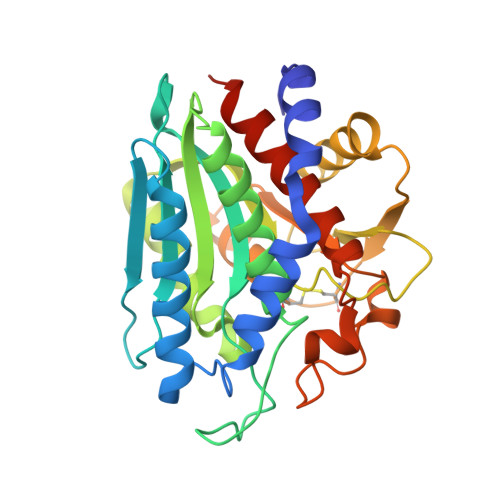
Metalloaminopeptidases (mAPs) are enzymes that are involved in HIV infectivity, tumor growth and metastasis, angiogenesis, and bacterial infection. Investigation of structure-function relationships in mAPs is a prerequisite to rational design of anti-mAP chemotherapeutics. The most intensively studied member of the biomedically important dinuclear mAPs is the prototypical secreted Vibrio proteolyticus di-zinc aminopeptidase (VpAP). The wild-type enzyme is readily purified from the supernatant of cultures of V. proteolyticus, but recombinant variants require expression in Escherichia coli. A greatly improved system for the purification of recombinant VpAP is described. A VpAP-(His)(6) polypeptide, containing an N-terminal propeptide, and a C-terminal (His)(6) adduct, was purified by metal ion affinity chromatography from the supernatant of cultures of E. coli. This single step replaced the sequence of (NH(4))(2)SO(4) fractionation, and anion-exchange and hydrophobic interaction chromatographic separations of earlier methods. Traditionally, recombinant VpAP proenzyme has been treated with proteinase K and with heat (70 degrees C), to remove the N- and C-terminal regions, and yield the mature active enzyme. This method is unsuitable for VpAP variants that are unstable towards these treatments. In the new method, the hitherto noted, but not fully appreciated, ability of VpAP to autocatalyze the hydrolysis of the N-terminal propeptide and C-terminal regions was exploited; extensive dialysis of the highly purified VpAP-(His)(6) full-length polypeptide yielded the mature active protein without recourse to proteinase K or heat treatment. Purification of variants that have previously defied isolation as mature forms of the protein was thus carried out.
- Department of Biophysics, Medical College of Wisconsin, 8701 Watertown Plank Road, Milwaukee, WI 53226-0509, USA.
Organizational Affiliation: