3FFU | pdb_00003ffu

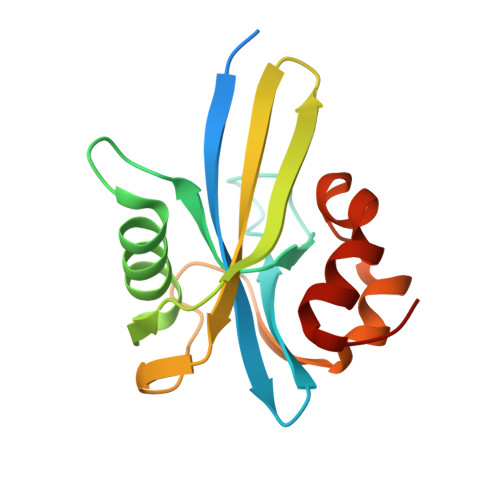
Structure of the RNA pyrophosphohydrolase BdRppH in complex with GTP and magnesium


Experimental Data Snapshot

  • Method: X-RAY DIFFRACTION
  • Resolution: 2.80 Å
  • R-Value Free: 
    0.301 (Depositor), 0.290 (DCC) 
  • R-Value Work: 
    0.226 (Depositor), 0.247 (DCC) 
  • R-Value Observed: 
    0.229 (Depositor) 

wwPDB Validation 3D Report Full Report

Validation slider image for 3FFU

Ligand Structure Quality Assessment 


This is version 1.4 of the entry. See complete history

Literature

Structure and Biological Function of the RNA Pyrophosphohydrolase BdRppH from Bdellovibrio bacteriovorus.

Messing, S.A.Gabelli, S.B.Liu, Q.Celesnik, H.Belasco, J.G.Pineiro, S.A.Amzel, L.M.

(2009) Structure 17: 472-481

  • DOI: https://doi.org/10.1016/j.str.2008.12.022
  • Primary Citation Related Structures: 
    3EES, 3EEU, 3EF5, 3FFU

  • PubMed Abstract: 

    Until recently, the mechanism of mRNA decay in bacteria was thought to be different from that of eukaryotes. This paradigm changed with the discovery that RppH (ORF176/NudH/YgdP), an Escherichia coli enzyme that belongs to the Nudix superfamily, is an RNA pyrophosphohydrolase that initiates mRNA decay by cleaving pyrophosphate from the 5'-triphosphate. Here we report the 1.9 Angstroms resolution structure of the Nudix hydrolase BdRppH from Bdellovibrio bacteriovorus, a bacterium that feeds on other Gram-negative bacteria. Based on the structure of the enzyme alone and in complex with GTP-Mg2+, we propose a mode of RNA binding similar to that of the nuclear decapping enzyme from Xenopus laevis, X29. In additional experiments, we show that BdRppH can indeed function in vitro and in vivo as an RNA pyrophosphohydrolase. These findings set the basis for the identification of possible decapping enzymes in other bacteria.


  • Organizational Affiliation
    • Department of Biophysics and Biophysical Chemistry, School of Medicine, Johns Hopkins University, Baltimore, MD 21205, USA.

Macromolecule Content 

  • Total Structure Weight: 36.46 kDa 
  • Atom Count: 2,253 
  • Modeled Residue Count: 266 
  • Deposited Residue Count: 306 
  • Unique protein chains: 1

Macromolecules

Find similar proteins by:|  3D Structure
Entity ID: 1
MoleculeChains  Sequence LengthOrganismDetailsImage
Probable pyrophosphohydrolase
A, B
153Bdellovibrio bacteriovorusMutation(s): 0 
Gene Names: Bd0714mutT
EC: 3.6.1 (PDB Primary Data), 3.6.1.55 (UniProt)
UniProt
Find proteins for Q6MPX4 (Bdellovibrio bacteriovorus (strain ATCC 15356 / DSM 50701 / NCIMB 9529 / HD100))
Explore Q6MPX4 
Go to UniProtKB:  Q6MPX4
Entity Groups
Sequence Clusters30% Identity50% Identity70% Identity90% Identity95% Identity100% Identity
UniProt GroupQ6MPX4
Sequence Annotations
Expand
Reference Sequence

Small Molecules

Ligands 2 Unique
IDChains Name / Formula / InChI Key2D Diagram3D Interactions
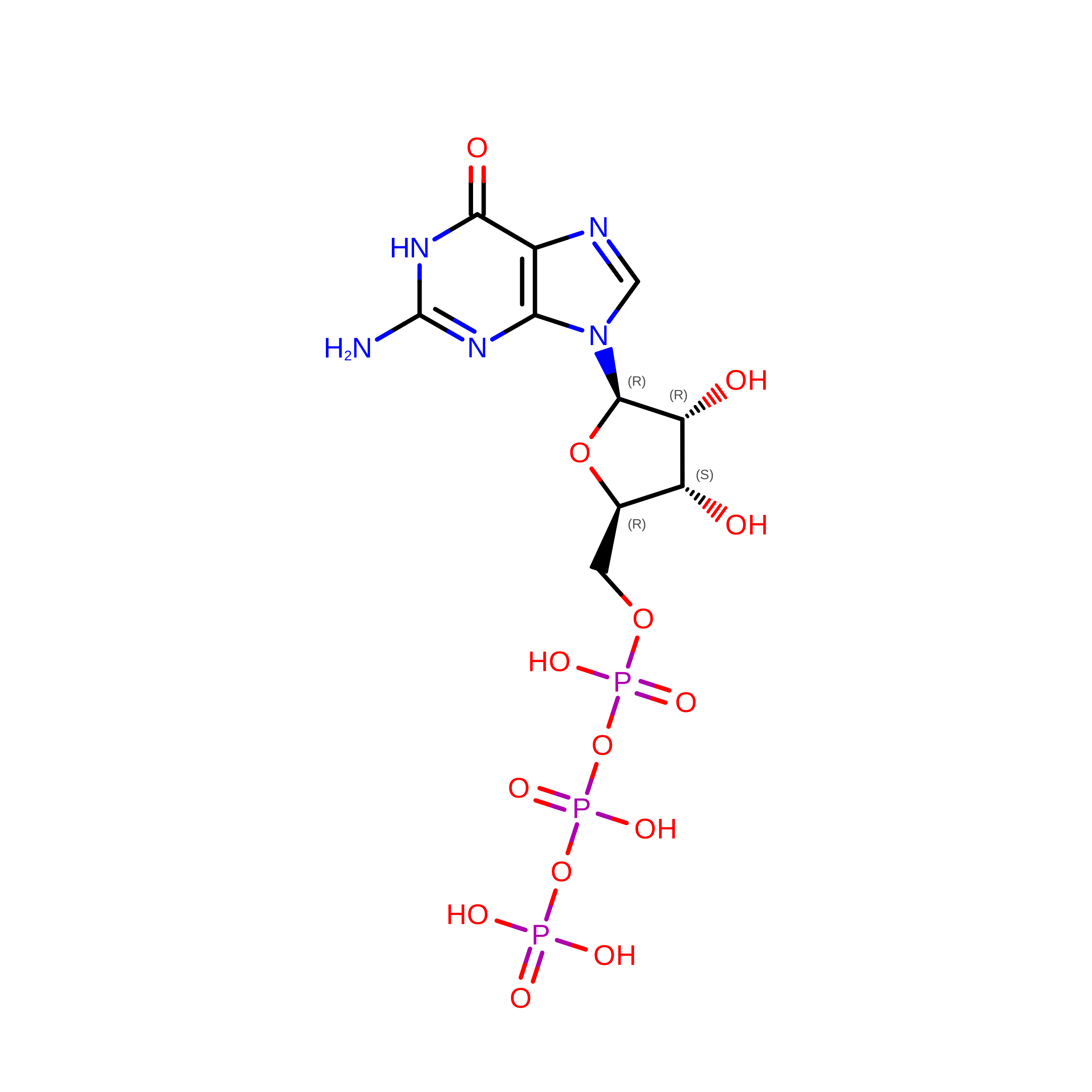
GTP

Query on GTP


Download:Ideal Coordinates CCD File
C [auth A],
G [auth B]
GUANOSINE-5'-TRIPHOSPHATE
C10 H16 N5 O14 P3
XKMLYUALXHKNFT-UUOKFMHZSA-N
MG

Query on MG


Download:Ideal Coordinates CCD File
D [auth A]
E [auth A]
F [auth A]
H [auth B]
I [auth B]
D [auth A],
E [auth A],
F [auth A],
H [auth B],
I [auth B],
J [auth B]
MAGNESIUM ION
Mg
JLVVSXFLKOJNIY-UHFFFAOYSA-N

Experimental Data & Validation

Experimental Data

  • Method: X-RAY DIFFRACTION
  • Resolution: 2.80 Å
  • R-Value Free:  0.301 (Depositor), 0.290 (DCC) 
  • R-Value Work:  0.226 (Depositor), 0.247 (DCC) 
  • R-Value Observed: 0.229 (Depositor) 
Space Group: P 21 21 21
Unit Cell:
Length ( Å )Angle ( ˚ )
a = 68.732α = 90
b = 68.749β = 90
c = 93.069γ = 90
Software Package:
Software NamePurpose
DENZOdata reduction
SCALEPACKdata scaling
REFMACrefinement
PDB_EXTRACTdata extraction

Structure Validation

View Full Validation Report


Ligand Structure Quality Assessment 


Entry History 

Deposition Data

Revision History  (Full details and data files)

  • Version 1.0: 2009-03-24
    Type: Initial release
  • Version 1.1: 2011-07-13
    Changes: Version format compliance
  • Version 1.2: 2017-11-01
    Changes: Refinement description
  • Version 1.3: 2018-04-04
    Changes: Data collection
  • Version 1.4: 2024-02-21
    Changes: Data collection, Database references, Derived calculations