3F8U | pdb_00003f8u

Tapasin/ERp57 heterodimer


Experimental Data Snapshot

  • Method: X-RAY DIFFRACTION
  • Resolution: 2.60 Å
  • R-Value Free: 
    0.285 (Depositor), 0.282 (DCC) 
  • R-Value Work: 
    0.245 (Depositor), 0.247 (DCC) 
  • R-Value Observed: 
    0.247 (Depositor) 

wwPDB Validation 3D Report Full Report

Validation slider image for 3F8U

Ligand Structure Quality Assessment 


This is version 1.5 of the entry. See complete history

Literature

Insights into MHC class I peptide loading from the structure of the tapasin-ERp57 thiol oxidoreductase heterodimer.

Dong, G.Wearsch, P.A.Peaper, D.R.Cresswell, P.Reinisch, K.M.

(2009) Immunity 30: 21-32

  • DOI: https://doi.org/10.1016/j.immuni.2008.10.018
  • Primary Citation Related Structures: 
    3F8U

  • PubMed Abstract: 

    Tapasin is a glycoprotein critical for loading major histocompatibility complex (MHC) class I molecules with high-affinity peptides. It functions within the multimeric peptide-loading complex (PLC) as a disulfide-linked, stable heterodimer with the thiol oxidoreductase ERp57, and this covalent interaction is required to support optimal PLC activity. Here, we present the 2.6 A resolution structure of the tapasin-ERp57 core of the PLC. The structure revealed that tapasin interacts with both ERp57 catalytic domains, accounting for the stability of the heterodimer, and provided an example of a protein disulfide isomerase family member interacting with substrate. Mutational analysis identified a conserved surface on tapasin that interacted with MHC class I molecules and was critical for peptide loading and editing functions of the tapasin-ERp57 heterodimer. By combining the tapasin-ERp57 structure with those of other defined PLC components, we present a molecular model that illuminates the processes involved in MHC class I peptide loading.


  • Organizational Affiliation
    • Department of Cell Biology, Yale University School of Medicine, New Haven, CT 06520, USA.

Macromolecule Content 

  • Total Structure Weight: 194.63 kDa 
  • Atom Count: 13,051 
  • Modeled Residue Count: 1,653 
  • Deposited Residue Count: 1,764 
  • Unique protein chains: 2

Macromolecules

Find similar proteins by:|  3D Structure
Entity ID: 1
MoleculeChains  Sequence LengthOrganismDetailsImage
Protein disulfide-isomerase A3ERp57
A, C
481Homo sapiensMutation(s): 1 
Gene Names: PDIA3ERP57ERP60GRP58
EC: 5.3.4.1
UniProt & NIH Common Fund Data Resources
Find proteins for P30101 (Homo sapiens)
Explore P30101 
Go to UniProtKB:  P30101
PHAROS:  P30101
GTEx:  ENSG00000167004 
Entity Groups
Sequence Clusters30% Identity50% Identity70% Identity90% Identity95% Identity100% Identity
UniProt GroupP30101
Sequence Annotations
Expand
Reference Sequence
Find similar proteins by:|  3D Structure
Entity ID: 2
MoleculeChains  Sequence LengthOrganismDetailsImage
Tapasin
B, D
401Homo sapiensMutation(s): 0 
Gene Names: TAPBPNGS17TAPA
UniProt & NIH Common Fund Data Resources
Find proteins for O15533 (Homo sapiens)
Explore O15533 
Go to UniProtKB:  O15533
PHAROS:  O15533
GTEx:  ENSG00000231925 
Entity Groups
Sequence Clusters30% Identity50% Identity70% Identity90% Identity95% Identity100% Identity
UniProt GroupO15533
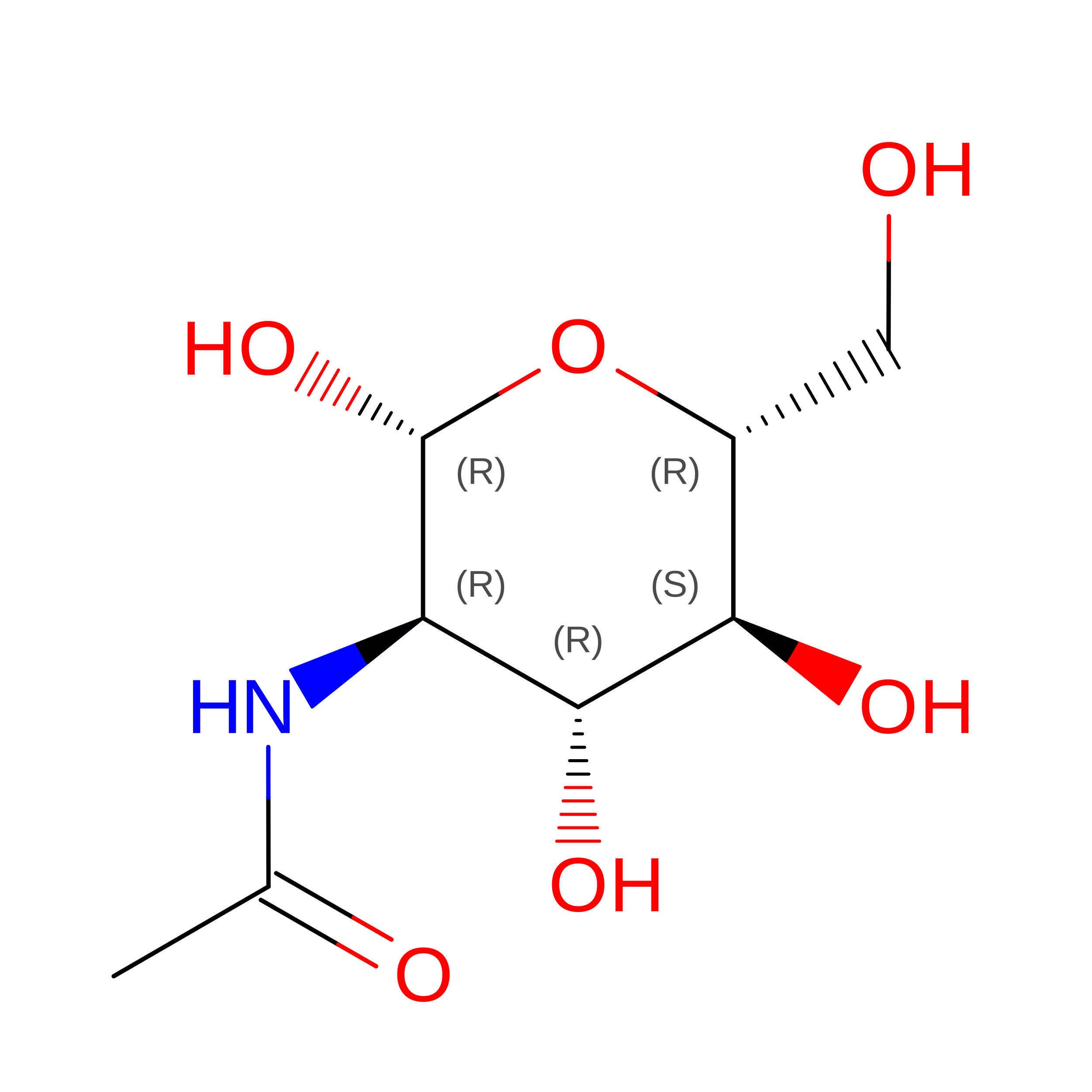
Glycosylation
Glycosylation Sites: 1Go to GlyGen: O15533-1
Sequence Annotations
Expand
Reference Sequence

Experimental Data & Validation

Experimental Data

  • Method: X-RAY DIFFRACTION
  • Resolution: 2.60 Å
  • R-Value Free:  0.285 (Depositor), 0.282 (DCC) 
  • R-Value Work:  0.245 (Depositor), 0.247 (DCC) 
  • R-Value Observed: 0.247 (Depositor) 
Space Group: P 1 21 1
Unit Cell:
Length ( Å )Angle ( ˚ )
a = 74.101α = 90
b = 72.295β = 94.613
c = 200.193γ = 90
Software Package:
Software NamePurpose
HKL-2000data collection
SHARPphasing
CNSrefinement
HKL-2000data reduction
HKL-2000data scaling

Structure Validation

View Full Validation Report


Ligand Structure Quality Assessment 


Entry History 

Deposition Data

Revision History  (Full details and data files)

  • Version 1.0: 2009-01-13
    Type: Initial release
  • Version 1.1: 2011-07-13
    Changes: Non-polymer description, Version format compliance
  • Version 1.2: 2020-07-29
    Type: Remediation
    Reason: Carbohydrate remediation
    Changes: Data collection, Derived calculations, Structure summary
  • Version 1.3: 2021-10-20
    Changes: Database references, Structure summary
  • Version 1.4: 2023-12-27
    Changes: Data collection
  • Version 1.5: 2024-10-30
    Changes: Structure summary