3F7G | pdb_00003f7g

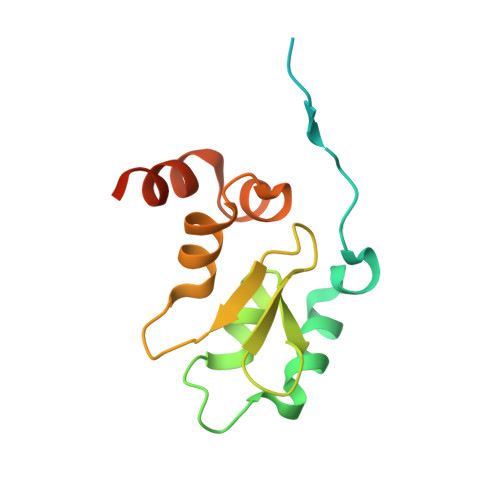
Structure of the BIR domain from ML-IAP bound to a peptidomimetic


Experimental Data Snapshot

  • Method: X-RAY DIFFRACTION
  • Resolution: 2.30 Å
  • R-Value Free: 
    0.209 (Depositor), 0.212 (DCC) 
  • R-Value Work: 
    0.167 (Depositor), 0.173 (DCC) 
  • R-Value Observed: 
    0.169 (Depositor) 

Starting Model: experimental
View more details

wwPDB Validation 3D Report Full Report

Validation slider image for 3F7G

Ligand Structure Quality Assessment 


This is version 1.3 of the entry. See complete history

Literature

Orally bioavailable antagonists of inhibitor of apoptosis proteins based on an azabicyclooctane scaffold

Cohen, F.Alicke, B.Elliott, L.O.Flygare, J.A.Goncharov, T.Keteltas, S.F.Franklin, M.C.Frankovitz, S.Stephan, J.P.Tsui, V.Vucic, D.Wong, H.Fairbrother, W.J.

(2009) J Med Chem 52: 1723-1730

  • DOI: https://doi.org/10.1021/jm801450c
  • Primary Citation Related Structures: 
    3F7G, 3F7H, 3F7I

  • PubMed Abstract: 

    A series of IAP antagonists based on an azabicyclooctane scaffold was designed and synthesized. The most potent of these compounds, 14b, binds to the XIAP BIR3 domain, the BIR domain of ML-IAP, and the BIR3 domain of c-IAP1 with K(i) values of 140, 38, and 33 nM, respectively. These compounds promote degradation of c-IAP1, activate caspases, and lead to decreased viability of breast cancer cells without affecting normal mammary epithelial cells. Finally, compound 14b inhibits tumor growth when dosed orally in a breast cancer xenograft model.


  • Organizational Affiliation
    • Departments of Discovery Chemistry, Genentech, Inc., 1 DNA Way, South San Francisco, California 94080, USA. fcohen@gene.com

Macromolecule Content 

  • Total Structure Weight: 79.94 kDa 
  • Atom Count: 4,283 
  • Modeled Residue Count: 495 
  • Deposited Residue Count: 700 
  • Unique protein chains: 1

Macromolecules

Find similar proteins by:|  3D Structure
Entity ID: 1
MoleculeChains  Sequence LengthOrganismDetailsImage
Baculoviral IAP repeat-containing protein 7
A, B, C, D, E
140Homo sapiensMutation(s): 0 
Gene Names: also known as KIAP OR MLIAP OR LIVINBIRC7KIAPLIVINMLIAPRNF50UNQ5800/PRO19607/PRO21344
EC: 2.3.2.27
UniProt & NIH Common Fund Data Resources
Find proteins for Q96CA5 (Homo sapiens)
Explore Q96CA5 
Go to UniProtKB:  Q96CA5
PHAROS:  Q96CA5
GTEx:  ENSG00000101197 
Entity Groups
Sequence Clusters30% Identity50% Identity70% Identity90% Identity95% Identity100% Identity
UniProt GroupQ96CA5
Sequence Annotations
Expand
Reference Sequence

Small Molecules

Ligands 3 Unique
IDChains Name / Formula / InChI Key2D Diagram3D Interactions
389

Query on 389


Download:Ideal Coordinates CCD File
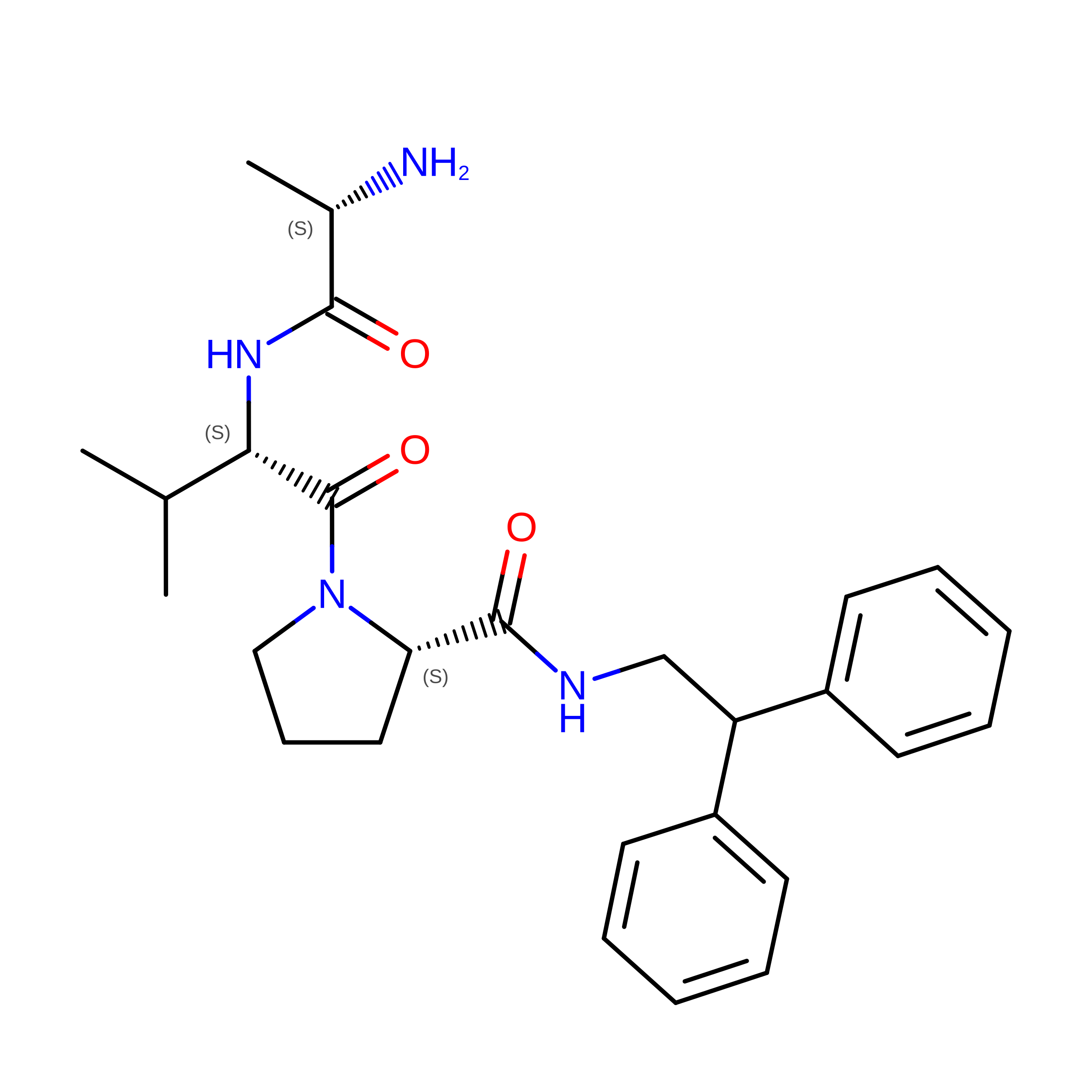
K [auth E]L-alanyl-L-valyl-N-(2,2-diphenylethyl)-L-prolinamide
C27 H36 N4 O3
ZJCCVSICICQPSQ-IGKWTDBASA-N
P33

Query on P33


Download:Ideal Coordinates CCD File
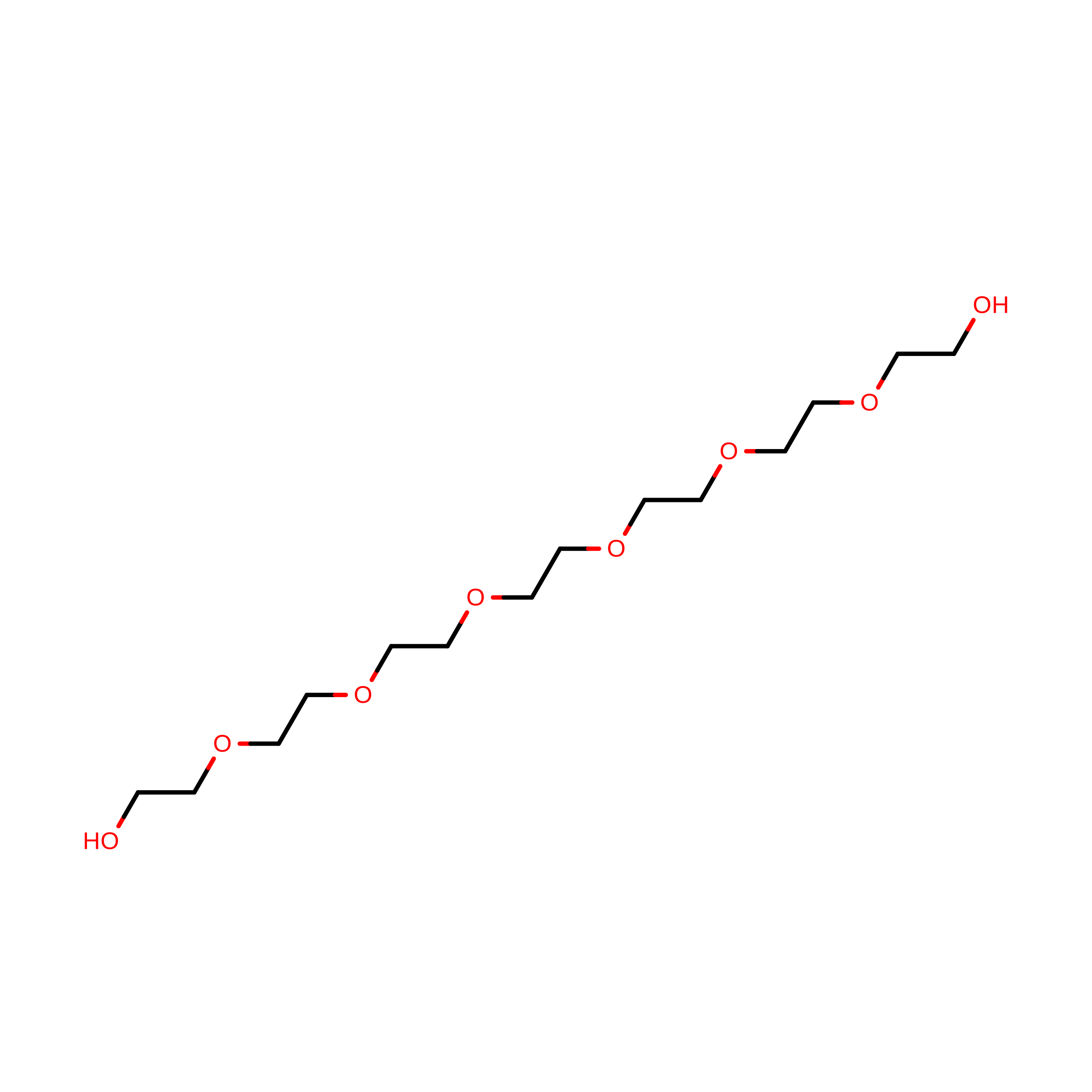
J [auth D]3,6,9,12,15,18-HEXAOXAICOSANE-1,20-DIOL
C14 H30 O8
XPJRQAIZZQMSCM-UHFFFAOYSA-N
ZN

Query on ZN


Download:Ideal Coordinates CCD File
F [auth A],
G [auth B],
H [auth C],
I [auth D],
L [auth E]
ZINC ION
Zn
PTFCDOFLOPIGGS-UHFFFAOYSA-N
Binding Affinity Annotations 
IDSourceBinding Affinity
389 BindingDB:  3F7G Ki: 43 (nM) from 1 assay(s)

Experimental Data & Validation

Experimental Data

  • Method: X-RAY DIFFRACTION
  • Resolution: 2.30 Å
  • R-Value Free:  0.209 (Depositor), 0.212 (DCC) 
  • R-Value Work:  0.167 (Depositor), 0.173 (DCC) 
  • R-Value Observed: 0.169 (Depositor) 
Space Group: P 32
Unit Cell:
Length ( Å )Angle ( ˚ )
a = 84.016α = 90
b = 84.016β = 90
c = 94.476γ = 120
Software Package:
Software NamePurpose
HKL-2000data collection
REFMACrefinement
HKL-2000data reduction
HKL-2000data scaling

Structure Validation

View Full Validation Report


Ligand Structure Quality Assessment 


Entry History 

Deposition Data

Revision History  (Full details and data files)

  • Version 1.0: 2009-03-17
    Type: Initial release
  • Version 1.1: 2011-07-13
    Changes: Advisory, Refinement description, Version format compliance
  • Version 1.2: 2017-10-25
    Changes: Refinement description
  • Version 1.3: 2023-09-06
    Changes: Data collection, Database references, Derived calculations, Refinement description, Structure summary