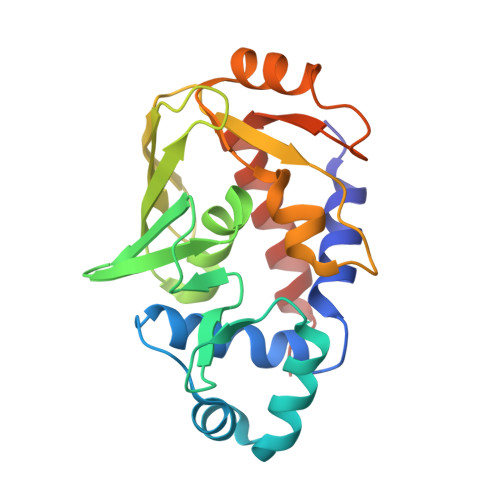
3F0O | pdb_00003f0o

Crystal structure of MerB, the Organomercurial Lyase involved in a bacterial mercury resistance system


Experimental Data Snapshot

  • Method: X-RAY DIFFRACTION
  • Resolution: 1.76 Å
  • R-Value Free: 
    0.208 (Depositor) 
  • R-Value Work: 
    0.182 (Depositor) 
  • R-Value Observed: 
    0.183 (Depositor) 

Starting Model: experimental
View more details

wwPDB Validation 3D Report Full Report

Validation slider image for 3F0O

This is version 1.3 of the entry. See complete history

Literature

Crystal Structures of the Organomercurial Lyase MerB in Its Free and Mercury-bound Forms: INSIGHTS INTO THE MECHANISM OF METHYLMERCURY DEGRADATION

Lafrance-Vanasse, J.Lefebvre, M.Di Lello, P.Sygusch, J.Omichinski, J.G.

(2009) J Biological Chem 284: 938-944

  • DOI: https://doi.org/10.1074/jbc.M807143200
  • Primary Citation Related Structures: 
    3F0O, 3F0P, 3F2F, 3F2G, 3F2H

  • PubMed Abstract: 

    Bacteria resistant to methylmercury utilize two enzymes (MerA and MerB) to degrade methylmercury to the less toxic elemental mercury. The crucial step is the cleavage of the carbon-mercury bond of methylmercury by the organomercurial lyase (MerB). In this study, we determined high resolution crystal structures of MerB in both the free (1.76-A resolution) and mercury-bound (1.64-A resolution) states. The crystal structure of free MerB is very similar to the NMR structure, but important differences are observed when comparing the two structures. In the crystal structure, an amino-terminal alpha-helix that is not present in the NMR structure makes contact with the core region adjacent to the catalytic site. This interaction between the amino-terminal helix and the core serves to bury the active site of MerB. The crystal structures also provide detailed insights into the mechanism of carbon-mercury bond cleavage by MerB. The structures demonstrate that two conserved cysteines (Cys-96 and Cys-159) play a role in substrate binding, carbon-mercury bond cleavage, and controlled product (ionic mercury) release. In addition, the structures establish that an aspartic acid (Asp-99) in the active site plays a crucial role in the proton transfer step required for the cleavage of the carbon-mercury bond. These findings are an important step in understanding the mechanism of carbon-mercury bond cleavage by MerB.


  • Organizational Affiliation
    • Department of Biochemistry, Université de Montréal, Montréal, Québec H3C 3J7, Canada.

Macromolecule Content 

  • Total Structure Weight: 46.2 kDa 
  • Atom Count: 3,429 
  • Modeled Residue Count: 403 
  • Deposited Residue Count: 424 
  • Unique protein chains: 1

Macromolecules

Find similar proteins by:|  3D Structure
Entity ID: 1
MoleculeChains  Sequence LengthOrganismDetailsImage
Alkylmercury lyase
A, B
212Escherichia coliMutation(s): 0 
Gene Names: merB
EC: 4.99.1.2
UniProt
Find proteins for P77072 (Escherichia coli)
Explore P77072 
Go to UniProtKB:  P77072
Entity Groups
Sequence Clusters30% Identity50% Identity70% Identity90% Identity95% Identity100% Identity
UniProt GroupP77072
Sequence Annotations
Expand
Reference Sequence

Small Molecules

Ligands 1 Unique
IDChains Name / Formula / InChI Key2D Diagram3D Interactions
BR

Query on BR


Download:Ideal Coordinates CCD File
C [auth A]BROMIDE ION
Br
CPELXLSAUQHCOX-UHFFFAOYSA-M

Experimental Data & Validation

Experimental Data

  • Method: X-RAY DIFFRACTION
  • Resolution: 1.76 Å
  • R-Value Free:  0.208 (Depositor) 
  • R-Value Work:  0.182 (Depositor) 
  • R-Value Observed: 0.183 (Depositor) 
Space Group: P 1 21 1
Unit Cell:
Length ( Å )Angle ( ˚ )
a = 38.71α = 90
b = 89.947β = 100.53
c = 52.167γ = 90
Software Package:
Software NamePurpose
HKL-2000data collection
SOLVEphasing
PHENIXrefinement
HKL-2000data reduction
HKL-2000data scaling

Structure Validation

View Full Validation Report


Entry History 

Deposition Data

Revision History  (Full details and data files)

  • Version 1.0: 2008-11-11
    Type: Initial release
  • Version 1.1: 2011-07-13
    Changes: Version format compliance
  • Version 1.2: 2023-12-27
    Changes: Data collection, Database references, Derived calculations
  • Version 1.3: 2024-04-03
    Changes: Refinement description