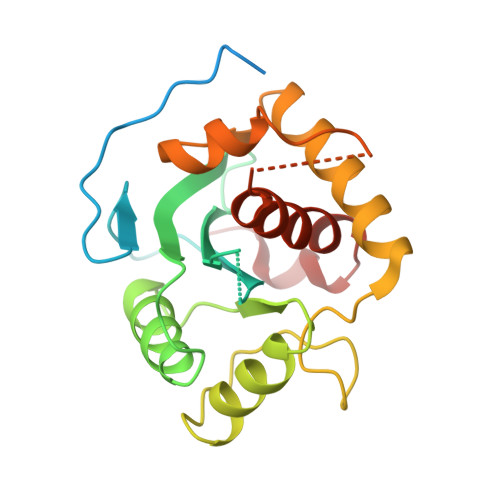
3C6H | pdb_00003c6h

Crystal Structure of the RB49 gp17 nuclease domain


Experimental Data Snapshot

  • Method: X-RAY DIFFRACTION
  • Resolution: 2.80 Å
  • R-Value Free: 
    0.290 (Depositor), 0.295 (DCC) 
  • R-Value Work: 
    0.242 (Depositor), 0.244 (DCC) 
  • R-Value Observed: 
    0.242 (Depositor) 

Starting Model: experimental
View more details

wwPDB Validation 3D Report Full Report

Validation slider image for 3C6H

This is version 1.3 of the entry. See complete history

Literature

The structure of the phage T4 DNA packaging motor suggests a mechanism dependent on electrostatic forces.

Sun, S.Kondabagil, K.Draper, B.Alam, T.I.Bowman, V.D.Zhang, Z.Hegde, S.Fokine, A.Rossmann, M.G.Rao, V.B.

(2008) Cell 135: 1251-1262

  • DOI: https://doi.org/10.1016/j.cell.2008.11.015
  • Primary Citation Related Structures: 
    3C6A, 3C6H, 3CPE, 3EZK

  • PubMed Abstract: 

    Viral genomes are packaged into "procapsids" by powerful molecular motors. We report the crystal structure of the DNA packaging motor protein, gene product 17 (gp17), in bacteriophage T4. The structure consists of an N-terminal ATPase domain, which provides energy for compacting DNA, and a C-terminal nuclease domain, which terminates packaging. We show that another function of the C-terminal domain is to translocate the genome into the procapsid. The two domains are in close contact in the crystal structure, representing a "tensed state." A cryo-electron microscopy reconstruction of the T4 procapsid complexed with gp17 shows that the packaging motor is a pentamer and that the domains within each monomer are spatially separated, representing a "relaxed state." These structures suggest a mechanism, supported by mutational and other data, in which electrostatic forces drive the DNA packaging by alternating between tensed and relaxed states. Similar mechanisms may occur in other molecular motors.


  • Organizational Affiliation
    • Department of Biological Sciences, Purdue University, 915 W. State Street, West Lafayette, IN 47907-2054, USA.

Macromolecule Content 

  • Total Structure Weight: 52.73 kDa 
  • Atom Count: 3,099 
  • Modeled Residue Count: 372 
  • Deposited Residue Count: 464 
  • Unique protein chains: 1

Macromolecules

Find similar proteins by:|  3D Structure
Entity ID: 1
MoleculeChains  Sequence LengthOrganismDetailsImage
Terminase large subunit
A, B
232Escherichia phage RB49Mutation(s): 0 
Gene Names: 17
EC: 3.6.4 (UniProt), 3.1.21 (UniProt)
UniProt
Find proteins for Q9T1C3 (Escherichia phage RB49)
Explore Q9T1C3 
Go to UniProtKB:  Q9T1C3
Entity Groups
Sequence Clusters30% Identity50% Identity70% Identity90% Identity95% Identity100% Identity
UniProt GroupQ9T1C3
Sequence Annotations
Expand
Reference Sequence

Experimental Data & Validation

Experimental Data

  • Method: X-RAY DIFFRACTION
  • Resolution: 2.80 Å
  • R-Value Free:  0.290 (Depositor), 0.295 (DCC) 
  • R-Value Work:  0.242 (Depositor), 0.244 (DCC) 
  • R-Value Observed: 0.242 (Depositor) 
Space Group: C 1 2 1
Unit Cell:
Length ( Å )Angle ( ˚ )
a = 96.436α = 90
b = 126.724β = 106.03
c = 52.391γ = 90
Software Package:
Software NamePurpose
DENZOdata reduction
SCALEPACKdata scaling
CNSrefinement
PDB_EXTRACTdata extraction
HKL-2000data collection
HKL-2000data reduction
HKL-2000data scaling
CNSphasing

Structure Validation

View Full Validation Report


Entry History 

Deposition Data

Revision History  (Full details and data files)

  • Version 1.0: 2009-01-13
    Type: Initial release
  • Version 1.1: 2011-07-13
    Changes: Version format compliance
  • Version 1.2: 2017-10-25
    Changes: Refinement description
  • Version 1.3: 2023-08-30
    Changes: Data collection, Database references, Derived calculations, Refinement description