3BXB | pdb_00003bxb

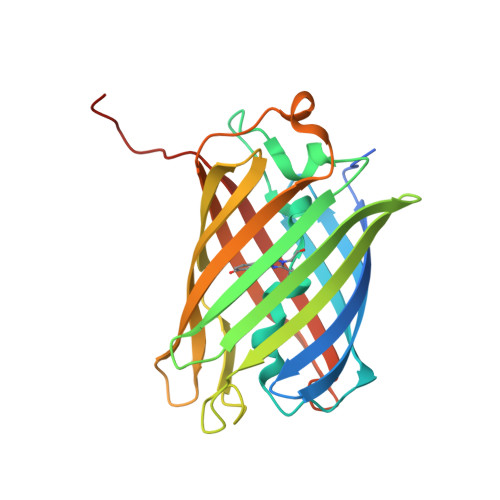
Monomeric Far-red Fluorescent Protein mKate Crystallized at pH 7.0


Experimental Data Snapshot

  • Method: X-RAY DIFFRACTION
  • Resolution: 2.60 Å
  • R-Value Free: 
    0.263 (Depositor), 0.256 (DCC) 
  • R-Value Work: 
    0.170 (Depositor), 0.166 (DCC) 

wwPDB Validation 3D Report Full Report

Validation slider image for 3BXB

This is version 2.0 of the entry. See complete history

Literature

A Crystallographic Study of Bright Far-Red Fluorescent Protein mKate Reveals pH-induced cis-trans Isomerization of the Chromophore.

Pletnev, S.Shcherbo, D.Chudakov, D.M.Pletneva, N.Merzlyak, E.M.Wlodawer, A.Dauter, Z.Pletnev, V.

(2008) J Biological Chem 283: 28980-28987

  • DOI: https://doi.org/10.1074/jbc.M800599200
  • Primary Citation Related Structures: 
    3BX9, 3BXA, 3BXB, 3BXC

  • PubMed Abstract: 

    The far-red fluorescent protein mKate (lambda(ex), 588 nm; lambda(em), 635 nm; chromophore-forming triad Met(63)-Tyr(64)-Gly(65)), originating from wild-type red fluorescent progenitor eqFP578 (sea anemone Entacmaea quadricolor), is monomeric and characterized by the pronounced pH dependence of fluorescence, relatively high brightness, and high photostability. The protein has been crystallized at a pH ranging from 2 to 9 in three space groups, and four structures have been determined by x-ray crystallography at the resolution of 1.75-2.6 A. The pH-dependent fluorescence of mKate has been shown to be due to reversible cis-trans isomerization of the chromophore phenolic ring. In the non-fluorescent state at pH 2.0, the chromophore of mKate is in the trans-isomeric form. The weakly fluorescent state of the protein at pH 4.2 is characterized by a mixture of trans and cis isomers. The chromophore in a highly fluorescent state at pH 7.0/9.0 adopts the cis form. Three key residues, Ser(143), Leu(174), and Arg(197) residing in the vicinity of the chromophore, have been identified as being primarily responsible for the far-red shift in the spectra. A group of residues consisting of Val(93), Arg(122), Glu(155), Arg(157), Asp(159), His(169), Ile(171), Asn(173), Val(192), Tyr(194), and Val(216), are most likely responsible for the observed monomeric state of the protein in solution.


  • Organizational Affiliation
    • Macromolecular Crystallography Laboratory, NCI, National Institutes of Health, Argonne, Illinois 60439, USA. svp@ncifcrf.gov

Macromolecule Content 

  • Total Structure Weight: 221.12 kDa 
  • Atom Count: 14,615 
  • Modeled Residue Count: 1,784 
  • Deposited Residue Count: 1,944 
  • Unique protein chains: 1

Macromolecules

Find similar proteins by:|  3D Structure
Entity ID: 1
MoleculeChains  Sequence LengthOrganismDetailsImage
Far-red fluorescent protein mKate
A, B, C, D, E
A, B, C, D, E, F, G, H
243Entacmaea quadricolorMutation(s): 0 

Small Molecules

Modified Residues  1 Unique
IDChains TypeFormula2D DiagramParent
NRQ
Query on NRQ
A, B, C, D, E
A, B, C, D, E, F, G, H
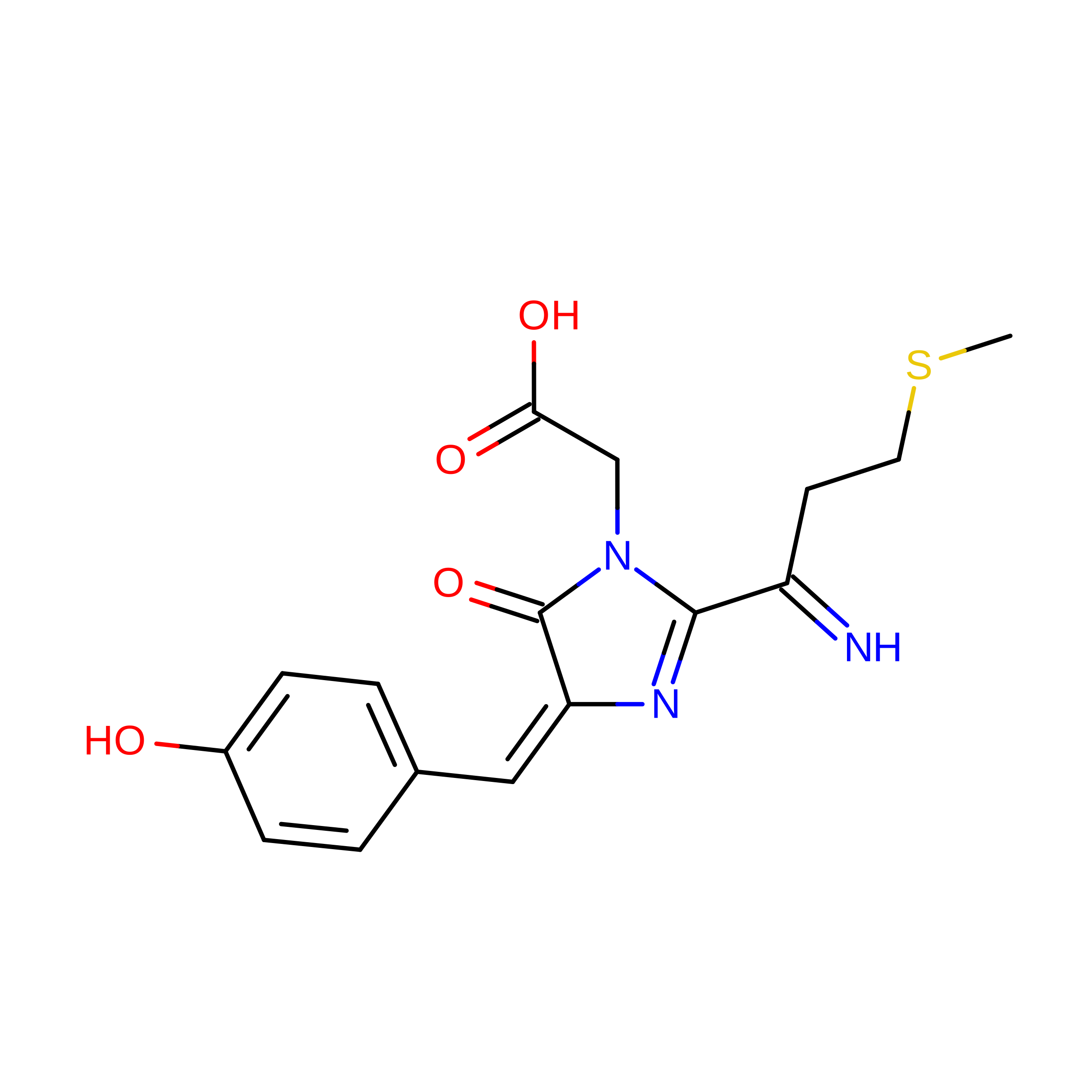
L-PEPTIDE LINKINGC16 H17 N3 O4 SMET, TYR, GLY

Experimental Data & Validation

Experimental Data

  • Method: X-RAY DIFFRACTION
  • Resolution: 2.60 Å
  • R-Value Free:  0.263 (Depositor), 0.256 (DCC) 
  • R-Value Work:  0.170 (Depositor), 0.166 (DCC) 
Space Group: P 1 21 1
Unit Cell:
Length ( Å )Angle ( ˚ )
a = 74.176α = 90
b = 104.967β = 105.81
c = 123.028γ = 90
Software Package:
Software NamePurpose
PHENIXrefinement
SCALEPACKdata scaling
REFMACrefinement
PDB_EXTRACTdata extraction
SERGUIdata collection
HKL-2000data reduction
HKL-2000data scaling
MOLREPphasing
DENZOdata reduction

Structure Validation

View Full Validation Report


Entry History 

Deposition Data

Revision History  (Full details and data files)

  • Version 1.0: 2008-07-22
    Type: Initial release
  • Version 1.1: 2011-07-13
    Changes: Version format compliance
  • Version 1.2: 2017-10-25
    Changes: Refinement description
  • Version 1.3: 2019-07-24
    Changes: Data collection, Database references, Derived calculations, Refinement description
  • Version 1.4: 2025-03-26
    Changes: Data collection, Database references, Structure summary
  • Version 2.0: 2026-03-18
    Changes: Polymer sequence