3BQ8 | pdb_00003bq8

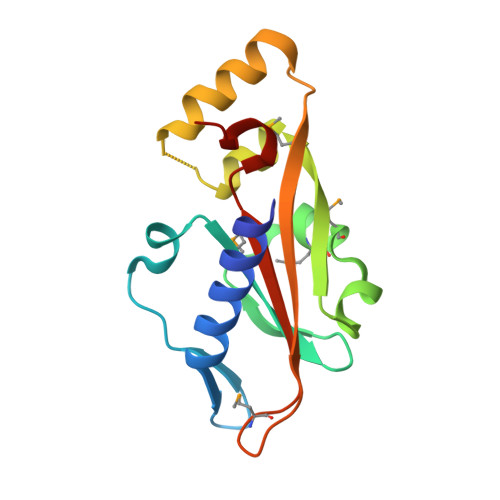
Crystal Structure of the E.coli PhoQ Sensor Domain


Experimental Data Snapshot

  • Method: X-RAY DIFFRACTION
  • Resolution: 2.50 Å
  • R-Value Free: 
    0.302 (Depositor), 0.200 (DCC) 
  • R-Value Work: 
    0.203 (Depositor), 0.209 (DCC) 
  • R-Value Observed: 
    0.203 (Depositor) 

wwPDB Validation 3D Report Full Report

Validation slider image for 3BQ8

This is version 1.3 of the entry. See complete history

Literature

Crystal Structure of a Functional Dimer of the PhoQ Sensor Domain.

Cheung, J.Bingman, C.A.Reyngold, M.Hendrickson, W.A.Waldburger, C.D.

(2008) J Biological Chem 283: 13762-13770

  • DOI: https://doi.org/10.1074/jbc.M710592200
  • Primary Citation Related Structures: 
    3BQ8, 3BQA

  • PubMed Abstract: 

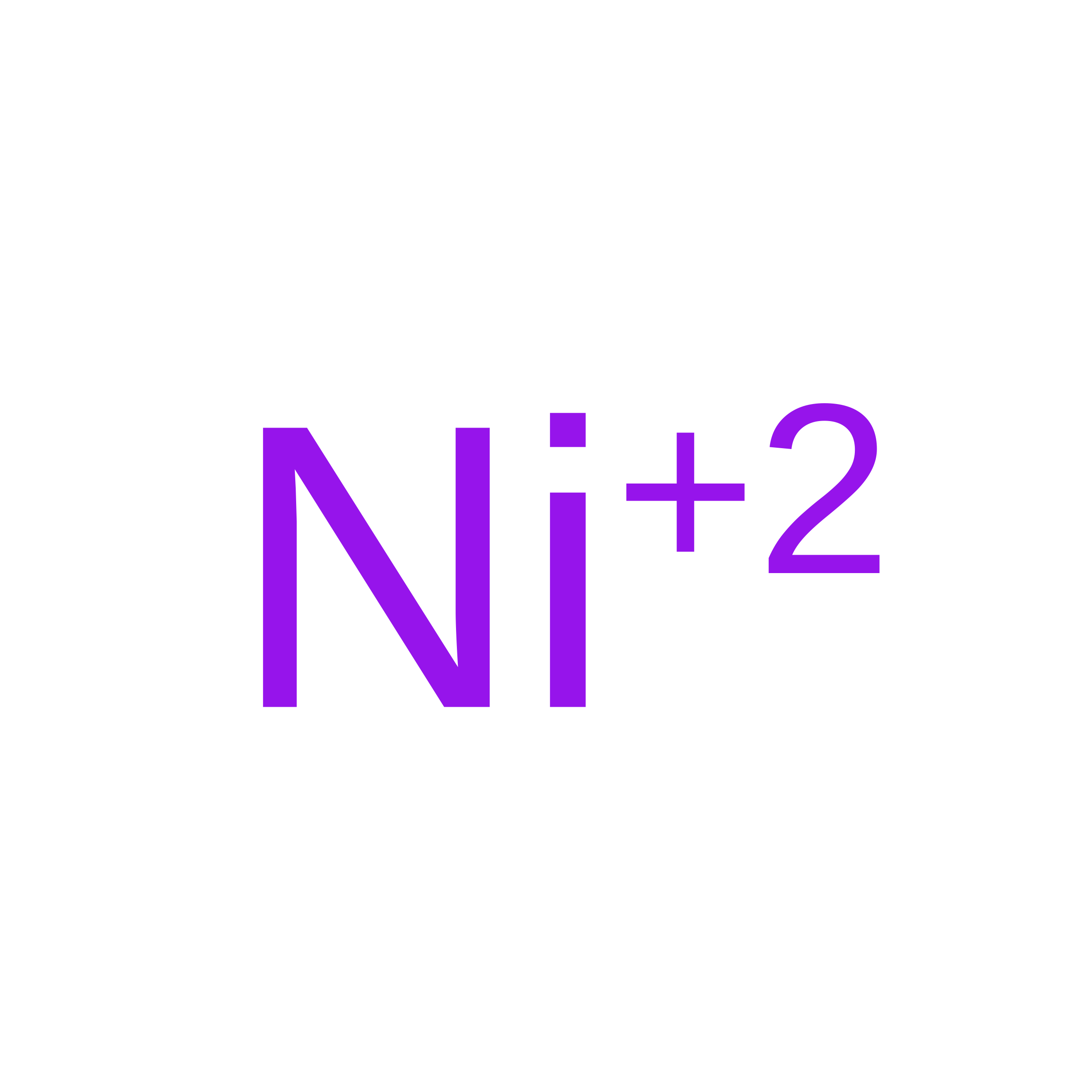
    The PhoP-PhoQ two-component system is a well studied bacterial signaling system that regulates virulence and stress response. Catalytic activity of the histidine kinase sensor protein PhoQ is activated by low extracellular concentrations of divalent cations such as Mg2+, and subsequently the response regulator PhoP is activated in turn through a classic phosphotransfer pathway that is typical in such systems. The PhoQ sensor domains of enteric bacteria contain an acidic cluster of residues (EDDDDAE) that has been implicated in direct binding to divalent cations. We have determined crystal structures of the wild-type Escherichia coli PhoQ periplasmic sensor domain and of a mutant variant in which the acidic cluster was neutralized to conservative uncharged residues (QNNNNAQ). The PhoQ domain structure is similar to that of DcuS and CitA sensor domains, and this PhoQ-DcuS-CitA (PDC) sensor fold is seen to be distinct from the superficially similar PAS domain fold. Analysis of the wild-type structure reveals a dimer that allows for the formation of a salt bridge across the dimer interface between Arg-50' and Asp-179 and with nickel ions bound to aspartate residues in the acidic cluster. The physiological importance of the salt bridge to in vivo PhoQ function has been confirmed by mutagenesis. The mutant structure has an alternative, non-physiological dimeric association.


  • Organizational Affiliation
    • Department of Biochemistry and Molecular Biophysics, Howard Hughes Medical Institute, Columbia University, New York, New York 10032, USA.

Macromolecule Content 

  • Total Structure Weight: 34.9 kDa 
  • Atom Count: 2,421 
  • Modeled Residue Count: 275 
  • Deposited Residue Count: 296 
  • Unique protein chains: 1

Macromolecules

Find similar proteins by:|  3D Structure
Entity ID: 1
MoleculeChains  Sequence LengthOrganismDetailsImage
Sensor protein phoQ
A, B
148Escherichia coliMutation(s): 0 
Gene Names: phoQ
EC: 2.7.13.3 (PDB Primary Data), 3.1.3 (UniProt)
UniProt
Find proteins for P23837 (Escherichia coli (strain K12))
Explore P23837 
Go to UniProtKB:  P23837
Entity Groups
Sequence Clusters30% Identity50% Identity70% Identity90% Identity95% Identity100% Identity
UniProt GroupP23837
Sequence Annotations
Expand
Reference Sequence

Experimental Data & Validation

Experimental Data

  • Method: X-RAY DIFFRACTION
  • Resolution: 2.50 Å
  • R-Value Free:  0.302 (Depositor), 0.200 (DCC) 
  • R-Value Work:  0.203 (Depositor), 0.209 (DCC) 
  • R-Value Observed: 0.203 (Depositor) 
Space Group: P 1 21 1
Unit Cell:
Length ( Å )Angle ( ˚ )
a = 33.591α = 90
b = 113.965β = 109.45
c = 45.528γ = 90
Software Package:
Software NamePurpose
DENZOdata reduction
SCALEPACKdata scaling
SOLVEphasing
DMphasing
CNSrefinement
PDB_EXTRACTdata extraction

Structure Validation

View Full Validation Report


Entry History 

Deposition Data

Revision History  (Full details and data files)

  • Version 1.0: 2008-03-25
    Type: Initial release
  • Version 1.1: 2011-07-13
    Changes: Version format compliance
  • Version 1.2: 2017-10-25
    Changes: Refinement description
  • Version 1.3: 2024-11-20
    Changes: Data collection, Database references, Derived calculations, Structure summary