3BLA | pdb_00003bla

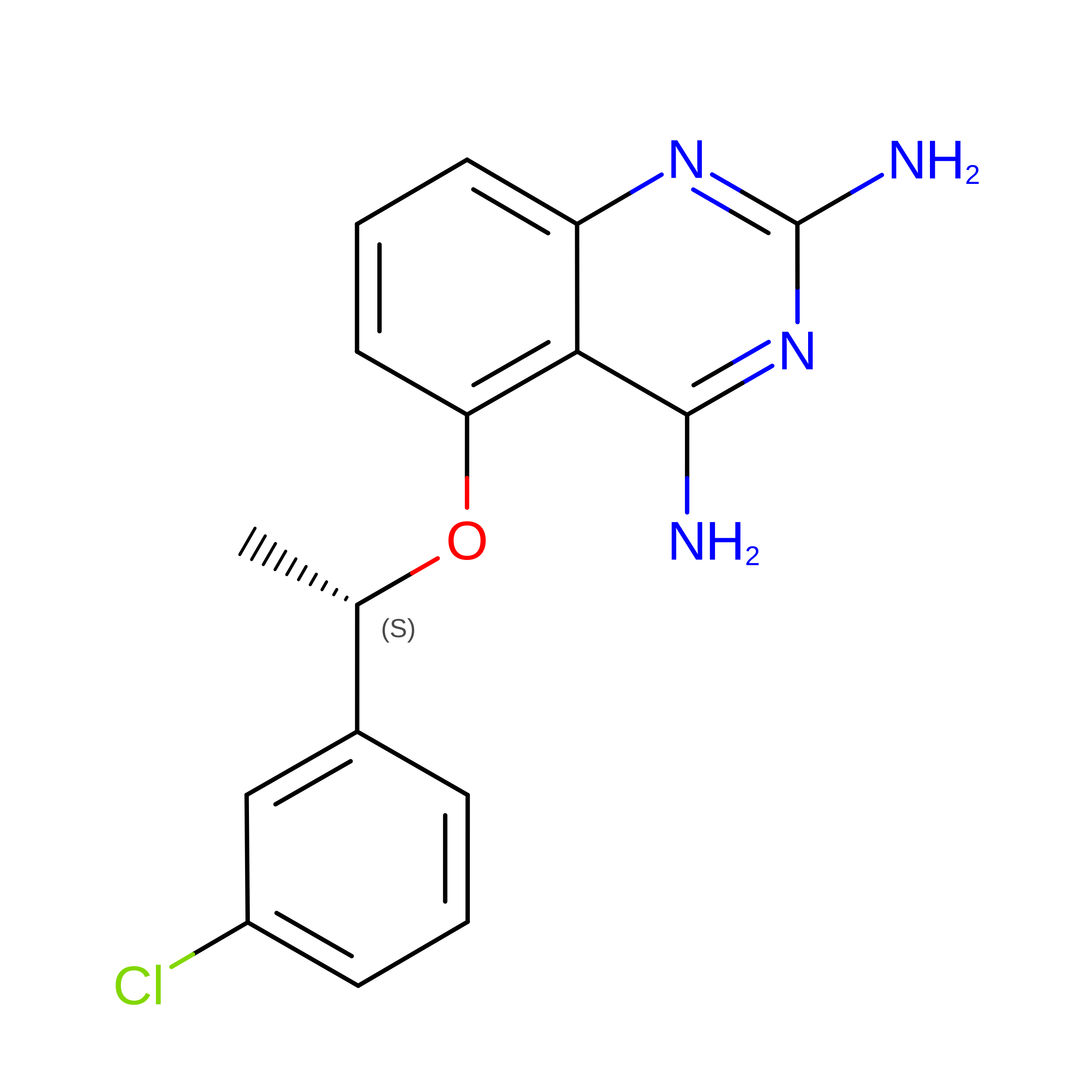
Synthetic Gene Encoded DcpS bound to inhibitor DG153249


Experimental Data Snapshot

  • Method: X-RAY DIFFRACTION
  • Resolution: 2.60 Å
  • R-Value Free: 
    0.278 (Depositor), 0.228 (DCC) 
  • R-Value Work: 
    0.210 (Depositor), 0.216 (DCC) 
  • R-Value Observed: 
    0.213 (Depositor) 

Starting Model: experimental
View more details

wwPDB Validation 3D Report Full Report

Validation slider image for 3BLA

Ligand Structure Quality Assessment 


This is version 1.2 of the entry. See complete history

Literature

DcpS as a therapeutic target for spinal muscular atrophy.

Singh, J.Salcius, M.Liu, S.W.Staker, B.L.Mishra, R.Thurmond, J.Michaud, G.Mattoon, D.R.Printen, J.Christensen, J.Bjornsson, J.M.Pollok, B.A.Kiledjian, M.Stewart, L.Jarecki, J.Gurney, M.E.

(2008) ACS Chem Biol 3: 711-722

  • DOI: https://doi.org/10.1021/cb800120t
  • Primary Citation Related Structures: 
    3BL7, 3BL9, 3BLA

  • PubMed Abstract: 

    Spinal muscular atrophy (SMA) is caused by deletion or mutation of both copies of the SMN1 gene, which produces an essential protein known as SMN. The severity of SMA is modified by variable copy number of a second gene,SMN2, which produces an mRNA that is incorrectly spliced with deletion of the last exon. We described previously the discovery of potent C5-substituted quinazolines that increase SMN2 gene expression by 2-fold. Discovery of potent SMN2 promoter inducers relied on a cellular assay without knowledge of the molecular target. Using protein microarray scanning with a radiolabeled C5-substituted quinazoline probe, we identified the scavenger decapping enzyme, DcpS, as a potential binder. We show that the C5-substituted quinazolines potently inhibit DcpS decapping activity and that the potency of inhibition correlates with potency forSMN2 promoter induction. Binding of C5-substituted quinazolines to DcpS holds the enzyme in an open, catalytically incompetent conformation. DcpS is a nuclear shuttling protein that binds and hydrolyzes the m(7)GpppN mRNA cap structure and a modulator of RNA metabolism. Therefore DcpS represents a novel therapeutic target for modulating gene expression by a small molecule.


  • Organizational Affiliation
    • deCODE chemistry, Inc., 2501 Davey Road, Woodridge, Illinois 60517, USA.

Macromolecule Content 

  • Total Structure Weight: 70.41 kDa 
  • Atom Count: 4,863 
  • Modeled Residue Count: 575 
  • Deposited Residue Count: 602 
  • Unique protein chains: 1

Macromolecules

Find similar proteins by:|  3D Structure
Entity ID: 1
MoleculeChains  Sequence LengthOrganismDetailsImage
Scavenger mRNA-decapping enzyme DcpS
A, B
301Homo sapiensMutation(s): 0 
Gene Names: DCPSDCS1HINT5
EC: 3 (PDB Primary Data), 3.6.1.59 (UniProt)
UniProt & NIH Common Fund Data Resources
Find proteins for Q96C86 (Homo sapiens)
Explore Q96C86 
Go to UniProtKB:  Q96C86
PHAROS:  Q96C86
GTEx:  ENSG00000110063 
Entity Groups
Sequence Clusters30% Identity50% Identity70% Identity90% Identity95% Identity100% Identity
UniProt GroupQ96C86
Sequence Annotations
Expand
Reference Sequence

Small Molecules

Experimental Data & Validation

Experimental Data

  • Method: X-RAY DIFFRACTION
  • Resolution: 2.60 Å
  • R-Value Free:  0.278 (Depositor), 0.228 (DCC) 
  • R-Value Work:  0.210 (Depositor), 0.216 (DCC) 
  • R-Value Observed: 0.213 (Depositor) 
Space Group: P 1
Unit Cell:
Length ( Å )Angle ( ˚ )
a = 48.73α = 117.68
b = 55.812β = 93.35
c = 59.4γ = 99.72
Software Package:
Software NamePurpose
SCALEPACKdata scaling
REFMACrefinement
PDB_EXTRACTdata extraction
HTCollectdata collection
HKL-2000data reduction
HKL-2000data scaling
MOLREPphasing

Structure Validation

View Full Validation Report


Ligand Structure Quality Assessment 


Entry History 

Deposition Data

Revision History  (Full details and data files)

  • Version 1.0: 2008-10-21
    Type: Initial release
  • Version 1.1: 2011-07-13
    Changes: Version format compliance
  • Version 1.2: 2023-08-30
    Changes: Data collection, Database references, Derived calculations, Refinement description