3BE2 | pdb_00003be2

Crystal structure of the VEGFR2 kinase domain in complex with a benzamide inhibitor


Experimental Data Snapshot

  • Method: X-RAY DIFFRACTION
  • Resolution: 1.75 Å
  • R-Value Free: 
    0.226 (Depositor), 0.221 (DCC) 
  • R-Value Work: 
    0.197 (Depositor), 0.187 (DCC) 

wwPDB Validation 3D Report Full Report

Validation slider image for 3BE2

Ligand Structure Quality Assessment 


This is version 1.5 of the entry. See complete history

Literature

Naphthamides as novel and potent vascular endothelial growth factor receptor tyrosine kinase inhibitors: design, synthesis, and evaluation.

Harmange, J.C.Weiss, M.M.Germain, J.Polverino, A.J.Borg, G.Bready, J.Chen, D.Choquette, D.Coxon, A.Demelfi, T.Dipietro, L.Doerr, N.Estrada, J.Flynn, J.Graceffa, R.F.Harriman, S.P.Kaufman, S.La, D.S.Long, A.Martin, M.W.Neervannan, S.Patel, V.F.Potashman, M.Regal, K.Roveto, P.M.Schrag, M.L.Starnes, C.Tasker, A.Teffera, Y.Wang, L.White, R.D.Whittington, D.A.Zanon, R.

(2008) J Med Chem 51: 1649-1667

  • DOI: https://doi.org/10.1021/jm701097z
  • Primary Citation Related Structures: 
    3B8Q, 3BE2

  • PubMed Abstract: 

    A series of naphthyl-based compounds were synthesized as potential inhibitors of vascular endothelial growth factor (VEGF) receptors. Investigations of structure-activity relationships led to the identification of a series of naphthamides that are potent inhibitors of the VEGF receptor tyrosine kinase family. Numerous analogues demonstrated low nanomolar inhibition of VEGF-dependent human umbilical vein endothelial cell (HUVEC) proliferation, and of these several compounds possessed favorable pharmacokinetic (PK) profiles. In particular, compound 48 demonstrated significant antitumor efficacy against established HT29 human colon adenocarcinoma xenografts implanted in athymic mice. A full account of the preparation, structure-activity relationships, pharmacokinetic properties, and pharmacology of analogues within this series is presented.


  • Organizational Affiliation
    • Department of Medicinal Chemistry, Amgen Inc., One Kendall Square, Cambridge, MA 02139, USA. harmange@amgen.com

Macromolecule Content 

  • Total Structure Weight: 36.82 kDa 
  • Atom Count: 2,654 
  • Modeled Residue Count: 290 
  • Deposited Residue Count: 314 
  • Unique protein chains: 1

Macromolecules

Find similar proteins by:|  3D Structure
Entity ID: 1
MoleculeChains  Sequence LengthOrganismDetailsImage
Vascular endothelial growth factor receptor 2314Homo sapiensMutation(s): 3 
Gene Names: KDRFLK1
EC: 2.7.10.1
UniProt & NIH Common Fund Data Resources
Find proteins for P35968 (Homo sapiens)
Explore P35968 
Go to UniProtKB:  P35968
PHAROS:  P35968
GTEx:  ENSG00000128052 
Entity Groups
Sequence Clusters30% Identity50% Identity70% Identity90% Identity95% Identity100% Identity
UniProt GroupP35968
Sequence Annotations
Expand
Reference Sequence

Small Molecules

Ligands 1 Unique
IDChains Name / Formula / InChI Key2D Diagram3D Interactions
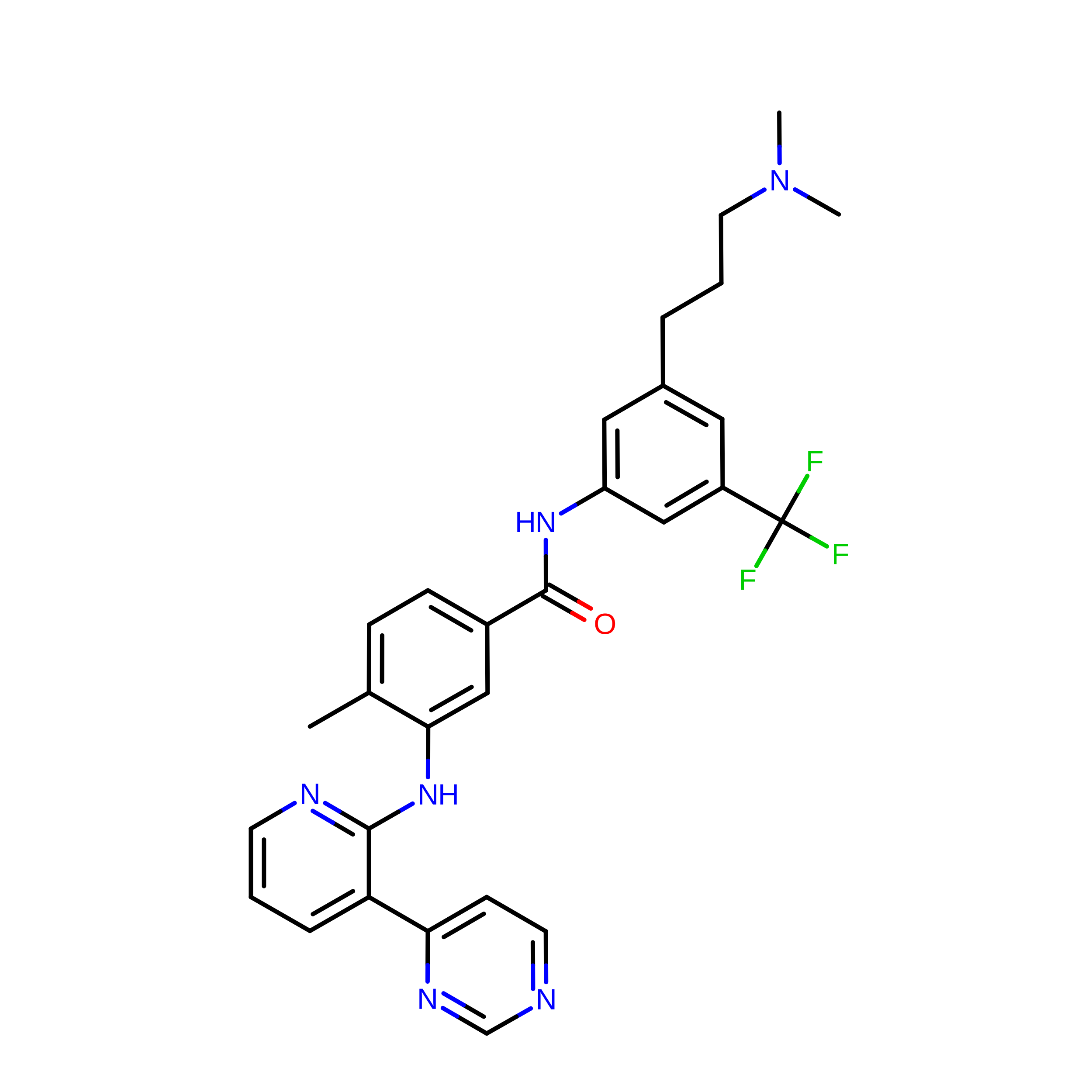
RAJ

Query on RAJ


Download:Ideal Coordinates CCD File
B [auth A]N-{3-[3-(DIMETHYLAMINO)PROPYL]-5-(TRIFLUOROMETHYL)PHENYL}-4-METHYL-3-[(3-PYRIMIDIN-4-YLPYRIDIN-2-YL)AMINO]BENZAMIDE
C29 H29 F3 N6 O
OHHGYJBFPVJURR-UHFFFAOYSA-N
Modified Residues  1 Unique
IDChains TypeFormula2D DiagramParent
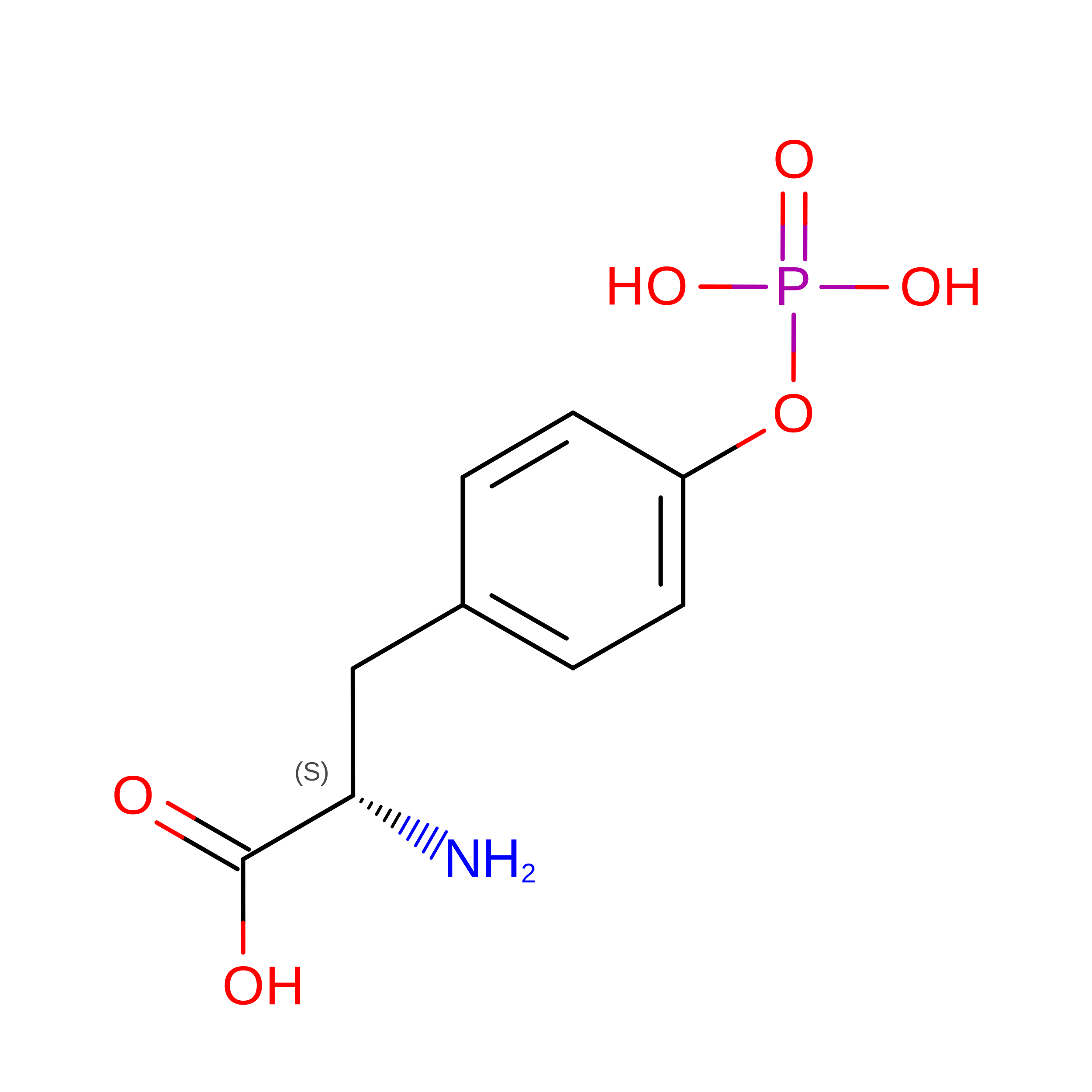
PTR
Query on PTR
A
L-PEPTIDE LINKINGC9 H12 N O6 PTYR

Experimental Data & Validation

Experimental Data

  • Method: X-RAY DIFFRACTION
  • Resolution: 1.75 Å
  • R-Value Free:  0.226 (Depositor), 0.221 (DCC) 
  • R-Value Work:  0.197 (Depositor), 0.187 (DCC) 
Space Group: P 1 21 1
Unit Cell:
Length ( Å )Angle ( ˚ )
a = 41.77α = 90
b = 84.38β = 100.09
c = 47.57γ = 90
Software Package:
Software NamePurpose
SCALEPACKdata scaling
EPMRphasing
CNSrefinement
PDB_EXTRACTdata extraction
DENZOdata reduction
CNSphasing

Structure Validation

View Full Validation Report


Ligand Structure Quality Assessment 


Entry History 

Deposition Data

Revision History  (Full details and data files)

  • Version 1.0: 2008-04-08
    Type: Initial release
  • Version 1.1: 2011-07-13
    Changes: Version format compliance
  • Version 1.2: 2017-07-26
    Changes: Refinement description, Source and taxonomy
  • Version 1.3: 2021-10-20
    Changes: Database references, Derived calculations
  • Version 1.4: 2024-02-21
    Changes: Data collection
  • Version 1.5: 2024-11-06
    Changes: Structure summary