3A56 | pdb_00003a56

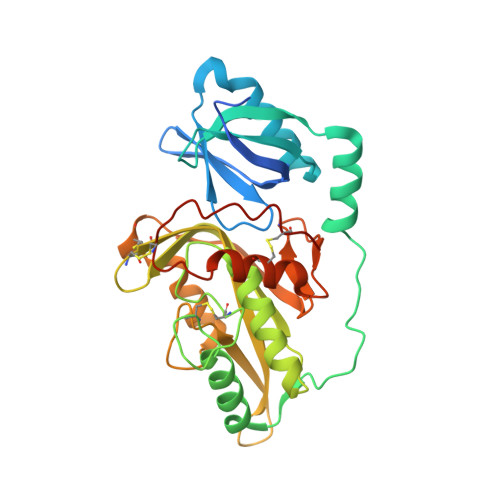
Crystal structure of pro- protein-glutaminase


Experimental Data Snapshot

  • Method: X-RAY DIFFRACTION
  • Resolution: 1.73 Å
  • R-Value Free: 
    0.206 (Depositor), 0.201 (DCC) 
  • R-Value Work: 
    0.175 (Depositor), 0.171 (DCC) 
  • R-Value Observed: 
    0.176 (Depositor) 

Starting Model: experimental
View more details

wwPDB Validation 3D Report Full Report

Validation slider image for 3A56

This is version 1.4 of the entry. See complete history

Literature

Crystal structures of protein glutaminase and its pro forms converted into enzyme-substrate complex

Hashizume, R.Maki, Y.Mizutani, K.Takahashi, N.Matsubara, H.Sugita, A.Sato, K.Yamaguchi, S.Mikami, B.

(2011) J Biological Chem 286: 38691-38702

  • DOI: https://doi.org/10.1074/jbc.M111.255133
  • Primary Citation Related Structures: 
    2ZK9, 3A54, 3A55, 3A56

  • PubMed Abstract: 

    Protein glutaminase, which converts a protein glutamine residue to a glutamate residue, is expected to be useful as a new food-processing enzyme. The crystal structures of the mature and pro forms of the enzyme were refined at 1.15 and 1.73 Å resolution, respectively. The overall structure of the mature enzyme has a weak homology to the core domain of human transglutaminase-2. The catalytic triad (Cys-His-Asp) common to transglutaminases and cysteine proteases is located in the bottom of the active site pocket. The structure of the recombinant pro form shows that a short loop between S2 and S3 in the proregion covers and interacts with the active site of the mature region, mimicking the protein substrate of the enzyme. Ala-47 is located just above the pocket of the active site. Two mutant structures (A47Q-1 and A47Q-2) refined at 1.5 Å resolution were found to correspond to the enzyme-substrate complex and an S-acyl intermediate. Based on these structures, the catalytic mechanism of protein glutaminase is proposed.


  • Organizational Affiliation
    • Laboratory of Applied Structural Biology, Division of Applied Life Sciences, Graduate School of Agriculture, Kyoto University, Gokasho, Uji, Kyoto 611-0011, Japan.

Macromolecule Content 

  • Total Structure Weight: 67.49 kDa 
  • Atom Count: 5,397 
  • Modeled Residue Count: 563 
  • Deposited Residue Count: 610 
  • Unique protein chains: 1

Macromolecules

Find similar proteins by:|  3D Structure
Entity ID: 1
MoleculeChains  Sequence LengthOrganismDetailsImage
Protein-glutaminase
A, B
305Chryseobacterium proteolyticumMutation(s): 0 
Gene Names: prgA
EC: 3.5.1 (PDB Primary Data), 3.5.1.44 (UniProt)
UniProt
Find proteins for Q9AQQ8 (Chryseobacterium proteolyticum)
Explore Q9AQQ8 
Go to UniProtKB:  Q9AQQ8
Entity Groups
Sequence Clusters30% Identity50% Identity70% Identity90% Identity95% Identity100% Identity
UniProt GroupQ9AQQ8
Sequence Annotations
Expand
Reference Sequence

Experimental Data & Validation

Experimental Data

  • Method: X-RAY DIFFRACTION
  • Resolution: 1.73 Å
  • R-Value Free:  0.206 (Depositor), 0.201 (DCC) 
  • R-Value Work:  0.175 (Depositor), 0.171 (DCC) 
  • R-Value Observed: 0.176 (Depositor) 
Space Group: P 21 21 21
Unit Cell:
Length ( Å )Angle ( ˚ )
a = 56.644α = 90
b = 103.29β = 90
c = 132.51γ = 90
Software Package:
Software NamePurpose
HKL-2000data collection
PHASESphasing
PHENIXrefinement
HKL-2000data reduction
HKL-2000data scaling

Structure Validation

View Full Validation Report


Entry History 

Deposition Data

Revision History  (Full details and data files)

  • Version 1.0: 2010-08-11
    Type: Initial release
  • Version 1.1: 2011-07-13
    Changes: Version format compliance
  • Version 1.2: 2012-08-29
    Changes: Database references
  • Version 1.3: 2023-11-01
    Changes: Data collection, Database references, Derived calculations, Refinement description
  • Version 1.4: 2024-11-20
    Changes: Structure summary