3A3W | pdb_00003a3w

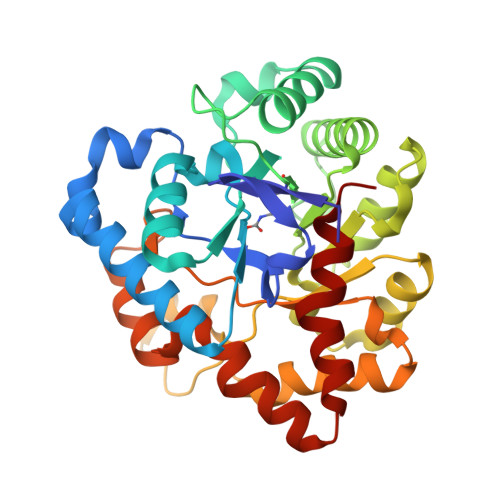
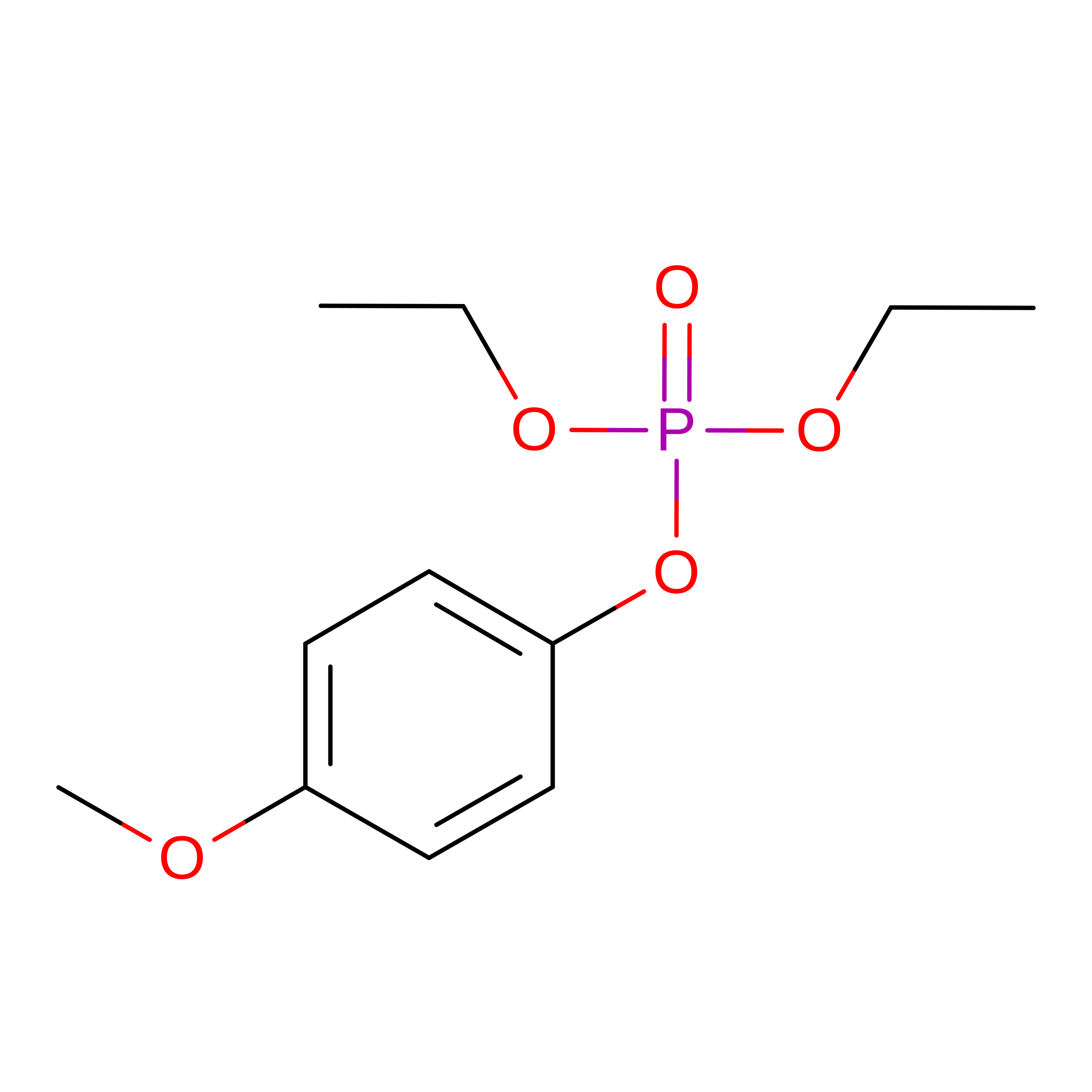
Structure of OpdA mutant (G60A/A80V/S92A/R118Q/K185R/Q206P/D208G/I260T/G273S) with diethyl 4-methoxyphenyl phosphate bound in the active site


Experimental Data Snapshot

  • Method: X-RAY DIFFRACTION
  • Resolution: 1.85 Å
  • R-Value Free: 
    0.209 (Depositor), 0.208 (DCC) 
  • R-Value Work: 
    0.174 (Depositor), 0.175 (DCC) 
  • R-Value Observed: 
    0.176 (Depositor) 

Starting Model: experimental
View more details

wwPDB Validation 3D Report Full Report

Validation slider image for 3A3W

Ligand Structure Quality Assessment 


This is version 1.4 of the entry. See complete history

Literature

Conformational sampling, catalysis, and evolution of the bacterial phosphotriesterase

Jackson, C.J.Foo, J.-L.Tokuriki, N.Afriat, L.Carr, P.D.Kim, H.-K.Schenk, G.Tawfik, D.S.Ollis, D.L.

(2009) Proc Natl Acad Sci U S A 

  • DOI: https://doi.org/10.1073/pnas.0907548106
  • Primary Citation Related Structures: 
    3A3W, 3A3X, 3A4J

  • PubMed Abstract: 

    To efficiently catalyze a chemical reaction, enzymes are required to maintain fast rates for formation of the Michaelis complex, the chemical reaction and product release. These distinct demands could be satisfied via fluctuation between different conformational substates (CSs) with unique configurations and catalytic properties. However, there is debate as to how these rapid conformational changes, or dynamics, exactly affect catalysis. As a model system, we have studied bacterial phosphotriesterase (PTE), which catalyzes the hydrolysis of the pesticide paraoxon at rates limited by a physical barrier-either substrate diffusion or conformational change. The mechanism of paraoxon hydrolysis is understood in detail and is based on a single, dominant, enzyme conformation. However, the other aspects of substrate turnover (substrate binding and product release), although possibly rate-limiting, have received relatively little attention. This work identifies "open" and "closed" CSs in PTE and dominant structural transition in the enzyme that links them. The closed state is optimally preorganized for paraoxon hydrolysis, but seems to block access to/from the active site. In contrast, the open CS enables access to the active site but is poorly organized for hydrolysis. Analysis of the structural and kinetic effects of mutations distant from the active site suggests that remote mutations affect the turnover rate by altering the conformational landscape.


  • Organizational Affiliation
    • Institut de Biologie Structurale, 38000 Grenoble, France. colin.jackson@ibs.fr

Macromolecule Content 

  • Total Structure Weight: 36.02 kDa 
  • Atom Count: 2,822 
  • Modeled Residue Count: 329 
  • Deposited Residue Count: 329 
  • Unique protein chains: 1

Macromolecules

Find similar proteins by:|  3D Structure
Entity ID: 1
MoleculeChains  Sequence LengthOrganismDetailsImage
Phosphotriesterase329Agrobacterium tumefaciensMutation(s): 9 
Gene Names: opdA
EC: 3.1.8.1
UniProt
Find proteins for Q93LD7 (Agrobacterium tumefaciens)
Explore Q93LD7 
Go to UniProtKB:  Q93LD7
Entity Groups
Sequence Clusters30% Identity50% Identity70% Identity90% Identity95% Identity100% Identity
UniProt GroupQ93LD7
Sequence Annotations
Expand
Reference Sequence

Small Molecules

Modified Residues  1 Unique
IDChains TypeFormula2D DiagramParent
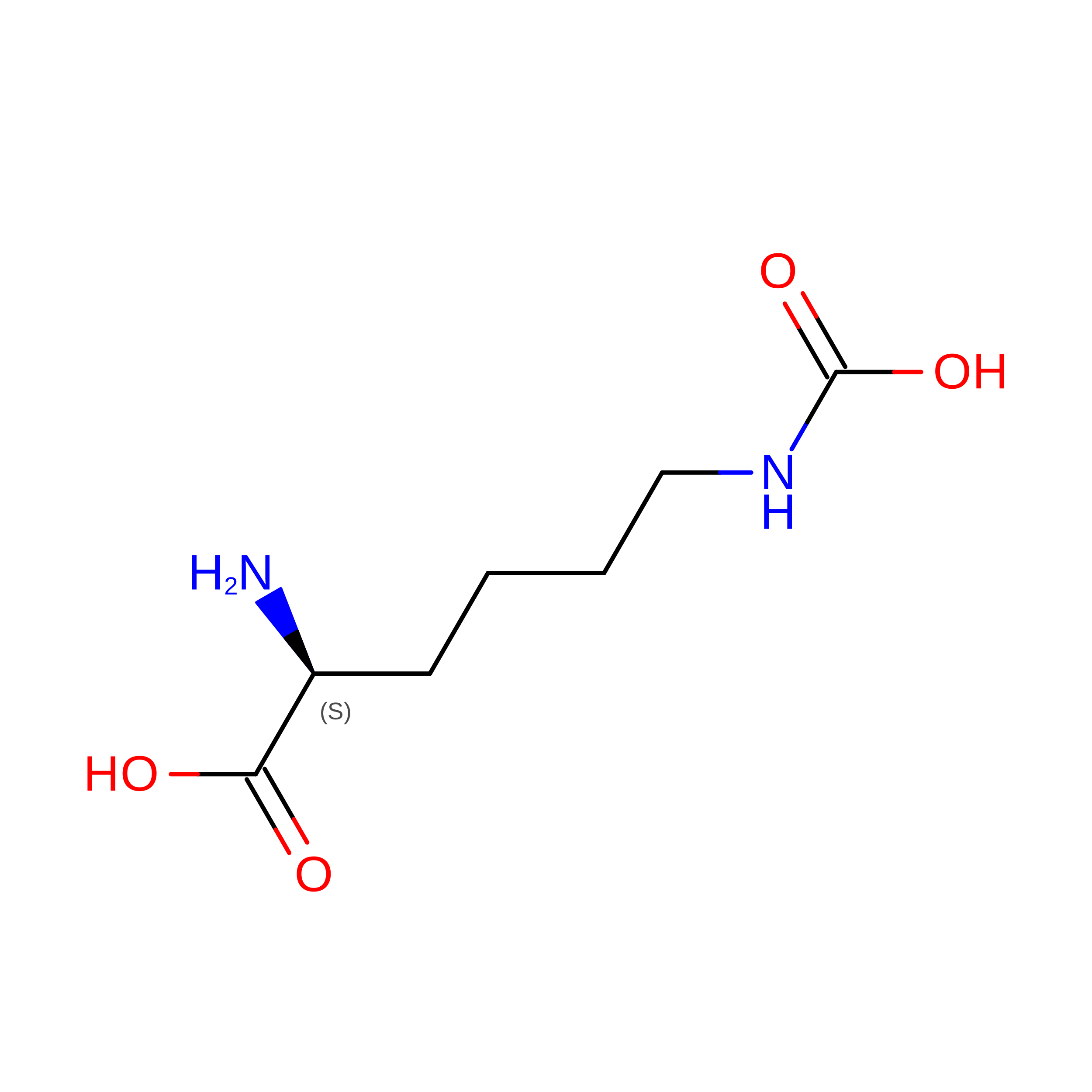
KCX
Query on KCX
A
L-PEPTIDE LINKINGC7 H14 N2 O4LYS

Experimental Data & Validation

Experimental Data

  • Method: X-RAY DIFFRACTION
  • Resolution: 1.85 Å
  • R-Value Free:  0.209 (Depositor), 0.208 (DCC) 
  • R-Value Work:  0.174 (Depositor), 0.175 (DCC) 
  • R-Value Observed: 0.176 (Depositor) 
Space Group: P 31 2 1
Unit Cell:
Length ( Å )Angle ( ˚ )
a = 109.011α = 90
b = 109.011β = 90
c = 62.689γ = 120
Software Package:
Software NamePurpose
REFMACrefinement
CrystalCleardata collection
DENZOdata reduction
SCALEPACKdata scaling
AMoREphasing

Structure Validation

View Full Validation Report


Ligand Structure Quality Assessment 


Entry History 

Deposition Data

Revision History  (Full details and data files)

  • Version 1.0: 2010-01-12
    Type: Initial release
  • Version 1.1: 2011-07-13
    Changes: Version format compliance
  • Version 1.2: 2021-11-10
    Changes: Database references, Derived calculations
  • Version 1.3: 2023-11-01
    Changes: Data collection, Refinement description
  • Version 1.4: 2023-11-15
    Changes: Data collection