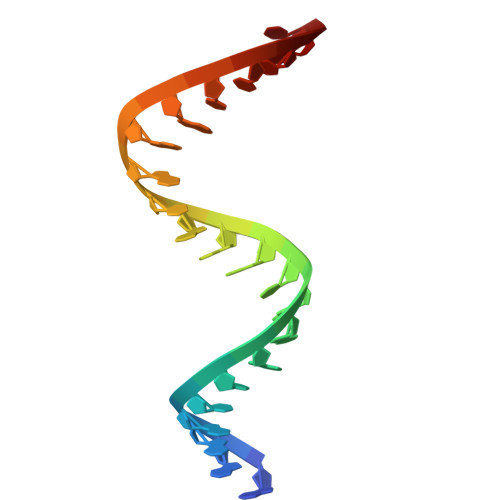
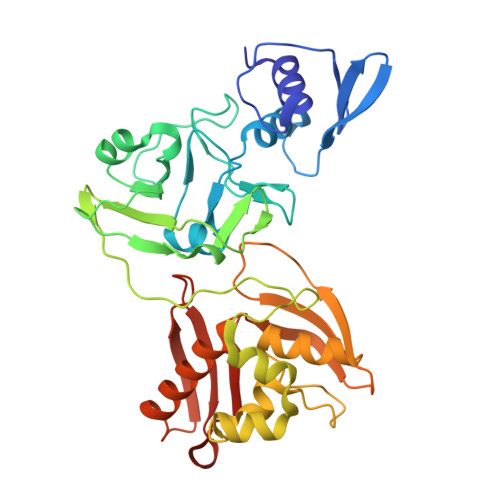
37KX | pdb_000037kx

Gammacoronavirus IBV dsRNA-bound nsp15


Experimental Data Snapshot

  • Method: ELECTRON MICROSCOPY
  • Resolution: 3.00 Å
  • Aggregation State: PARTICLE 
  • Reconstruction Method: SINGLE PARTICLE 

Starting Model: experimental
View more details

wwPDB Validation 3D Report Full Report

Validation slider image for 37KX

This is version 1.1 of the entry. See complete history. 

Literature

Structural and biochemical analysis of the IBV nsp15 endoribonuclease reveals the necessity of peripheral site residues for activity.

Tully, E.S., Kirchdoerfer, R.N.

(2026) bioRxiv 

  • DOI: https://doi.org/10.64898/2026.08.28.747898
  • Primary Citation Related Structures: 
    37IX, 37KX, 37UN, 37UO

  • PubMed Abstract: 

    Infectious bronchitis virus (IBV) is a member of the Gammacoronavirus genus responsible for respiratory illness and weakened eggshells in infected chickens, adversely impacting the poultry industry. Escaping innate immune detection during infection is crucial for coronavirus proliferation in the host. The production of double-stranded RNA during coronavirus replication triggers innate immune sensors to create an antiviral state within infected cells. To counter this response, coronaviruses employ nonstructural protein 15 (nsp15) endoribonuclease to degrade double-stranded RNA. Here, we use cryo-electron microscopy and biochemistry to characterize IBV nsp15's interactions with RNA. While the overall structure and active site of IBV nsp15 strongly resemble previous studies of nsp15 from other coronaviral genera, we note that double-stranded RNA contacts several non-conserved residues peripheral to the enzyme active site. Our data show that these residue positions can have strong impacts on RNA cleavage suggesting unique solutions for RNA engagement across coronavirus species. We also demonstrate a preference for IBV nsp15 to cleave double-stranded RNA over single-stranded RNA and observe nsp15 hexamers with two double-stranded RNAs bound simultaneously. This study reenforces the need to study diverse coronavirus species to identify distinct viral enzyme characteristics.

Macromolecule Content 

  • Total Structure Weight: 243.76 kDa 
  • Atom Count: 17,056 
  • Modeled Residue Count: 2,076 
  • Deposited Residue Count: 2,082 
  • Unique protein chains: 1
  • Unique nucleic acid chains: 2

Macromolecules


Find similar proteins by:|  3D Structure
Entity ID: 1
MoleculeChains  Sequence LengthOrganismDetailsImage
nonstructural protein 15
A, B, C, D, E
A, B, C, D, E, F
340Infectious bronchitis virusMutation(s): 0 
Gene Names: 1b
UniProt
Find proteins for G4XMQ6 (Infectious bronchitis virus)
Explore G4XMQ6 
Go to UniProtKB:  G4XMQ6
Entity Groups
Sequence Clusters30% Identity50% Identity70% Identity90% Identity95% Identity100% Identity
UniProt GroupG4XMQ6
Sequence Annotations
Expand
Reference Sequence
Find similar nucleic acids by:  Sequence
Entity ID: 2
MoleculeChains LengthOrganismImage
RNA (20-MER)20synthetic RNA
Sequence Annotations
Expand
Reference Sequence
Find similar nucleic acids by:  Sequence
Entity ID: 3
MoleculeChains LengthOrganismImage
RNA (22-MER)22synthetic RNA
Sequence Annotations
Expand
Reference Sequence

Experimental Data & Validation

Experimental Data

  • Method: ELECTRON MICROSCOPY
  • Resolution: 3.00 Å
  • Aggregation State: PARTICLE 
  • Reconstruction Method: SINGLE PARTICLE 
EM Software:
TaskSoftware PackageVersion
RECONSTRUCTIONcryoSPARC4.6
MODEL REFINEMENTPHENIX1.21.2_5419
MODEL REFINEMENTISOLDE1.12
MODEL REFINEMENTCoot0.9.8.95

Structure Validation

View Full Validation Report


Entry History 

& Funding Information

Deposition Data


Funding OrganizationLocationGrant Number
National Institutes of Health/National Institute Of Allergy and Infectious Diseases (NIH/NIAID)United StatesAI159945

Revision History  (Full details and data files)

  • Version 1.0: 2026-09-09
    Type: Initial release
  • Version 1.1: 2026-11-04
    Changes: Data collection, Database references