Download Mendeley
Design and structural basis of selective nonsteroidal inhibitors of aster cholesterol trafficking.
Kim, H., Romartinez-Alonso, B., Xiao, X., Gao, Y., Kennelly, J.P., Ferrari, A., Li, R., Cui, L., Whang, E., Schwabe, J.W.R., Jung, M.E., Tontonoz, P.(2026) Proc Natl Acad Sci U S A 123: e2617638123-e2617638123
- PubMed: 42679036 Search on PubMed
- DOI: https://doi.org/10.1073/pnas.2617638123
- Primary Citation Related Structures:
30JI, 30JR - PubMed Abstract:
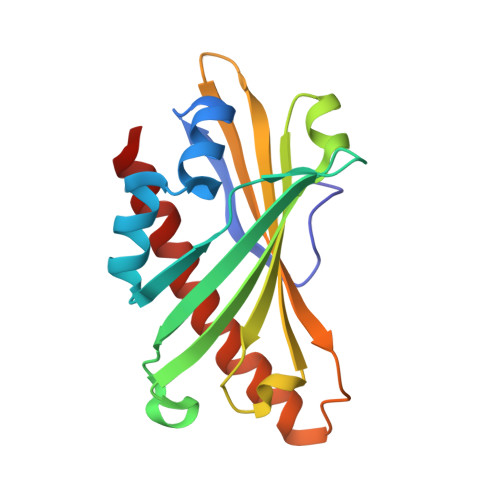
Aster proteins (Aster-A, -B, and -C) are crucial for transporting cholesterol from the plasma membrane (PM) to the endoplasmic reticulum (ER). Asters are expressed in a cell type-specific manner across tissues. Their global disruption leads to varied physiological outcomes given the diverse roles of cholesterol throughout the body. We previously identified sterol analogs, such AI-3d, that inhibit all three Aster proteins. However, their utility is limited by toxicity and off-target effects. Here, we report the development of nonsteroidal Aster inhibitors that are active in cells and in vivo, using binding-guided design to generate compounds with isoform-selective affinities. We found that YKJ-124 is a low-toxicity, Aster-A-preferring inhibitor that elevates PM-accessible cholesterol in primary T cells and potentiates store-operated Ca 2+ entry in Th17 cells, phenocopying Aster-A deficiency. YKJ-300 and YKJ-305 selectively target Aster-C; cocrystal structures and point mutation studies reveal a Ser477-dependent hydrogen bond (Gly in Aster-A/B) that underlies this specificity. We also explored the in vivo consequences of pharmacologic Aster-C inhibition. YKJ-305 treatment of mice blunted fasting-induced hepatic cholesterol transport and cholesterol ester formation, accompanied by compensatory activation of the SREBP2 pathway. Last, we also identify broader-spectrum inhibitors (YKJ-86) and dual Aster-A/C inhibitors (YKJ-262) that drive PM cholesterol accumulation in fibroblasts and human intestinal enteroids. Together, these chemical probes enable isoform-resolved manipulation of Aster-dependent cholesterol trafficking and provide a foundation for developing Aster-targeted therapies for cholesterol dysregulation.
- Department of Chemistry, University of California, Los Angeles, CA 90095.
Organizational Affiliation: