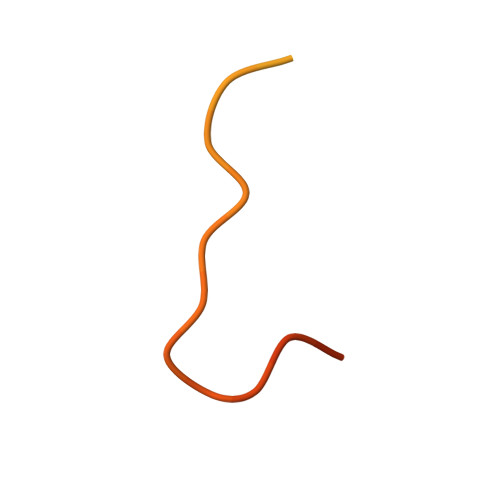
2RPQ | pdb_00002rpq

Solution Structure of a SUMO-interacting motif of MBD1-containing chromatin-associated factor 1 bound to SUMO-3


Experimental Data Snapshot

  • Method: SOLUTION NMR
  • Conformers Calculated: 20 
  • Conformers Submitted: 20 
  • Selection Criteria: all calculated structures submitted 

wwPDB Validation 3D Report Full Report

Validation slider image for 2RPQ

This is version 1.3 of the entry. See complete history

Literature

Structure of the small ubiquitin-like modifier (SUMO)-interacting motif of MBD1-containing chromatin-associated factor 1 bound to SUMO-3

Sekiyama, N.Ikegami, T.Yamane, T.Ikeguchi, M.Uchimura, Y.Baba, D.Ariyoshi, M.Tochio, H.Saitoh, H.Shirakawa, M.

(2008) J Biological Chem 283: 35966-35975

  • DOI: https://doi.org/10.1074/jbc.M802528200
  • Primary Citation Related Structures: 
    2RPQ

  • PubMed Abstract: 

    Post-translational modification by small ubiquitin-like modifier (SUMO) proteins has been implicated in the regulation of a variety of cellular events. The functions of sumoylation are often mediated by downstream effector proteins harboring SUMO-interacting motifs (SIMs) that are composed of a hydrophobic core and a stretch of acidic residues. MBD1-containing chromatin-associated factor 1 (MCAF1), a transcription repressor, interacts with SUMO-2/3 and SUMO-1, with a preference for SUMO-2/3. We used NMR spectroscopy to solve the solution structure of the SIM of MCAF1 bound to SUMO-3. The hydrophobic core of the SIM forms a parallel beta-sheet pairing with strand beta2 of SUMO-3, whereas its C-terminal acidic stretch seems to mediate electrostatic interactions with a surface area formed by basic residues of SUMO-3. The significance of these electrostatic interactions was shown by mutations of both SUMO-3 and MCAF1. The present structural and biochemical data suggest that the acidic stretch of the SIM of MCAF1 plays an important role in the binding to SUMO-3.


  • Organizational Affiliation
    • Graduate School of Engineering, Kyoto University, Kyoto 615-8510, Japan.

Macromolecule Content 

  • Total Structure Weight: 15.54 kDa 
  • Atom Count: 826 
  • Modeled Residue Count: 104 
  • Deposited Residue Count: 142 
  • Unique protein chains: 2

Macromolecules

Find similar proteins by:|  3D Structure
Entity ID: 1
MoleculeChains  Sequence LengthOrganismDetailsImage
Small ubiquitin-related modifier 293Homo sapiensMutation(s): 0 
UniProt & NIH Common Fund Data Resources
Find proteins for P61956 (Homo sapiens)
Explore P61956 
Go to UniProtKB:  P61956
PHAROS:  P61956
GTEx:  ENSG00000188612 
Entity Groups
Sequence Clusters30% Identity50% Identity70% Identity90% Identity95% Identity100% Identity
UniProt GroupP61956
Sequence Annotations
Expand
Reference Sequence
Find similar proteins by:|  3D Structure
Entity ID: 2
MoleculeChains  Sequence LengthOrganismDetailsImage
Activating transcription factor 7-interacting protein 149N/AMutation(s): 0 
UniProt & NIH Common Fund Data Resources
Find proteins for Q6VMQ6 (Homo sapiens)
Explore Q6VMQ6 
Go to UniProtKB:  Q6VMQ6
PHAROS:  Q6VMQ6
GTEx:  ENSG00000171681 
Entity Groups
Sequence Clusters30% Identity50% Identity70% Identity90% Identity95% Identity100% Identity
UniProt GroupQ6VMQ6
Sequence Annotations
Expand
Reference Sequence

Experimental Data & Validation

Experimental Data

  • Method: SOLUTION NMR
  • Conformers Calculated: 20 
  • Conformers Submitted: 20 
  • Selection Criteria: all calculated structures submitted 

Structure Validation

View Full Validation Report


Entry History 

Deposition Data

Revision History  (Full details and data files)

  • Version 1.0: 2008-10-07
    Type: Initial release
  • Version 1.1: 2011-07-13
    Changes: Version format compliance
  • Version 1.2: 2015-12-09
    Changes: Database references
  • Version 1.3: 2024-05-01
    Changes: Data collection, Database references, Derived calculations