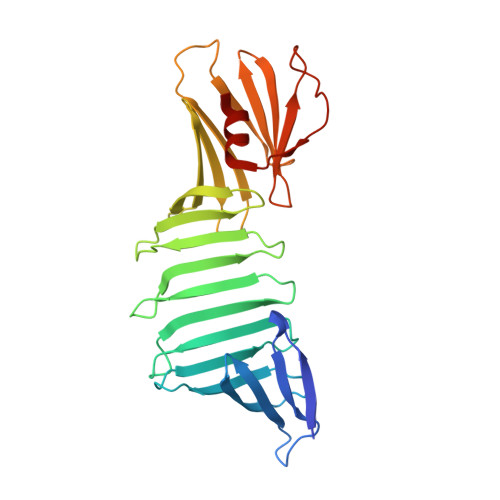
2PI3 | pdb_00002pi3

The crystal structure of OspA mutant


Experimental Data Snapshot

  • Method: X-RAY DIFFRACTION
  • Resolution: 1.40 Å
  • R-Value Free: 
    0.207 (Depositor), 0.214 (DCC) 
  • R-Value Work: 
    0.169 (Depositor), 0.178 (DCC) 
  • R-Value Observed: 
    0.171 (Depositor) 

Starting Model: experimental
View more details

wwPDB Validation 3D Report Full Report

Validation slider image for 2PI3

This is version 1.4 of the entry. See complete history

Literature

Aromatic cluster mutations produce focal modulations of beta-sheet structure.

Biancalana, M.Makabe, K.Yan, S.Koide, S.

(2015) Protein Sci 24: 841-849

  • DOI: https://doi.org/10.1002/pro.2657
  • Primary Citation Related Structures: 
    2OY5, 2PI3, 3AUM

  • PubMed Abstract: 

    Site-directed mutagenesis is a powerful tool for altering the structure and function of proteins in a focused manner. Here, we examined how a model β-sheet protein could be tuned by mutation of numerous surface-exposed residues to aromatic amino acids. We designed these aromatic side chain "clusters" at highly solvent-exposed positions in the flat, single-layer β-sheet of Borrelia outer surface protein A (OspA). This unusual β-sheet scaffold allows us to interrogate the effects of these mutations in the context of well-defined structure but in the absence of the strong scaffolding effects of globular protein architecture. We anticipated that the introduction of a cluster of aromatic amino acid residues on the β-sheet surface would result in large conformational changes and/or stabilization and thereby provide new means of controlling the properties of β-sheets. Surprisingly, X-ray crystal structures revealed that the introduction of aromatic clusters produced only subtle conformational changes in the OspA β-sheet. Additionally, despite burying a large degree of hydrophobic surface area, the aromatic cluster mutants were slightly less stable than the wild-type scaffold. These results thereby demonstrate that the introduction of aromatic cluster mutations can serve as a means for subtly modulating β-sheet conformation in protein design.


  • Organizational Affiliation
    • Department of Biochemistry and Molecular Biology, The University of Chicago, 929 East 57th Street, Chicago, Illinois, 60637.

Macromolecule Content 

  • Total Structure Weight: 26.52 kDa 
  • Atom Count: 2,278 
  • Modeled Residue Count: 246 
  • Deposited Residue Count: 251 
  • Unique protein chains: 1

Macromolecules

Find similar proteins by:|  3D Structure
Entity ID: 1
MoleculeChains  Sequence LengthOrganismDetailsImage
Outer surface protein AA [auth O]251Borreliella burgdorferiMutation(s): 15 
Gene Names: ospA
UniProt
Find proteins for P0CL66 (Borreliella burgdorferi (strain ATCC 35210 / DSM 4680 / CIP 102532 / B31))
Explore P0CL66 
Go to UniProtKB:  P0CL66
Entity Groups
Sequence Clusters30% Identity50% Identity70% Identity90% Identity95% Identity100% Identity
UniProt GroupP0CL66
Sequence Annotations
Expand
Reference Sequence

Experimental Data & Validation

Experimental Data

  • Method: X-RAY DIFFRACTION
  • Resolution: 1.40 Å
  • R-Value Free:  0.207 (Depositor), 0.214 (DCC) 
  • R-Value Work:  0.169 (Depositor), 0.178 (DCC) 
  • R-Value Observed: 0.171 (Depositor) 
Space Group: P 1 21 1
Unit Cell:
Length ( Å )Angle ( ˚ )
a = 36.133α = 90
b = 55.617β = 98.97
c = 66.124γ = 90
Software Package:
Software NamePurpose
REFMACrefinement
HKL-2000data collection
HKL-2000data reduction
HKL-2000data scaling
MOLREPphasing

Structure Validation

View Full Validation Report


Entry History 

Deposition Data

Revision History  (Full details and data files)

  • Version 1.0: 2008-05-27
    Type: Initial release
  • Version 1.1: 2011-07-13
    Changes: Version format compliance
  • Version 1.2: 2018-05-30
    Changes: Data collection, Database references, Source and taxonomy
  • Version 1.3: 2021-10-20
    Changes: Database references
  • Version 1.4: 2023-08-30
    Changes: Data collection, Refinement description