2KAE | pdb_00002kae

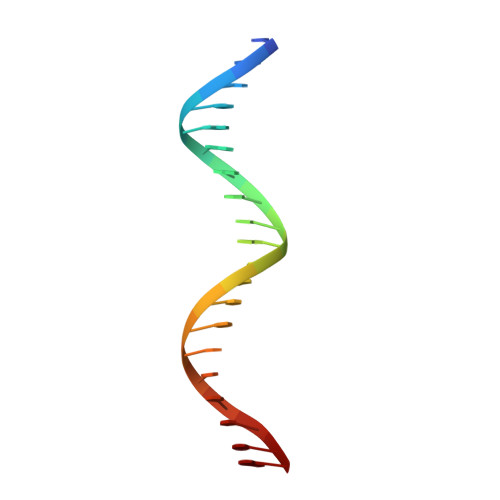
data-driven model of MED1:DNA complex


Experimental Data Snapshot

  • Method: SOLUTION NMR
  • Conformers Calculated: 10 
  • Conformers Submitted: 10 
  • Selection Criteria: structures with the lowest energy 

wwPDB Validation 3D Report Full Report

Validation slider image for 2KAE

This is version 1.3 of the entry. See complete history

Literature

Structural Analysis of MED-1 Reveals Unexpected Diversity in the Mechanism of DNA Recognition by GATA-type Zinc Finger Domains.

Lowry, J.A.Gamsjaeger, R.Thong, S.Y.Hung, W.Kwan, A.H.Broitman-Maduro, G.Matthews, J.M.Maduro, M.Mackay, J.P.

(2009) J Biological Chem 284: 5827-5835

  • DOI: https://doi.org/10.1074/jbc.M808712200
  • Primary Citation Related Structures: 
    2KAE

  • PubMed Abstract: 

    MED-1 is a member of a group of divergent GATA-type zinc finger proteins recently identified in several species of Caenorhabditis. The med genes are transcriptional regulators that are involved in the specification of the mesoderm and endoderm precursor cells in nematodes. Unlike other GATA-type zinc fingers that recognize the consensus sequence (A/C/T)GATA(A/G), the MED-1 zinc finger (MED1zf) binds the larger and atypical site GTATACT(T/C)(3). We have examined the basis for this unusual DNA specificity using a range of biochemical and biophysical approaches. Most strikingly, we show that although the core of the MED1zf structure is similar to that of GATA-1, the basic tail C-terminal to the zinc finger unexpectedly adopts an alpha-helical structure upon binding DNA. This additional helix appears to contact the major groove of the DNA, making contacts that explain the extended DNA consensus sequence observed for MED1zf. Our data expand the versatility of DNA recognition by GATA-type zinc fingers and perhaps shed new light on the DNA-binding properties of mammalian GATA factors.


  • Organizational Affiliation
    • School of Molecular and Microbial Biosciences, University of Sydney, New South Wales 2006, Australia.

Macromolecule Content 

  • Total Structure Weight: 20.7 kDa 
  • Atom Count: 1,284 
  • Modeled Residue Count: 96 
  • Deposited Residue Count: 111 
  • Unique protein chains: 1
  • Unique nucleic acid chains: 1

Macromolecules


Find similar proteins by:|  3D Structure
Entity ID: 1
MoleculeChains  Sequence LengthOrganismDetailsImage
GATA-type transcription factor71Caenorhabditis elegansMutation(s): 0 
Gene Names: med-1T24D3.1
Find similar nucleic acids by:  Sequence
Entity ID: 2
MoleculeChains LengthOrganismImage
5'-D(*DCP*DGP*DGP*DAP*DAP*DAP*DAP*DGP*DTP*DAP*DTP*DAP*DCP*DTP*DTP*DTP*DTP*DCP*DCP*DG)-3'B [auth C],
C [auth B]
20N/A
Sequence Annotations
Expand
Reference Sequence

Small Molecules

Ligands 1 Unique
IDChains Name / Formula / InChI Key2D Diagram3D Interactions
ZN

Query on ZN


Download:Ideal Coordinates CCD File
D [auth A]ZINC ION
Zn
PTFCDOFLOPIGGS-UHFFFAOYSA-N

Experimental Data & Validation

Experimental Data

  • Method: SOLUTION NMR
  • Conformers Calculated: 10 
  • Conformers Submitted: 10 
  • Selection Criteria: structures with the lowest energy 

Structure Validation

View Full Validation Report


Entry History 

Deposition Data

Revision History  (Full details and data files)

  • Version 1.0: 2009-01-06
    Type: Initial release
  • Version 1.1: 2011-07-13
    Changes: Version format compliance
  • Version 1.2: 2022-03-16
    Changes: Database references, Derived calculations
  • Version 1.3: 2024-05-22
    Changes: Data collection