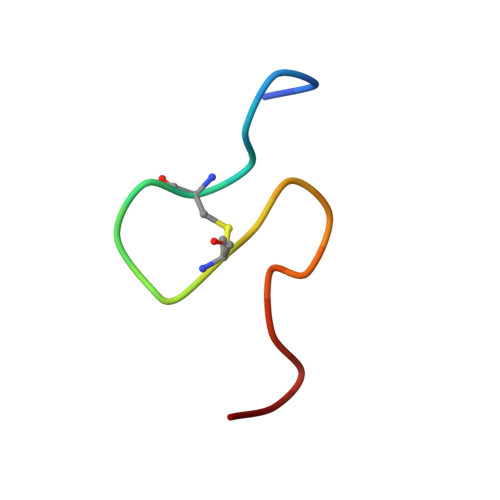
2JNR | pdb_00002jnr

Discovery and optimization of a natural HIV-1 entry inhibitor targeting the gp41 fusion peptide


Experimental Data Snapshot

  • Method: SOLUTION NMR
  • Conformers Calculated: 1 
  • Conformers Submitted: 1 
  • Selection Criteria: all calculated structures submitted 

wwPDB Validation 3D Report Full Report

Validation slider image for 2JNR

This is version 1.5 of the entry. See complete history. 

Literature

Discovery and Optimization of a Natural HIV-1 Entry Inhibitor Targeting the gp41 Fusion Peptide.

Munch, J., Standker, L., Adermann, K., Schulz, A., Schindler, M., Chinnadurai, R., Pohlmann, S., Chaipan, C., Biet, T., Peters, T., Meyer, B., Wilhelm, D., Lu, H., Jing, W., Jiang, S., Forssmann, W.G., Kirchhoff, F.

(2007) Cell 129: 263-275

  • DOI: https://doi.org/10.1016/j.cell.2007.02.042
  • Primary Citation Related Structures: 
    2JNR

  • PubMed Abstract: 

    A variety of molecules in human blood have been implicated in the inhibition of HIV-1. However, it remained elusive which circulating natural compounds are most effective in controlling viral replication in vivo. To identify natural HIV-1 inhibitors we screened a comprehensive peptide library generated from human hemofiltrate. The most potent fraction contained a 20-residue peptide, designated VIRUS-INHIBITORY PEPTIDE (VIRIP), corresponding to the C-proximal region of alpha1-antitrypsin, the most abundant circulating serine protease inhibitor. We found that VIRIP inhibits a wide variety of HIV-1 strains including those resistant to current antiretroviral drugs. Further analysis demonstrated that VIRIP blocks HIV-1 entry by interacting with the gp41 fusion peptide and showed that a few amino acid changes increase its antiretroviral potency by two orders of magnitude. Thus, as a highly specific natural inhibitor of the HIV-1 gp41 fusion peptide, VIRIP may lead to the development of another class of antiretroviral drugs.


  • Organizational Affiliation: 
    • Institute of Virology, University of Ulm, 89081 Ulm, Germany.

Macromolecule Content 

  • Total Structure Weight: 4.37 kDa 
  • Atom Count: 307 
  • Modeled Residue Count: 43 
  • Deposited Residue Count: 43 
  • Unique protein chains: 2

Macromolecules

Find similar proteins by:  Sequence   |   3D Structure  
Entity ID: 1
MoleculeChains  Sequence LengthOrganismDetailsImage
VIR16520synthetic constructMutation(s): 0 
Entity Groups
Sequence Clusters30% Identity50% Identity70% Identity90% Identity95% Identity100% Identity
Sequence Annotations
Expand
Reference Sequence
Find similar proteins by:  Sequence   |   3D Structure  
Entity ID: 2
MoleculeChains  Sequence LengthOrganismDetailsImage
ENV polyprotein23synthetic constructMutation(s): 1 
UniProt
Find proteins for Q72502 (Human immunodeficiency virus type 1)
Explore Q72502 
Go to UniProtKB:  Q72502
Entity Groups
Sequence Clusters30% Identity50% Identity70% Identity90% Identity95% Identity100% Identity
UniProt GroupQ72502
Sequence Annotations
Expand
Reference Sequence

Experimental Data & Validation

Experimental Data

  • Method: SOLUTION NMR
  • Conformers Calculated: 1 
  • Conformers Submitted: 1 
  • Selection Criteria: all calculated structures submitted 

Structure Validation

View Full Validation Report


Entry History 

Revision History  (Full details and data files)

  • Version 1.0: 2007-05-08
    Type: Initial release
  • Version 1.1: 2008-05-01
    Changes: Version format compliance
  • Version 1.2: 2011-07-13
    Changes: Version format compliance
  • Version 1.3: 2021-10-20
    Changes: Database references, Derived calculations, Source and taxonomy
  • Version 1.4: 2023-12-20
    Changes: Data collection, Other
  • Version 1.5: 2024-11-20
    Changes: Structure summary