2F5T | pdb_00002f5t

Crystal Structure of the sugar binding domain of the archaeal transcriptional regulator TrmB


Experimental Data Snapshot

  • Method: X-RAY DIFFRACTION
  • Resolution: 1.45 Å
  • R-Value Free: 
    0.195 (Depositor), 0.194 (DCC) 
  • R-Value Work: 
    0.162 (Depositor), 0.158 (DCC) 

wwPDB Validation 3D Report Full Report

Validation slider image for 2F5T

This is version 2.1 of the entry. See complete history

Literature

Crystal Structure of the Sugar Binding Domain of the Archaeal Transcriptional Regulator TrmB

Krug, M.Lee, S.J.Diederichs, K.Boos, W.Welte, W.

(2006) J Biological Chem 281: 10976-10982

  • DOI: https://doi.org/10.1074/jbc.M512809200
  • Primary Citation Related Structures: 
    2F5T

  • PubMed Abstract: 

    TrmB is an alpha-glucoside-sensing transcriptional regulator controlling two operons encoding maltose/trehalose and maltodextrin ABC transporters of Pyrococcus furiosus. The crystal structure of an N-terminal truncated derivative of TrmB (amino acids 2-109 deleted; TrmB(delta2-109)) was solved at 1.5 A resolution. This protein has lost its DNA binding domain but has retained its sugar recognition site. The structure represents a novel sugar-binding fold. TrmB(delta2-109) bound maltose, glucose, sucrose, and maltotriose, exhibiting Kd values of 6.8, 25, 34, and 160 microM, respectively. TrmB(delta2-109) behaved as a monomer in dilute buffer solution in contrast to the full-length protein, which is a dimer. Co-crystallization with bound maltose identified a binding site involving seven amino acid residues: Ser229, Asn305, Gly320, Met321, Val324, Ile325, and Glu326. Six of these residues interact with the nonreducing glucosyl residue of maltose. The nonreducing glucosyl residue is shared by all substrates bound to TrmB, suggesting it as a common recognition motif.


  • Organizational Affiliation
    • Department of Biology, University of Konstanz, 78457 Konstanz, Germany.

Macromolecule Content 

  • Total Structure Weight: 27.05 kDa 
  • Atom Count: 2,027 
  • Modeled Residue Count: 233 
  • Deposited Residue Count: 233 
  • Unique protein chains: 1

Macromolecules

Find similar proteins by:|  3D Structure
Entity ID: 1
MoleculeChains  Sequence LengthOrganismDetailsImage
archaeal transcriptional regulator TrmBA [auth X]233Thermococcus litoralisMutation(s): 0 
UniProt
Find proteins for Q7LYW4 (Thermococcus litoralis (strain ATCC 51850 / DSM 5473 / JCM 8560 / NS-C))
Explore Q7LYW4 
Go to UniProtKB:  Q7LYW4
Entity Groups
Sequence Clusters30% Identity50% Identity70% Identity90% Identity95% Identity100% Identity
UniProt GroupQ7LYW4
Sequence Annotations
Expand
Reference Sequence

Oligosaccharides

Help  
Entity ID: 2
MoleculeChains Length2D Diagram GlycosylationD Interactions
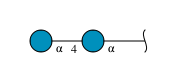
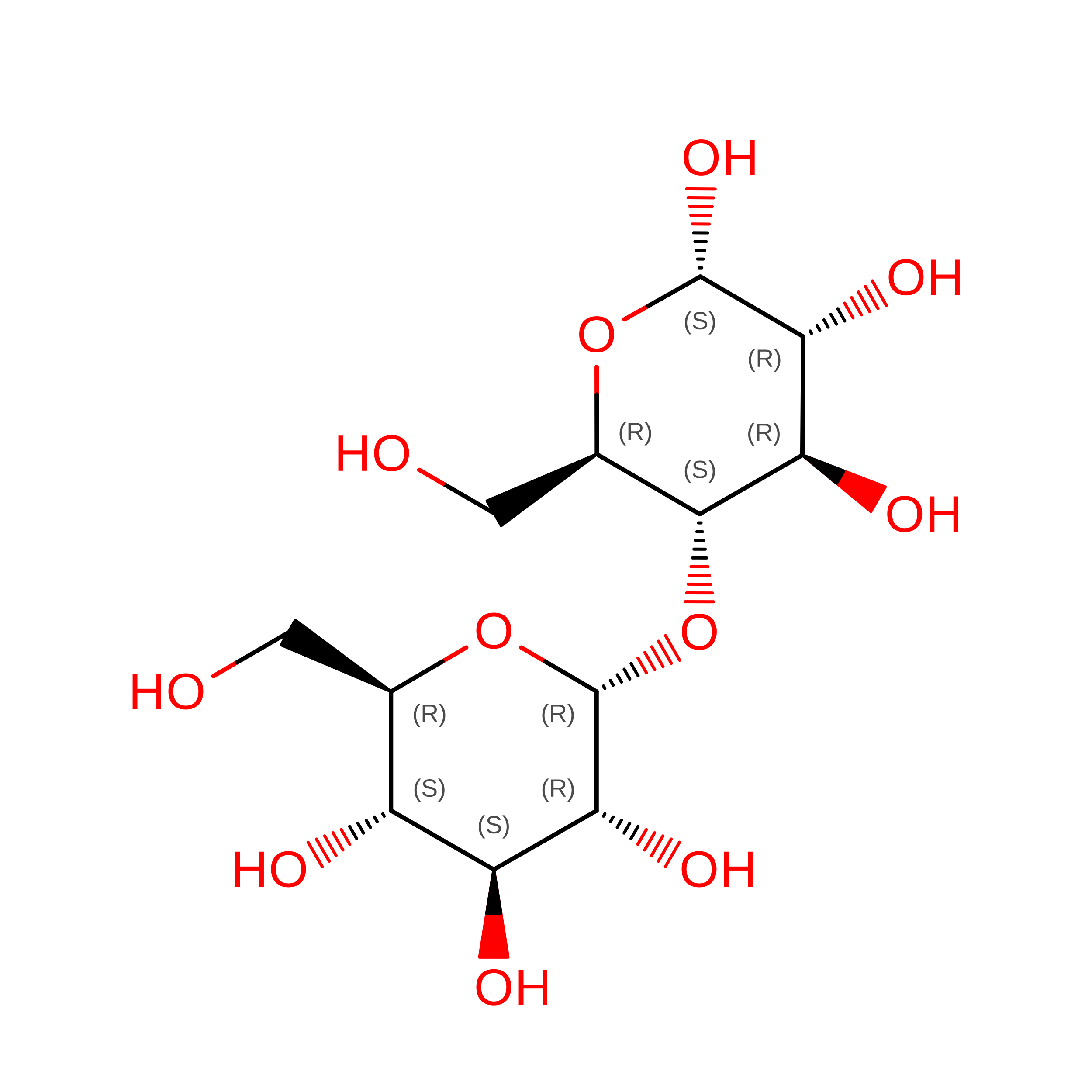
alpha-D-glucopyranose-(1-4)-alpha-D-glucopyranoseB [auth A]2N/A
Glycosylation Resources
GlyTouCan: G07411ON
GlyCosmos: G07411ON

Small Molecules

Ligands 1 Unique
IDChains Name / Formula / InChI Key2D Diagram3D Interactions
IMD

Query on IMD


Download:Ideal Coordinates CCD File
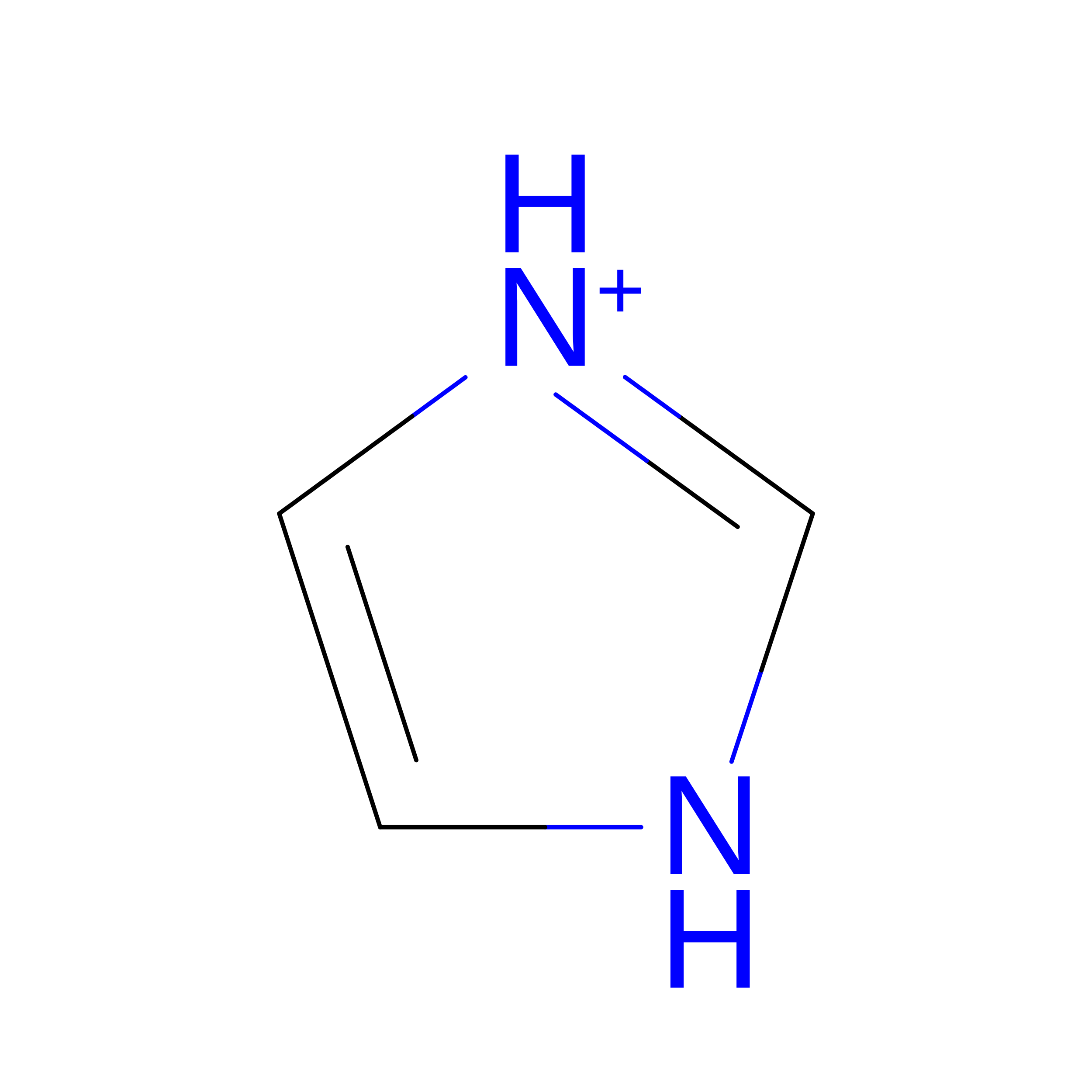
C [auth X]IMIDAZOLE
C3 H5 N2
RAXXELZNTBOGNW-UHFFFAOYSA-O

Biologically Interesting Molecules (External Reference) 

1 Unique

Experimental Data & Validation

Experimental Data

  • Method: X-RAY DIFFRACTION
  • Resolution: 1.45 Å
  • R-Value Free:  0.195 (Depositor), 0.194 (DCC) 
  • R-Value Work:  0.162 (Depositor), 0.158 (DCC) 
Space Group: P 32 2 1
Unit Cell:
Length ( Å )Angle ( ˚ )
a = 56.857α = 90
b = 56.857β = 90
c = 132.482γ = 120
Software Package:
Software NamePurpose
XSCALEdata scaling
SOLVEphasing
RESOLVEphasing
REFMACrefinement
PDB_EXTRACTdata extraction

Structure Validation

View Full Validation Report


Entry History 

Deposition Data

Revision History  (Full details and data files)

  • Version 1.0: 2006-02-21
    Type: Initial release
  • Version 1.1: 2008-04-01
    Changes: Version format compliance
  • Version 1.2: 2011-07-13
    Changes: Derived calculations, Version format compliance
  • Version 2.0: 2020-07-29
    Type: Remediation
    Reason: Carbohydrate remediation
    Changes: Advisory, Atomic model, Data collection, Database references, Derived calculations, Non-polymer description, Structure summary
  • Version 2.1: 2024-02-14
    Changes: Data collection, Database references, Structure summary