2CDO | pdb_00002cdo

structure of agarase carbohydrate binding module in complex with neoagarohexaose


Experimental Data Snapshot

  • Method: X-RAY DIFFRACTION
  • Resolution: 1.64 Å
  • R-Value Free: 
    0.241 (Depositor), 0.241 (DCC) 
  • R-Value Work: 
    0.176 (Depositor), 0.176 (DCC) 
  • R-Value Observed: 
    0.179 (Depositor) 

wwPDB Validation 3D Report Full Report

Validation slider image for 2CDO

This is version 2.1 of the entry. See complete history

Literature

Family 6 Carbohydrate Binding Modules in Beta-Agarases Display Exquisite Selectivity for the Non- Reducing Termini of Agarose Chains.

Henshaw, J.Horne, A.Van Bueren, A.L.Money, V.A.Bolam, D.N.Czjzek, M.Ekborg, N.A.Weiner, R.M.Hutcheson, S.W.Davies, G.J.Boraston, A.B.Gilbert, H.J.

(2006) J Biological Chem 281: 17099

  • DOI: https://doi.org/10.1074/jbc.M600702200
  • Primary Citation Related Structures: 
    2CDO, 2CDP

  • PubMed Abstract: 

    Carbohydrate recognition is central to the biological and industrial exploitation of plant structural polysaccharides. These insoluble polymers are recalcitrant to microbial degradation, and enzymes that catalyze this process generally contain non-catalytic carbohydrate binding modules (CBMs) that potentiate activity by increasing substrate binding. Agarose, a repeat of the disaccharide 3,6-anhydro-alpha-L-galactose-(1,3)-beta-D-galactopyranose-(1,4), is the dominant matrix polysaccharide in marine algae, yet the role of CBMs in the hydrolysis of this important polymer has not previously been explored. Here we show that family 6 CBMs, present in two different beta-agarases, bind specifically to the non-reducing end of agarose chains, recognizing only the first repeat of the disaccharide. The crystal structure of one of these modules Aga16B-CBM6-2, in complex with neoagarohexaose, reveals the mechanism by which the protein displays exquisite specificity, targeting the equatorial O4 and the axial O3 of the anhydro-L-galactose. Targeting of the CBM6 to the non-reducing end of agarose chains may direct the appended catalytic modules to areas of the plant cell wall attacked by beta-agarases where the matrix polysaccharide is likely to be more amenable to further enzymic hydrolysis.


  • Organizational Affiliation
    • Institute for Cell and Molecular Biosciences, University of Newcastle upon Tyne, Framlington Place, Newcastle upon Tyne NE2 4HH, United Kingdom.

Macromolecule Content 

  • Total Structure Weight: 73.28 kDa 
  • Atom Count: 5,064 
  • Modeled Residue Count: 548 
  • Deposited Residue Count: 640 
  • Unique protein chains: 1

Macromolecules

Find similar proteins by:|  3D Structure
Entity ID: 1
MoleculeChains  Sequence LengthOrganismDetailsImage
BETA-AGARASE 1
A, B, C, D
160Saccharophagus degradansMutation(s): 2 
UniProt
Find proteins for Q6DN99 (Saccharophagus degradans)
Explore Q6DN99 
Go to UniProtKB:  Q6DN99
Entity Groups
Sequence Clusters30% Identity50% Identity70% Identity90% Identity95% Identity100% Identity
UniProt GroupQ6DN99
Sequence Annotations
Expand
Reference Sequence

Oligosaccharides

Help  
Entity ID: 2
MoleculeChains Length2D Diagram GlycosylationD Interactions
3,6-anhydro-alpha-L-galactopyranose-(1-3)-beta-D-galactopyranose-(1-4)-3,6-anhydro-alpha-L-galactopyranose-(1-3)-beta-D-galactopyranose-(1-4)-3,6-anhydro-alpha-L-galactopyranose-(1-3)-beta-D-galactopyranose
E, F, G, H
6N/A
Glycosylation Resources
GlyTouCan: G13512XO
GlyCosmos: G13512XO

Small Molecules

Ligands 3 Unique
IDChains Name / Formula / InChI Key2D Diagram3D Interactions
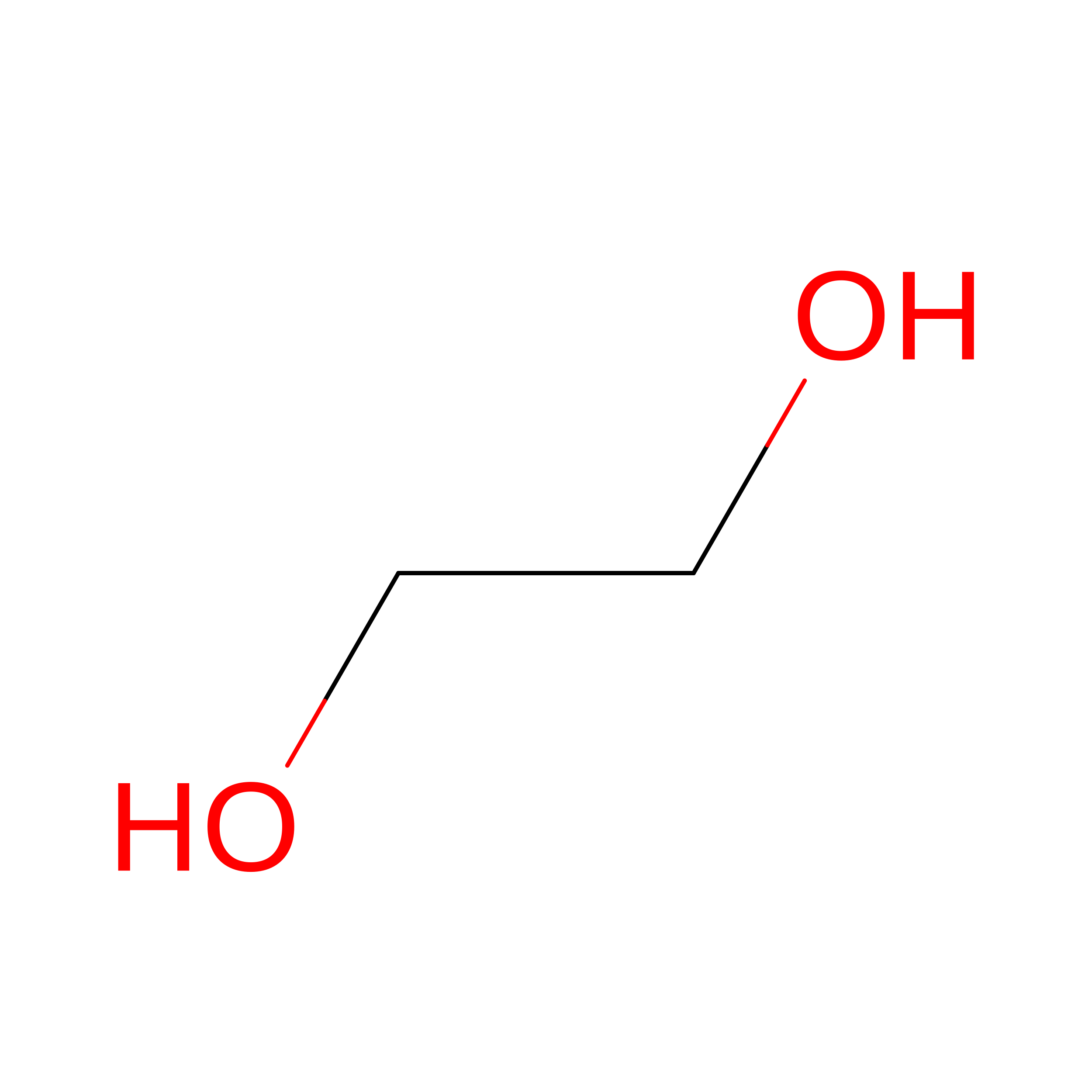
EDO

Query on EDO


Download:Ideal Coordinates CCD File
AA [auth C]
BA [auth C]
GA [auth D]
P [auth B]
Q [auth B]
AA [auth C],
BA [auth C],
GA [auth D],
P [auth B],
Q [auth B],
T [auth B],
W [auth C]
1,2-ETHANEDIOL
C2 H6 O2
LYCAIKOWRPUZTN-UHFFFAOYSA-N
CA

Query on CA


Download:Ideal Coordinates CCD File
CA [auth D]
DA [auth D]
I [auth A]
J [auth A]
N [auth B]
CA [auth D],
DA [auth D],
I [auth A],
J [auth A],
N [auth B],
O [auth B],
U [auth C],
V [auth C]
CALCIUM ION
Ca
BHPQYMZQTOCNFJ-UHFFFAOYSA-N
CL

Query on CL


Download:Ideal Coordinates CCD File
EA [auth D]
FA [auth D]
K [auth A]
L [auth A]
M [auth A]
EA [auth D],
FA [auth D],
K [auth A],
L [auth A],
M [auth A],
R [auth B],
S [auth B],
X [auth C],
Y [auth C],
Z [auth C]
CHLORIDE ION
Cl
VEXZGXHMUGYJMC-UHFFFAOYSA-M
Modified Residues  1 Unique
IDChains TypeFormula2D DiagramParent
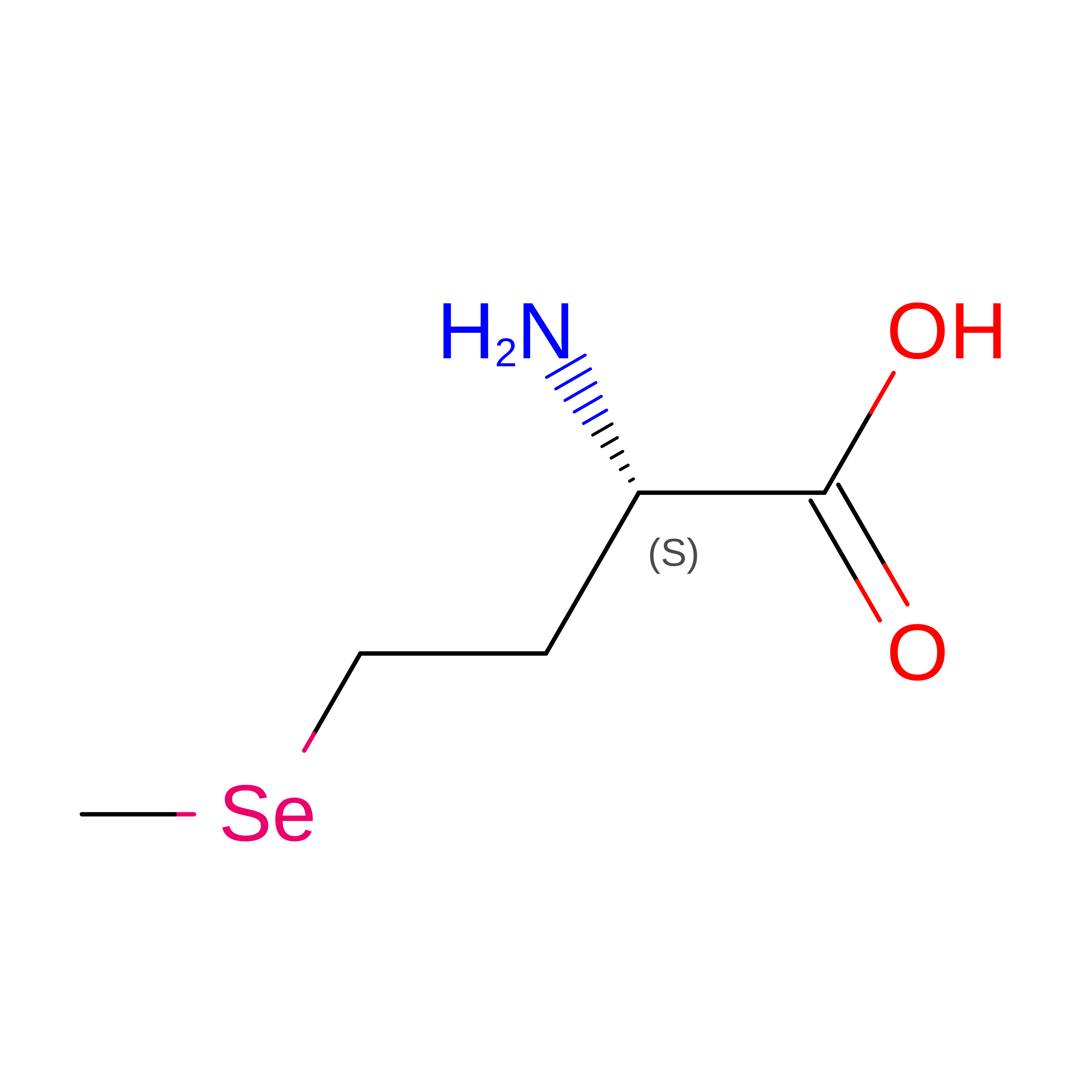
MSE
Query on MSE
A, B, C, D
L-PEPTIDE LINKINGC5 H11 N O2 SeMET

Experimental Data & Validation

Experimental Data

  • Method: X-RAY DIFFRACTION
  • Resolution: 1.64 Å
  • R-Value Free:  0.241 (Depositor), 0.241 (DCC) 
  • R-Value Work:  0.176 (Depositor), 0.176 (DCC) 
  • R-Value Observed: 0.179 (Depositor) 
Space Group: P 21 21 21
Unit Cell:
Length ( Å )Angle ( ˚ )
a = 54.036α = 90
b = 54.979β = 90
c = 196.82γ = 90
Software Package:
Software NamePurpose
REFMACrefinement
MOSFLMdata reduction
SCALAdata scaling
SHELXphasing

Structure Validation

View Full Validation Report


Entry History 

Revision History  (Full details and data files)

  • Version 1.0: 2006-02-16
    Type: Initial release
  • Version 1.1: 2011-05-08
    Changes: Version format compliance
  • Version 1.2: 2011-07-13
    Changes: Version format compliance
  • Version 2.0: 2020-07-29
    Type: Remediation
    Reason: Carbohydrate remediation
    Changes: Advisory, Atomic model, Data collection, Derived calculations, Other, Structure summary
  • Version 2.1: 2024-10-23
    Changes: Data collection, Database references, Structure summary