2BR6 | pdb_00002br6

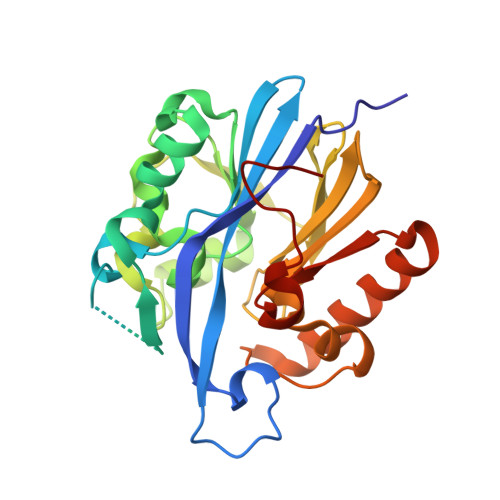
Crystal Structure of Quorum-Quenching N-Acyl Homoserine Lactone Lactonase


Experimental Data Snapshot

  • Method: X-RAY DIFFRACTION
  • Resolution: 1.70 Å
  • R-Value Free: 
    0.220 (Depositor), 0.222 (DCC) 
  • R-Value Work: 
    0.181 (Depositor), 0.180 (DCC) 
  • R-Value Observed: 
    0.183 (Depositor) 

wwPDB Validation 3D Report Full Report

Validation slider image for 2BR6

This is version 1.3 of the entry. See complete history

Literature

The Molecular Structure and Catalytic Mechanism of a Quorum-Quenching N-Acyl-L-Homoserine Lactone Hydrolase.

Kim, M.H.Choi, W.C.Kang, H.O.Lee, J.S.Kang, B.S.Kim, K.J.Derewenda, Z.S.Oh, T.K.Lee, C.H.Lee, J.K.

(2005) Proc Natl Acad Sci U S A 102: 17606

  • DOI: https://doi.org/10.1073/pnas.0504996102
  • Primary Citation Related Structures: 
    2BR6, 2BTN

  • PubMed Abstract: 

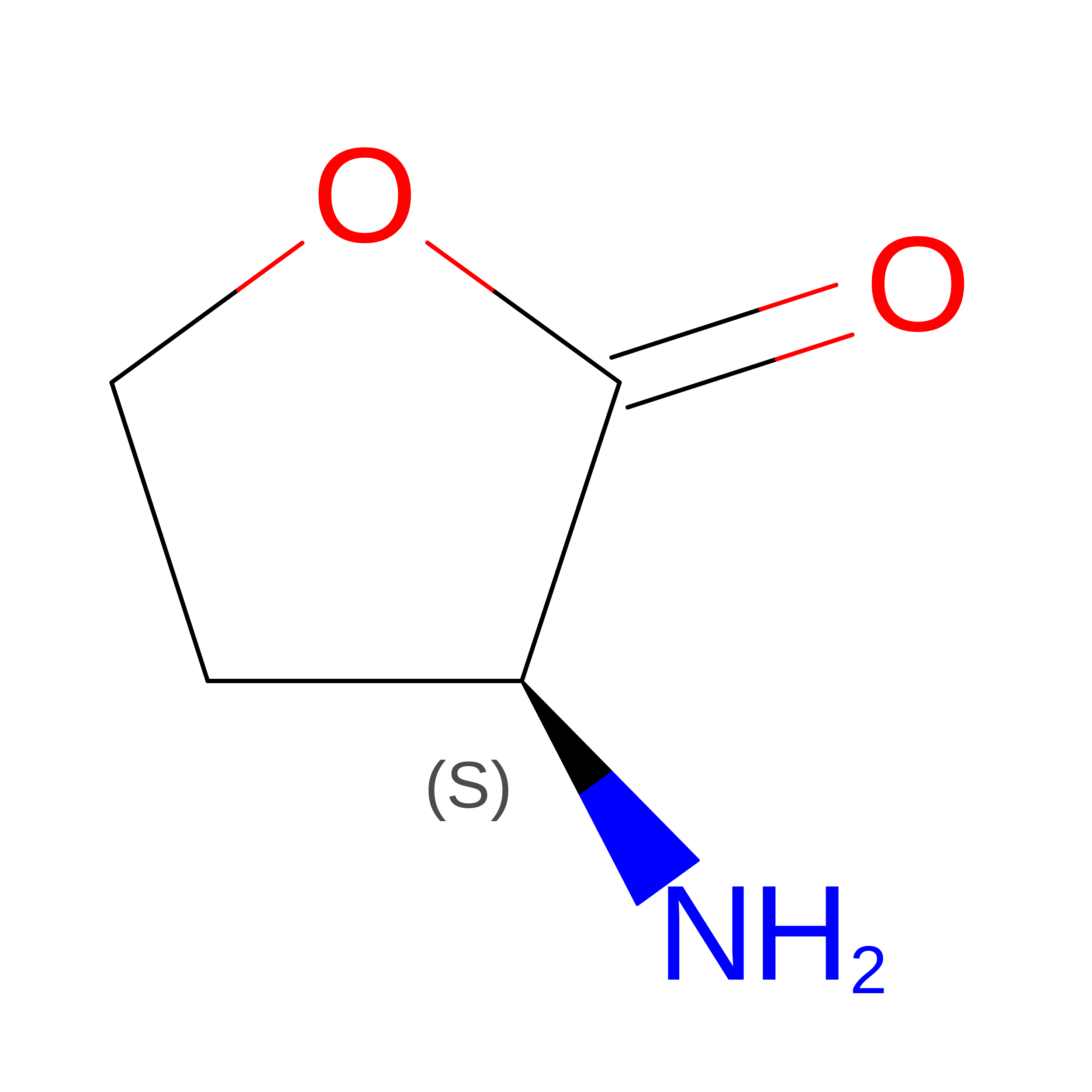
    In many Gram-negative bacteria, including a number of pathogens such as Pseudomonas aeruginosa and Erwinia carotovora, virulence factor production and biofilm formation are linked to the quorum-sensing systems that use diffusible N-acyl-L-homoserine lactones (AHLs) as intercellular messenger molecules. A number of organisms also contain genes coding for lactonases that hydrolyze AHLs into inactive products, thereby blocking the quorum-sensing systems. Consequently, these enzymes attract intense interest for the development of antiinfection therapies. However, the catalytic mechanism of AHL-lactonase is poorly understood and subject to controversy. We here report a 2.0-angstroms resolution structure of the AHL-lactonase from Bacillus thuringiensis and a 1.7-angstroms crystal structure of its complex with L-homoserine lactone. Despite limited sequence similarity, the enzyme shows remarkable structural similarities to glyoxalase II and RNase Z proteins, members of the metallo-beta-lactamase superfamily. We present experimental evidence that AHL-lactonase is a metalloenzyme containing two zinc ions involved in catalysis, and we propose a catalytic mechanism for bacterial metallo-AHL-lactonases.


  • Organizational Affiliation
    • Korea Research Institute of Bioscience and Biotechnology, Yusong, Daejon 305-600, Korea.

Macromolecule Content 

  • Total Structure Weight: 28.91 kDa 
  • Atom Count: 2,157 
  • Modeled Residue Count: 240 
  • Deposited Residue Count: 252 
  • Unique protein chains: 1

Macromolecules

Find similar proteins by:|  3D Structure
Entity ID: 1
MoleculeChains  Sequence LengthOrganismDetailsImage
AIIA-LIKE PROTEIN252Bacillus thuringiensisMutation(s): 0 
EC: 3.1.1.81
UniProt
Find proteins for P0CJ63 (Bacillus thuringiensis subsp. kurstaki)
Explore P0CJ63 
Go to UniProtKB:  P0CJ63
Entity Groups
Sequence Clusters30% Identity50% Identity70% Identity90% Identity95% Identity100% Identity
UniProt GroupP0CJ63
Sequence Annotations
Expand
Reference Sequence

Experimental Data & Validation

Experimental Data

  • Method: X-RAY DIFFRACTION
  • Resolution: 1.70 Å
  • R-Value Free:  0.220 (Depositor), 0.222 (DCC) 
  • R-Value Work:  0.181 (Depositor), 0.180 (DCC) 
  • R-Value Observed: 0.183 (Depositor) 
Space Group: P 21 21 21
Unit Cell:
Length ( Å )Angle ( ˚ )
a = 51.904α = 90
b = 55.745β = 90
c = 73.855γ = 90
Software Package:
Software NamePurpose
REFMACrefinement
SCALEPACKdata scaling
AMoREphasing

Structure Validation

View Full Validation Report


Entry History 

Deposition Data

Revision History  (Full details and data files)

  • Version 1.0: 2005-12-07
    Type: Initial release
  • Version 1.1: 2011-05-08
    Changes: Version format compliance
  • Version 1.2: 2011-07-13
    Changes: Version format compliance
  • Version 1.3: 2024-05-08
    Changes: Data collection, Database references, Derived calculations, Other