2ZXE | pdb_00002zxe

Crystal structure of the sodium - potassium pump in the E2.2K+.Pi state


Experimental Data Snapshot

  • Method: X-RAY DIFFRACTION
  • Resolution: 2.40 Å
  • R-Value Free: 
    0.271 (Depositor), 0.275 (DCC) 
  • R-Value Work: 
    0.246 (Depositor), 0.246 (DCC) 
  • R-Value Observed: 
    0.248 (Depositor) 

Starting Model: experimental
View more details

wwPDB Validation 3D Report Full Report

Validation slider image for 2ZXE

Ligand Structure Quality Assessment 


This is version 2.2 of the entry. See complete history

Literature

Crystal structure of the sodium - potassium pump at 2.4 A resolution

Shinoda, T.Ogawa, H.Cornelius, F.Toyoshima, C.

(2009) Nature 459: 446-450

  • DOI: https://doi.org/10.1038/nature07939
  • Primary Citation Related Structures: 
    2ZXE

  • PubMed Abstract: 

    Sodium-potassium ATPase is an ATP-powered ion pump that establishes concentration gradients for Na(+) and K(+) ions across the plasma membrane in all animal cells by pumping Na(+) from the cytoplasm and K(+) from the extracellular medium. Such gradients are used in many essential processes, notably for generating action potentials. Na(+), K(+)-ATPase is a member of the P-type ATPases, which include sarcoplasmic reticulum Ca(2+)-ATPase and gastric H(+), K(+)-ATPase, among others, and is the target of cardiac glycosides. Here we describe a crystal structure of this important ion pump, from shark rectal glands, consisting of alpha- and beta-subunits and a regulatory FXYD protein, all of which are highly homologous to human ones. The ATPase was fixed in a state analogous to E2.2K(+).P(i), in which the ATPase has a high affinity for K(+) and still binds P(i), as in the first crystal structure of pig kidney enzyme at 3.5 A resolution. Clearly visualized now at 2.4 A resolution are coordination of K(+) and associated water molecules in the transmembrane binding sites and a phosphate analogue (MgF(4)(2-)) in the phosphorylation site. The crystal structure shows that the beta-subunit has a critical role in K(+) binding (although its involvement has previously been suggested) and explains, at least partially, why the homologous Ca(2+)-ATPase counter-transports H(+) rather than K(+), despite the coordinating residues being almost identical.


  • Organizational Affiliation
    • Institute of Molecular and Cellular Biosciences, The University of Tokyo, Bunkyo-ku, Tokyo 113-0032, Japan.

Macromolecule Content 

  • Total Structure Weight: 157.99 kDa 
  • Atom Count: 10,340 
  • Modeled Residue Count: 1,296 
  • Deposited Residue Count: 1,407 
  • Unique protein chains: 3

Macromolecules

Find similar proteins by:|  3D Structure
Entity ID: 1
MoleculeChains  Sequence LengthOrganismDetailsImage
Na, K-ATPase alpha subunit1,028Squalus acanthiasMutation(s): 0 
Membrane Entity: Yes 
UniProt
Find proteins for Q4H132 (Squalus acanthias)
Explore Q4H132 
Go to UniProtKB:  Q4H132
Entity Groups
Sequence Clusters30% Identity50% Identity70% Identity90% Identity95% Identity100% Identity
UniProt GroupQ4H132
Sequence Annotations
Expand
Reference Sequence
Find similar proteins by:|  3D Structure
Entity ID: 2
MoleculeChains  Sequence LengthOrganismDetailsImage
Na+,K+-ATPase beta subunit305Squalus acanthiasMutation(s): 0 
Membrane Entity: Yes 
UniProt
Find proteins for C4IX13 (Squalus acanthias)
Explore C4IX13 
Go to UniProtKB:  C4IX13
Entity Groups
Sequence Clusters30% Identity50% Identity70% Identity90% Identity95% Identity100% Identity
UniProt GroupC4IX13
Glycosylation
Glycosylation Sites: 2
Sequence Annotations
Expand
Reference Sequence
Find similar proteins by:|  3D Structure
Entity ID: 3
MoleculeChains  Sequence LengthOrganismDetailsImage
Phospholemman-like proteinC [auth G]74Squalus acanthiasMutation(s): 0 
Membrane Entity: Yes 
UniProt
Find proteins for Q70Q12 (Squalus acanthias)
Explore Q70Q12 
Go to UniProtKB:  Q70Q12
Entity Groups
Sequence Clusters30% Identity50% Identity70% Identity90% Identity95% Identity100% Identity
UniProt GroupQ70Q12
Sequence Annotations
Expand
Reference Sequence

Oligosaccharides

Help  
Entity ID: 4
MoleculeChains Length2D Diagram GlycosylationD Interactions
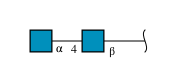
2-acetamido-2-deoxy-alpha-D-glucopyranose-(1-4)-2-acetamido-2-deoxy-beta-D-glucopyranoseD [auth C]2N-Glycosylation
Glycosylation Resources
GlyTouCan: G07375KG
GlyCosmos: G07375KG
GlyGen: G07375KG

Small Molecules

Ligands 5 Unique
IDChains Name / Formula / InChI Key2D Diagram3D Interactions
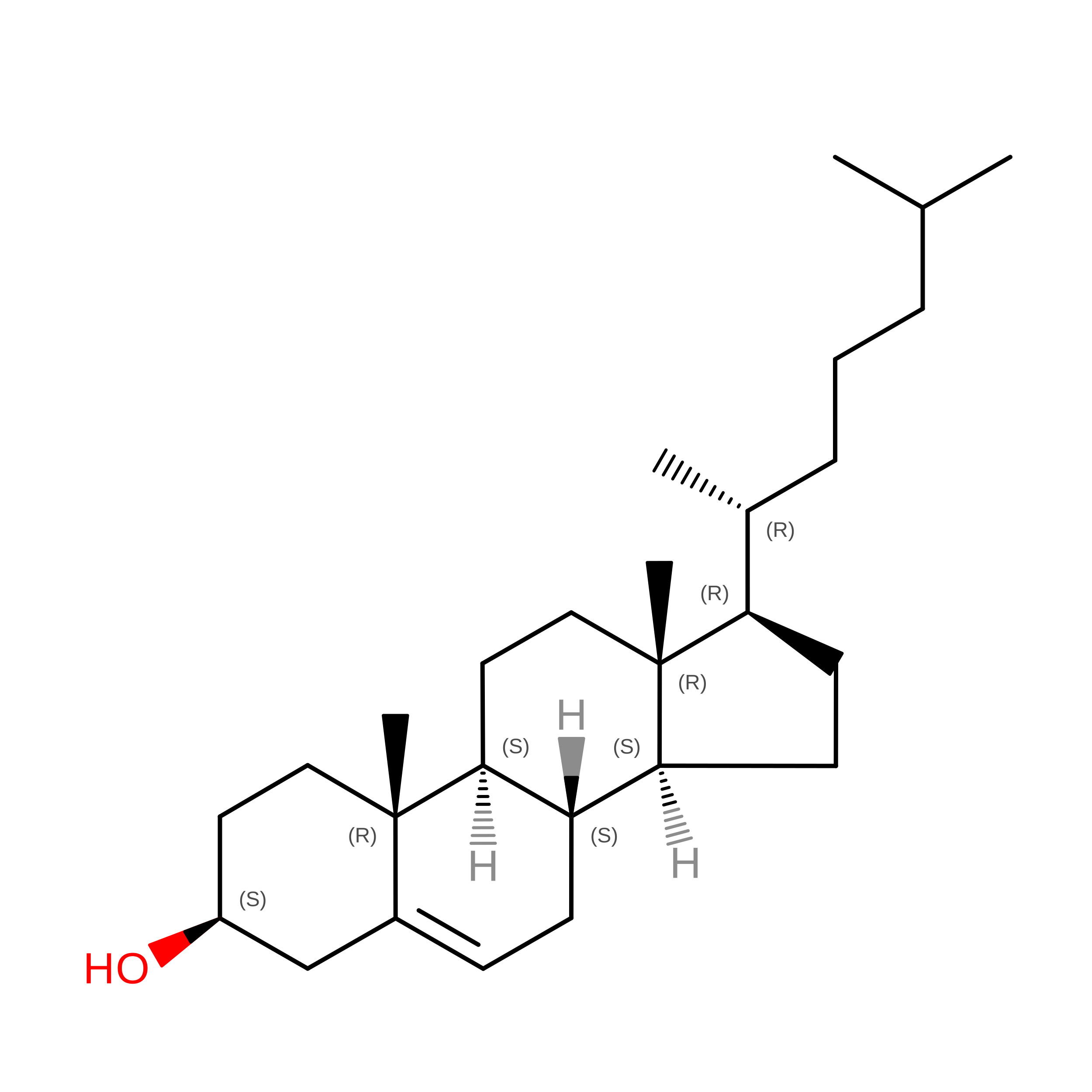
CLR

Query on CLR


Download:Ideal Coordinates CCD File
J [auth A]CHOLESTEROL
C27 H46 O
HVYWMOMLDIMFJA-DPAQBDIFSA-N
NAG

Query on NAG


Download:Ideal Coordinates CCD File
K [auth B]2-acetamido-2-deoxy-beta-D-glucopyranose
C8 H15 N O6
OVRNDRQMDRJTHS-FMDGEEDCSA-N
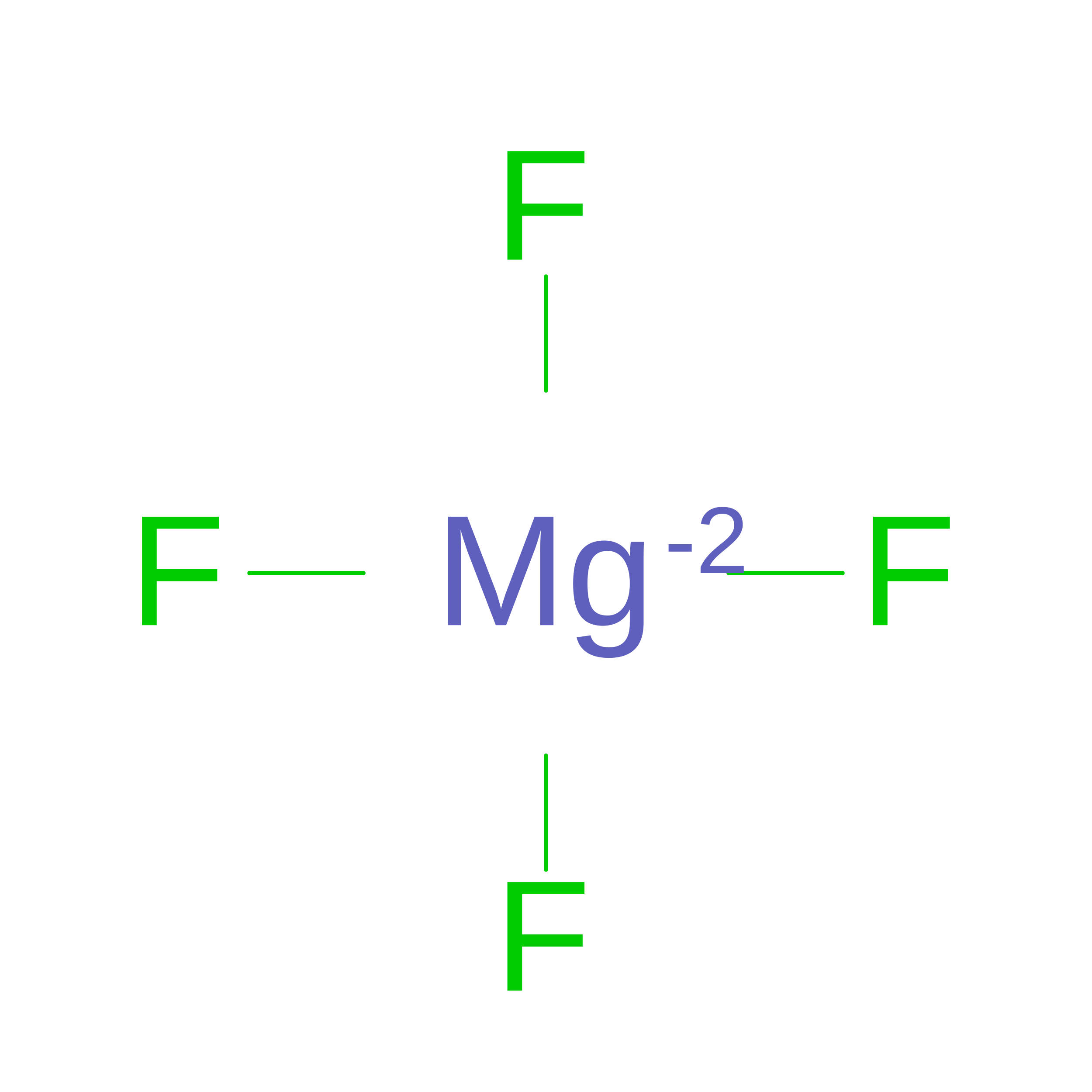
MF4

Query on MF4


Download:Ideal Coordinates CCD File
E [auth A]TETRAFLUOROMAGNESATE(2-)
F4 Mg
XVYWAXYEHHUKQW-UHFFFAOYSA-J
K

Query on K


Download:Ideal Coordinates CCD File
G [auth A],
H [auth A],
I [auth A]
POTASSIUM ION
K
NPYPAHLBTDXSSS-UHFFFAOYSA-N
MG

Query on MG


Download:Ideal Coordinates CCD File
F [auth A]MAGNESIUM ION
Mg
JLVVSXFLKOJNIY-UHFFFAOYSA-N

Experimental Data & Validation

Experimental Data

  • Method: X-RAY DIFFRACTION
  • Resolution: 2.40 Å
  • R-Value Free:  0.271 (Depositor), 0.275 (DCC) 
  • R-Value Work:  0.246 (Depositor), 0.246 (DCC) 
  • R-Value Observed: 0.248 (Depositor) 
Space Group: C 1 2 1
Unit Cell:
Length ( Å )Angle ( ˚ )
a = 223.815α = 90
b = 50.914β = 105.12
c = 163.786γ = 90
Software Package:
Software NamePurpose
REFMACrefinement
DENZOdata reduction
SCALEPACKdata scaling
CNSphasing

Structure Validation

View Full Validation Report


Ligand Structure Quality Assessment 


Entry History 

Deposition Data

Revision History  (Full details and data files)

  • Version 1.0: 2009-05-19
    Type: Initial release
  • Version 1.1: 2011-07-13
    Changes: Advisory, Refinement description, Version format compliance
  • Version 2.0: 2020-07-29
    Type: Remediation
    Reason: Carbohydrate remediation
    Changes: Atomic model, Data collection, Derived calculations, Structure summary
  • Version 2.1: 2023-11-01
    Changes: Data collection, Database references, Refinement description, Structure summary
  • Version 2.2: 2024-11-06
    Changes: Structure summary