2ZNR | pdb_00002znr

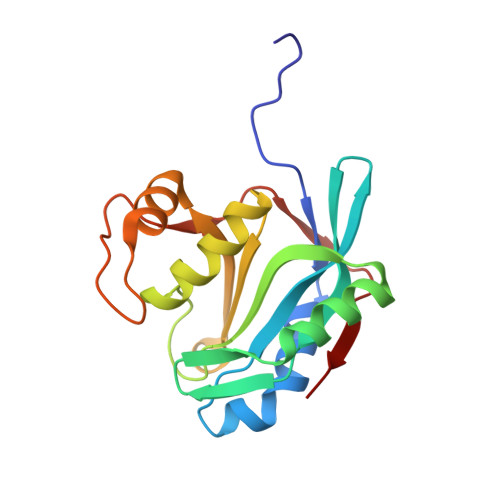
Crystal structure of the DUB domain of human AMSH-LP


Experimental Data Snapshot

  • Method: X-RAY DIFFRACTION
  • Resolution: 1.20 Å
  • R-Value Free: 
    0.165 (Depositor), 0.164 (DCC) 
  • R-Value Work: 
    0.149 (Depositor), 0.148 (DCC) 
  • R-Value Observed: 
    0.150 (Depositor) 

wwPDB Validation 3D Report Full Report

Validation slider image for 2ZNR

This is version 1.2 of the entry. See complete history

Literature

Structural basis for specific cleavage of Lys 63-linked polyubiquitin chains

Sato, Y.Yoshikawa, A.Yamagata, A.Mimura, H.Yamashita, M.Ookata, K.Nureki, O.Iwai, K.Komada, M.Fukai, S.

(2008) Nature 455: 358-362

  • DOI: https://doi.org/10.1038/nature07254
  • Primary Citation Related Structures: 
    2ZNR, 2ZNV

  • PubMed Abstract: 

    Deubiquitinating enzymes (DUBs) remove ubiquitin from conjugated substrates to regulate various cellular processes. The Zn(2+)-dependent DUBs AMSH and AMSH-LP regulate receptor trafficking by specifically cleaving Lys 63-linked polyubiquitin chains from internalized receptors. Here we report the crystal structures of the human AMSH-LP DUB domain alone and in complex with a Lys 63-linked di-ubiquitin at 1.2 A and 1.6 A resolutions, respectively. The AMSH-LP DUB domain consists of a Zn(2+)-coordinating catalytic core and two characteristic insertions, Ins-1 and Ins-2. The distal ubiquitin interacts with Ins-1 and the core, whereas the proximal ubiquitin interacts with Ins-2 and the core. The core and Ins-1 form a catalytic groove that accommodates the Lys 63 side chain of the proximal ubiquitin and the isopeptide-linked carboxy-terminal tail of the distal ubiquitin. This is the first reported structure of a DUB in complex with an isopeptide-linked ubiquitin chain, which reveals the mechanism for Lys 63-linkage-specific deubiquitination by AMSH family members.


  • Organizational Affiliation
    • Structural Biology Laboratory, Life Science Division, Synchrotron Radiation Research Organization and Institute of Molecular and Cellular Biosciences, The University of Tokyo, Tokyo 113-0032, Japan.

Macromolecule Content 

  • Total Structure Weight: 20.68 kDa 
  • Atom Count: 1,732 
  • Modeled Residue Count: 178 
  • Deposited Residue Count: 178 
  • Unique protein chains: 1

Macromolecules

Find similar proteins by:|  3D Structure
Entity ID: 1
MoleculeChains  Sequence LengthOrganismDetailsImage
AMSH-like protease178Homo sapiensMutation(s): 0 
Gene Names: STAMBPL1AMSHLPKIAA1373
EC: 3.1.2.15 (PDB Primary Data), 3.4.19 (UniProt)
UniProt & NIH Common Fund Data Resources
Find proteins for Q96FJ0 (Homo sapiens)
Explore Q96FJ0 
Go to UniProtKB:  Q96FJ0
PHAROS:  Q96FJ0
GTEx:  ENSG00000138134 
Entity Groups
Sequence Clusters30% Identity50% Identity70% Identity90% Identity95% Identity100% Identity
UniProt GroupQ96FJ0
Sequence Annotations
Expand
Reference Sequence

Small Molecules

Ligands 3 Unique
IDChains Name / Formula / InChI Key2D Diagram3D Interactions
PR

Query on PR


Download:Ideal Coordinates CCD File
D [auth A]PRASEODYMIUM ION
Pr
WCWKKSOQLQEJTE-UHFFFAOYSA-N
ZN

Query on ZN


Download:Ideal Coordinates CCD File
B [auth A],
C [auth A]
ZINC ION
Zn
PTFCDOFLOPIGGS-UHFFFAOYSA-N
EDO

Query on EDO


Download:Ideal Coordinates CCD File
E [auth A]
F [auth A]
G [auth A]
H [auth A]
I [auth A]
E [auth A],
F [auth A],
G [auth A],
H [auth A],
I [auth A],
J [auth A],
K [auth A]
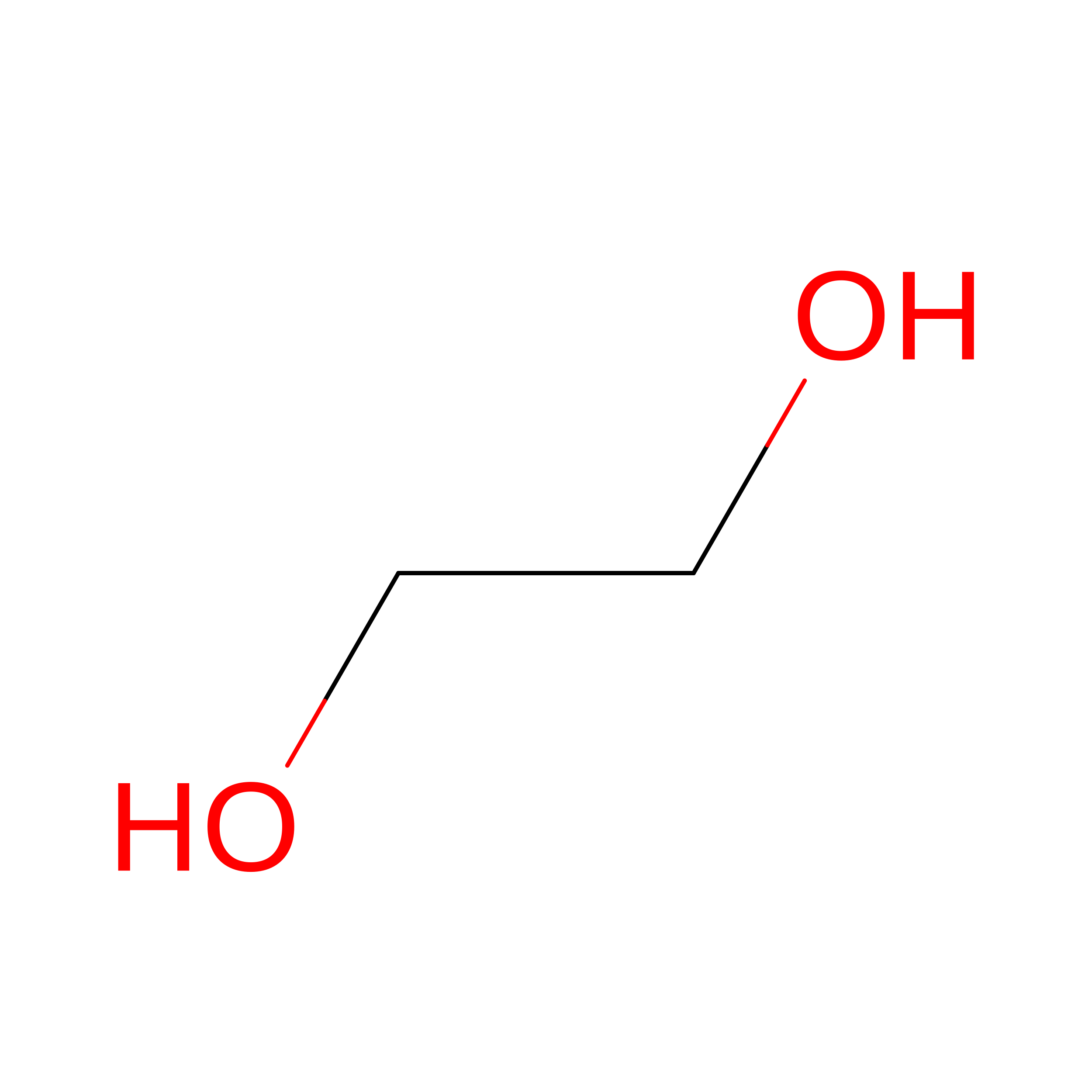
1,2-ETHANEDIOL
C2 H6 O2
LYCAIKOWRPUZTN-UHFFFAOYSA-N

Experimental Data & Validation

Experimental Data

  • Method: X-RAY DIFFRACTION
  • Resolution: 1.20 Å
  • R-Value Free:  0.165 (Depositor), 0.164 (DCC) 
  • R-Value Work:  0.149 (Depositor), 0.148 (DCC) 
  • R-Value Observed: 0.150 (Depositor) 
Space Group: P 65
Unit Cell:
Length ( Å )Angle ( ˚ )
a = 81.865α = 90
b = 81.865β = 90
c = 64.693γ = 120
Software Package:
Software NamePurpose
REFMACrefinement
ADSCdata collection
HKL-2000data reduction
SCALEPACKdata scaling
SHARPphasing

Structure Validation

View Full Validation Report


Entry History 

Deposition Data

Revision History  (Full details and data files)

  • Version 1.0: 2008-09-02
    Type: Initial release
  • Version 1.1: 2011-07-13
    Changes: Version format compliance
  • Version 1.2: 2024-03-13
    Changes: Data collection, Database references, Derived calculations