2ZHH | pdb_00002zhh

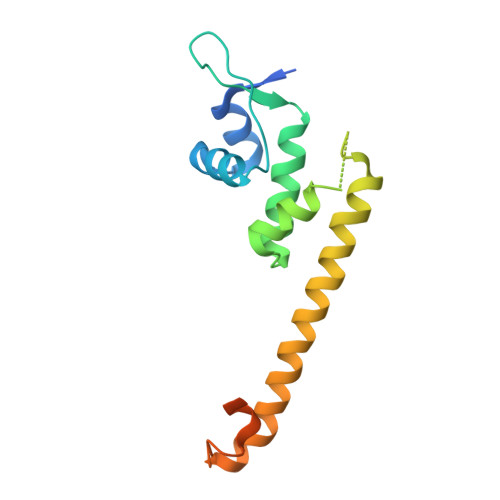
Crystal structure of SoxR


Experimental Data Snapshot

  • Method: X-RAY DIFFRACTION
  • Resolution: 3.20 Å
  • R-Value Free: 
    0.276 (Depositor), 0.279 (DCC) 
  • R-Value Work: 
    0.244 (Depositor), 0.239 (DCC) 
  • R-Value Observed: 
    0.244 (Depositor) 

Starting Model: experimental
View more details

wwPDB Validation 3D Report Full Report

Validation slider image for 2ZHH

This is version 1.2 of the entry. See complete history

Literature

Crystal structure of the [2Fe-2S] oxidative-stress sensor SoxR bound to DNA

Watanabe, S.Kita, A.Kobayashi, K.Miki, K.

(2008) Proc Natl Acad Sci U S A 105: 4121-4126

  • DOI: https://doi.org/10.1073/pnas.0709188105
  • Primary Citation Related Structures: 
    2ZHG, 2ZHH

  • PubMed Abstract: 

    The [2Fe-2S] transcription factor SoxR, a member of the MerR family, functions as a bacterial sensor of oxidative stress such as superoxide and nitric oxide. SoxR is activated by reversible one-electron oxidation of the [2Fe-2S] cluster and then enhances the production of various antioxidant proteins through the soxRS regulon. In the active state, SoxR and other MerR family proteins activate transcription from unique promoters, which have a long 19- or 20-bp spacer between the -35 and -10 operator elements, by untwisting the promoter DNA. Here, we show the crystal structures of SoxR and its complex with the target promoter in the oxidized (active) state. The structures reveal that the [2Fe-2S] cluster of SoxR is completely solvent-exposed and surrounded by an asymmetric environment stabilized by interaction with the other subunit. The asymmetrically charged environment of the [2Fe-2S] cluster probably causes redox-dependent conformational changes of SoxR and the target promoter. Compared with the promoter structures with the 19-bp spacer previously studied, the DNA structure is more sharply bent, by approximately 1 bp, with the two central base pairs holding Watson-Crick base pairs. Comparison of the target promoter sequences of the MerR family indicates that the present DNA structure represents the activated conformation of the target promoter with a 20-bp spacer in the MerR family.


  • Organizational Affiliation
    • Department of Chemistry, Graduate School of Science, Kyoto University, Sakyo-ku, Kyoto 606-8502, Japan.

Macromolecule Content 

  • Total Structure Weight: 17.51 kDa 
  • Atom Count: 920 
  • Modeled Residue Count: 120 
  • Deposited Residue Count: 154 
  • Unique protein chains: 1

Macromolecules

Find similar proteins by:|  3D Structure
Entity ID: 1
MoleculeChains  Sequence LengthOrganismDetailsImage
Redox-sensitive transcriptional activator soxR154Escherichia coli K-12Mutation(s): 0 
Gene Names: soxR
UniProt
Find proteins for P0ACS2 (Escherichia coli (strain K12))
Explore P0ACS2 
Go to UniProtKB:  P0ACS2
Entity Groups
Sequence Clusters30% Identity50% Identity70% Identity90% Identity95% Identity100% Identity
UniProt GroupP0ACS2
Sequence Annotations
Expand
Reference Sequence

Small Molecules

Ligands 2 Unique
IDChains Name / Formula / InChI Key2D Diagram3D Interactions
FES

Query on FES


Download:Ideal Coordinates CCD File
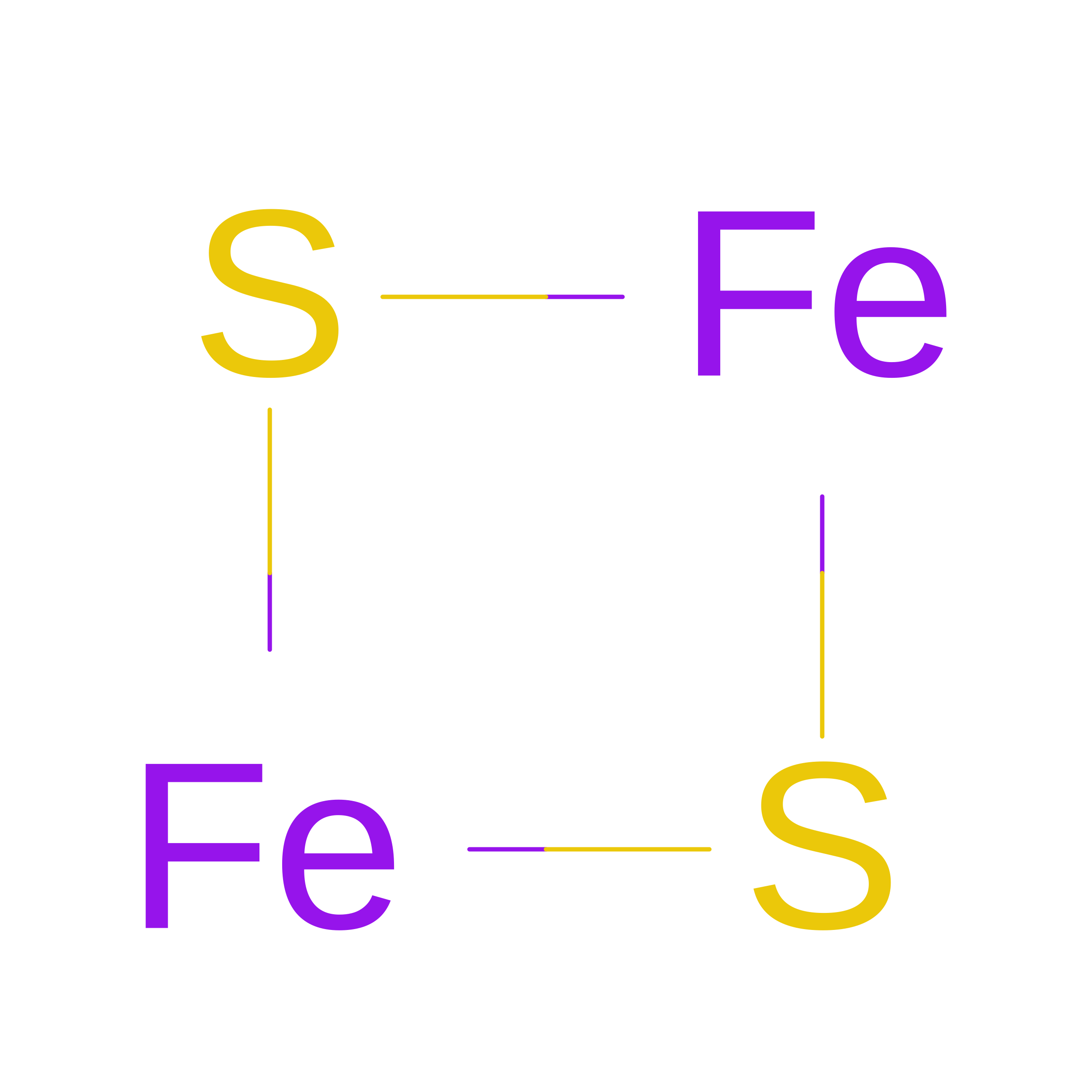
B [auth A]FE2/S2 (INORGANIC) CLUSTER
Fe2 S2
NIXDOXVAJZFRNF-UHFFFAOYSA-N
DTT

Query on DTT


Download:Ideal Coordinates CCD File
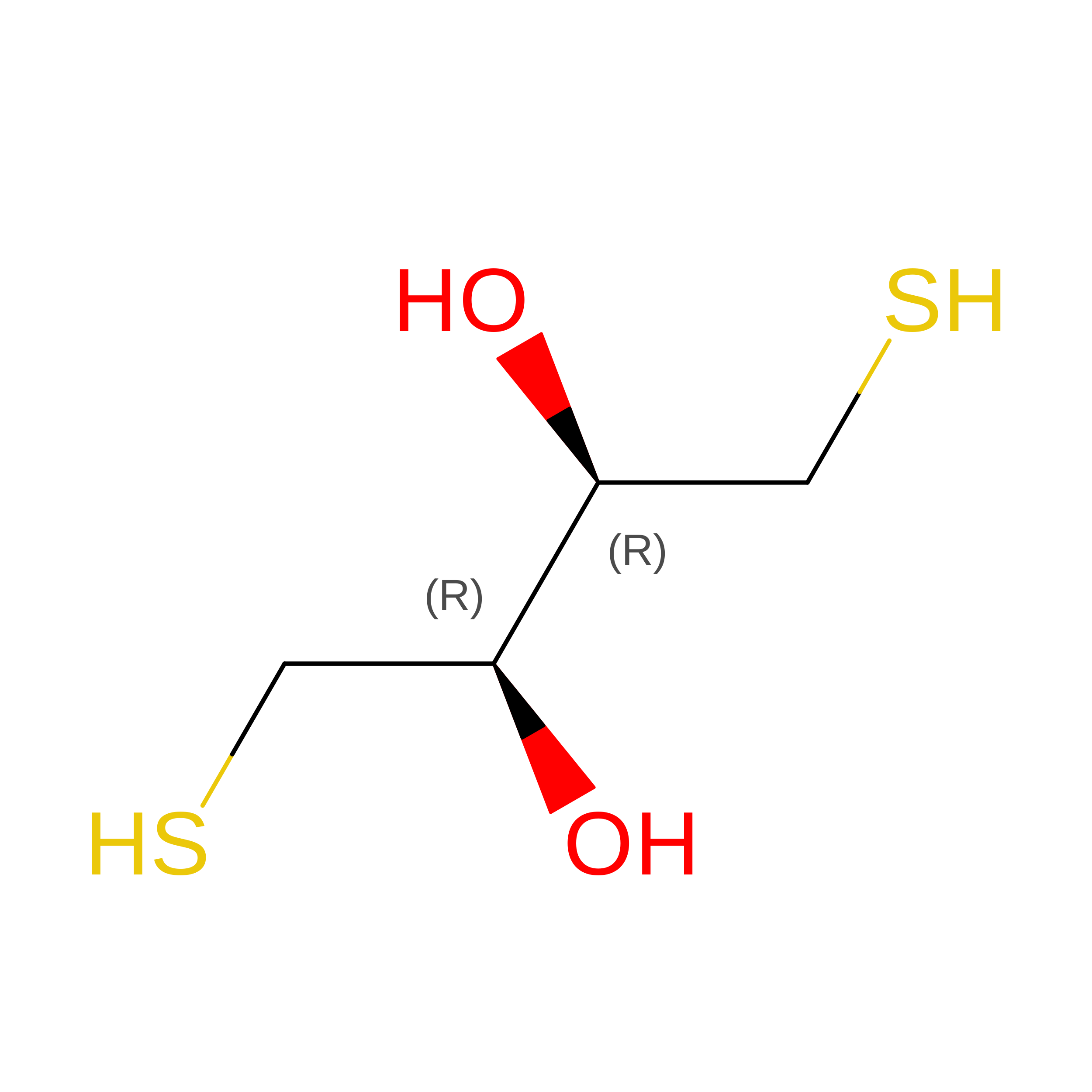
C [auth A]2,3-DIHYDROXY-1,4-DITHIOBUTANE
C4 H10 O2 S2
VHJLVAABSRFDPM-IMJSIDKUSA-N

Experimental Data & Validation

Experimental Data

  • Method: X-RAY DIFFRACTION
  • Resolution: 3.20 Å
  • R-Value Free:  0.276 (Depositor), 0.279 (DCC) 
  • R-Value Work:  0.244 (Depositor), 0.239 (DCC) 
  • R-Value Observed: 0.244 (Depositor) 
Space Group: P 62
Unit Cell:
Length ( Å )Angle ( ˚ )
a = 80.006α = 90
b = 80.006β = 90
c = 88.118γ = 120
Software Package:
Software NamePurpose
CNSrefinement
HKL-2000data collection
HKL-2000data reduction
HKL-2000data scaling
MOLREPphasing

Structure Validation

View Full Validation Report


Entry History 

Deposition Data

Revision History  (Full details and data files)

  • Version 1.0: 2008-03-25
    Type: Initial release
  • Version 1.1: 2011-07-13
    Changes: Source and taxonomy, Version format compliance
  • Version 1.2: 2023-11-01
    Changes: Data collection, Database references, Derived calculations, Refinement description